 Alex Morgan
What a tournament adds
A single match is a self-contained thing: you win or lose, and then it is over. A tournament stacks matches so that the fourth one matters more than the first, because by then you have something to lose.
That escalation is almost free from a design point of view — the underlying match is unchanged — and it transforms the emotional shape of a session. It also gives a game a natural difficulty curve without needing a difficulty menu, because each round is a harder opponent than the last.
The cost is the failure mode. In a knockout, losing round three wipes out the twelve minutes that got you there. Whether that is dramatic or merely annoying depends entirely on how long a round takes, which is why the matches in these games are first to seven rather than first to eleven.
How a bracket is built
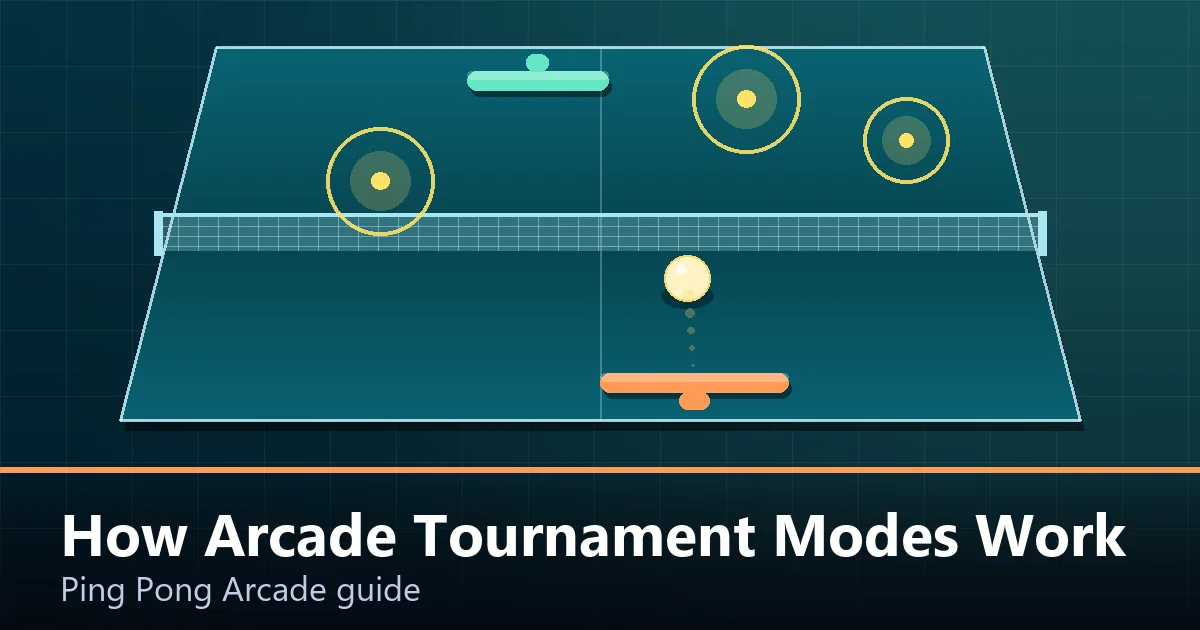
A standard bracket here is four rounds: quarterfinal, semifinal, final and the champion's match. Each is first to seven points with a two-point cushion.
The opponents are drawn at the start of a run from a roster of sixteen invented characters, chosen so their difficulty ratings climb across the rounds — roughly Easy or Medium first, Medium or Hard in the middle, Hard in the semifinal, Expert in the final. No opponent appears twice in the same bracket, and the final slot is always the arena champion.
That mix of fixed and variable is deliberate. The shape of a run is consistent enough to plan around, and the route through it is different enough that memorising one bracket does not solve the next.
| Round | Typical tier | Points to win | What usually decides it |
|---|---|---|---|
| Quarterfinal | Easy / Medium | 7 | Unforced errors from over-attacking |
| Semifinal | Medium / Hard | 7 | Whether you are serving to the corners |
| Final | Hard | 7 | Patience in neutral rallies |
| Champion | Expert | 7 | Keeping returns low over the net |
Why first to seven rather than eleven
Seven is short enough that four rounds fit into a single sitting — eight to fifteen minutes for a full bracket — and long enough that a single unlucky point does not decide a match.
It also shifts the strategy noticeably. At first to eleven, an ambitious shot costs one of eleven points and there is room to experiment. At first to seven, three unforced errors is usually the whole match, so refusing to attack a marginal ball matters far more than any offensive skill.
The two-point cushion still applies, which is what stops a short match from feeling arbitrary. A tight match can and often does run past seven, especially against the Expert final.
The opponents are numbers as well as descriptions
Every character on the roster has a written style and a matching set of AI settings, and the description on the pre-match screen is genuine scouting rather than flavour text.
- 'Wide retriever' means a higher paddle speed with a slower recovery toward the middle — hit two balls to the same side
- 'Power smasher' means a raised smash chance — keep every return low so nothing sits up
- 'Spin specialist' means a high spin skill on returns — intercept earlier, before the curve develops
- 'Chop defender' means heavy under-spin on floated returns — lift the ball rather than driving it
- 'Fast blocker' means it takes the ball early and stands close — change the pace to break the rhythm
- 'Serve specialist' means the serve is the weapon — read the spin before committing to a swing
Reading the pre-match screen is worth roughly a point a round, which over four rounds is frequently the difference between a bracket won and a bracket lost. It is the cheapest advantage available in the category.
Everything in the bracket is fictional
This needs stating plainly because tournament modes are the place where a game is most tempted to borrow credibility it has not earned.
Every opponent in these games is invented. The names, the playing styles and the short biographies were written for this site. None of them is based on a real person, and no real player, club, federation, sponsor or competition result appears anywhere here.
The round names — quarterfinal, semifinal, final — describe the shape of a knockout bracket rather than any real event, and the arena names come from the games. Ping Pong Arcade is not affiliated with, endorsed by or connected to any table tennis organisation.
Saved progress, and why it is local
Bracket progress is written to your browser's local storage after every match, so a run interrupted halfway through can be picked up later in the same browser.
It is not synchronised and not linked to an account, because this is a static site with no server behind it. Clearing your site data, switching browsers or moving to another device will start you at round one.
Losing a match clears the saved bracket, which is what makes it a knockout rather than a set of retryable levels. What survives is your furthest round reached, stored separately and treated as a personal best alongside the arcade score.
Boss ladders as an alternative shape
A boss ladder solves the same problem differently. Instead of single-elimination matches, you face a sequence of opponents, each protected by a shield that only comes down as you win points against them, and each changing exactly one rule about the table while they play.
One rule per boss is a deliberate limit. A boss that changes five things at once reads as random and cannot be solved; a boss that changes one thing is a puzzle with an answer — a narrower blade, a faster ball, reduced gravity, a drifting surface.
The other difference is recoverability. Clearing a stage returns a life, so a ladder run that starts badly can still finish, whereas a knockout run that loses once cannot. That makes a ladder the gentler of the two structures despite usually being longer.
Boss Paddle's six stages need twenty-seven points in total, which is the longest single run of any tournament game on this site.
How to actually win a bracket
Short matches reward consistency far more than brilliance, and the advice follows directly from that.
- Read the pre-match screen. The described style corresponds to real settings and is worth about a point a round.
- Refuse every marginal attacking ball. At first to seven, three unforced errors is the match.
- Serve to the corners every time. You serve on half the points and it is the most reliable source of a weak return.
- Against Expert, keep every return low over the net — a ball that sits up is the one shot it is guaranteed to punish.
- Move the opponent wide before attacking. Against the top tiers, the only attackable ball is the one that follows a wide shot.
- At six-all, stop attacking entirely. Deuces are decided by unforced errors almost without exception.
Choosing the right tournament to start with
The three tournament-shaped games on this site escalate, and playing them in order is much more productive than starting at the top.
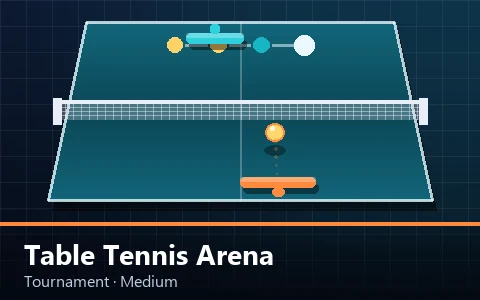
Table Tennis Arena is three rounds against a fixed roster of three named opponents, which takes about seven minutes. Because the ladder does not change between runs you can learn it, which makes it the right entry point.
Pong Tournament is four rounds with a roster drawn fresh each time, so it rewards adapting rather than memorising. It is the standard bracket.
Boss Paddle is six stages with rule changes and a twenty-seven-point total, and it assumes you already handle the Expert rating comfortably. Ping Pong Arcade Ultimate sits alongside it as the longest run on the site.
Key takeaways
- A tournament stacks matches so later rounds carry more weight, which is a difficulty curve without a difficulty menu.
- Brackets here are four rounds of first to seven, drawn fresh each run with the champion always last.
- Short matches mean three unforced errors is usually the whole match, so patience beats aggression.
- The pre-match description maps to real AI settings and is worth about a point per round.
- Every opponent, round and arena is invented; no real player or competition appears anywhere.
- Boss ladders return a life per stage cleared, which makes them recoverable where a knockout is not.
Frequently asked questions
Are the tournament opponents real players?
No. Every opponent, bracket and arena on this site is invented for Ping Pong Arcade. No real athlete, club, federation or competition result appears anywhere, and none of the characters is based on a real person.
Can I resume a tournament later?
Yes, in the same browser on the same device. Progress is stored in local storage. There is no synchronisation because there is no server behind the site.
Why does losing clear my saved bracket?
Because a knockout you could retry from the semifinal is not a knockout. Your furthest round reached is preserved separately as a personal best.
How long does a full bracket take?
Eight to fifteen minutes for four rounds of first to seven, longer if any of them go to deuce. Boss Paddle's six-stage ladder usually takes a little more.
What is the single best tactic against the Expert final?
Keep every return low over the net. A ball that sits up is the one shot the Expert rating is guaranteed to attack, and moving it wide before you commit is the only reliable way to get an attackable ball back.
Which tournament should I play first?
Table Tennis Arena. Three rounds against a fixed roster takes about seven minutes and can be learned, which makes it much better practice than a bracket that changes every run.