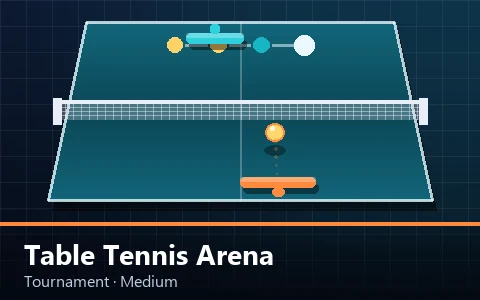
Table Tennis Arena
A short knockout series. Three opponents, three described playing styles, and a bracket that saves itself between visits.
Four rounds, a fresh ladder every run, and no second chances.
Drag anywhere on the table to move, and use the smash button under the game for a power shot.
Pong Tournament is the full bracket: quarterfinal, semifinal, final and the champion's match, each first to seven with a two-point cushion. Lose once and the run is over. The roster is drawn fresh at the start of every bracket, climbing from the Easy and Medium tiers through Hard, and the last name is always Arc Delamar on Expert.
Because the opponents change between runs, this is the tournament that rewards being able to adapt rather than being able to memorise. One bracket might give you two wide retrievers and a chopper; the next might be all attackers. The pre-match description is the only scouting you get.
| Action | Input |
|---|---|
| Move your paddle | ← → or A D, or drag on the table |
| Smash | Space or Shift just before contact |
| Pause / resume | P or Esc |
| Restart the run | R |
| Sound on or off | The sound button under the table |
On a touchscreen: Drag anywhere on the table to move, and use the smash button under the game for a power shot.
At the start of a bracket the game picks four opponents whose difficulty ratings climb across the rounds: roughly Easy or Medium first, Medium or Hard in the middle, Hard in the semifinal, and Expert in the final. No opponent appears twice in the same bracket.
The final slot is always the arena champion, which keeps the shape of a run consistent even though the route to it is not. Winning clears the saved bracket and the next run draws a different ladder.
Each roster entry has a style label and a paragraph of advice, and both are derived from the actual numbers the AI runs on. 'Slow to come back to the middle' means a lower recovery rate. 'Attacks anything short' means a raised smash chance combined with a deep placement bias.
Reading it before the match is worth roughly a point a round, which over four rounds is frequently the difference between a bracket won and a bracket lost.
A knockout that you could retry from the semifinal would not be a knockout. Losing wipes the saved bracket and the next run starts from the quarterfinal against a newly drawn ladder.
What is preserved is your furthest round reached, which is stored separately and is the figure the game treats as your personal best alongside the arcade score.
The ball carries a height as well as a table position, so it arcs, bounces off the surface and can clip the net. When a paddle strikes it, the engine picks a landing point and solves for the exact launch velocity that reaches it, which is why the aim marker on the table is honest. In Pong Tournament the physics run at the site's standard values, which makes it a good reference point for the variants that change them.
The paddle is a blade that slides along your baseline. Four numbers decide how it feels: how fast it moves, how hard the ball leaves the face, how accurately a shot lands where you aimed it, and how high above the table it can still make contact. In Pong Tournament the blade is 17 world units wide and travels at 118 units per second.
Where the ball meets the blade steers the return. A contact at the centre sends the ball straight down the table, and a contact at the edge sends it roughly 26 units off centre. Holding a direction key at the moment of contact adds a smaller correction on top.
The serve here is a single press. The ball is released toward the far half from wherever your paddle is standing, so where you stand when you serve decides the angle. Service alternates between the two ends where the game keeps a match score.
Pong Tournament is rated Hard overall. Reads the ball quickly, covers the table well and punishes a loose return, with an error rate around seven per cent. The opponent rating is set by the game itself rather than by a switch, because it changes as you progress. Expert is deliberately hard rather than impossible: it keeps both a reaction delay and an error rate, because an opponent that never misses is a wall rather than a challenge.
No. Every opponent, round name and competition in this game is invented for Ping Pong Arcade. No real athlete, club, federation, sponsor or result appears anywhere on this site.
No. Four opponents are drawn fresh each bracket with rising difficulty, except the final, which is always the arena champion on Expert.
No. Losing ends the bracket and clears the saved progress, which is what makes it a knockout. Your furthest round reached is still recorded.
Usually eight to fifteen minutes depending on rally length. Four first-to-seven matches with a two-point cushion can run longer if any of them go to deuce.
The final, by design. The champion runs the Expert rating: a fast paddle, a ninety-millisecond reaction delay, high placement accuracy and a raised smash chance, with roughly a three per cent error rate left in.
Other games that use the same ideas, or that make a good next step from this one.
A short knockout series. Three opponents, three described playing styles, and a bracket that saves itself between visits.
A boss ladder where every opponent changes something about the table — and the last one changes three things at once.
The harder endless mode. Starts at Medium, ramps in under two minutes, and gives you a single life throughout.
Everything Ping Pong Arcade does, in one run: rallies, serving, targets, survival and points against the full difficulty range.
Thirty original games across six categories, all free and all playable in this browser.