Table Tennis Arena
A short knockout series. Three opponents, three described playing styles, and a bracket that saves itself between visits.
Tournaments games
Four rounds, four opponents, one bracket. Lose once and it is over.
A tournament turns a single match into a run. Beat the first opponent and you advance to someone sharper; lose once and the bracket ends. That structure does something no single match can: it makes the fourth game of a session matter more than the first, because by then you have something to lose.
Every opponent in these games is invented. The roster was written for Ping Pong Arcade, each character has a described playing style that the AI actually implements, and none of them represents a real player, club or competition. The round names come from the shape of the bracket, not from any real event.
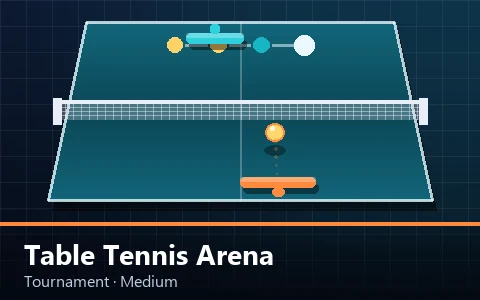
A short knockout series. Three opponents, three described playing styles, and a bracket that saves itself between visits.
The full knockout. Quarterfinal to final against a roster drawn fresh each run, ending with the arena champion.
A boss ladder where every opponent changes something about the table — and the last one changes three things at once.
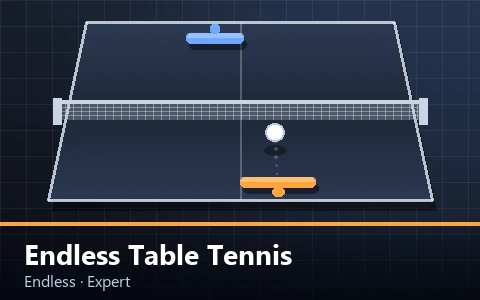
The harder endless mode. Starts at Medium, ramps in under two minutes, and gives you a single life throughout.
Everything Ping Pong Arcade does, in one run: rallies, serving, targets, survival and points against the full difficulty range.
A standard bracket is four rounds: quarterfinal, semifinal, final and the champion's match. Matches are first to seven points with a two-point cushion, which is short enough that a bracket fits into a single sitting and long enough that one unlucky point does not decide it.
Opponents get harder in a defined order. The early rounds pull from the Easy and Medium tiers, the later rounds from Hard, and the final round is always the arena champion on the Expert rating. Because the ladder is fixed you can learn it, and because the AI keeps a reaction delay and an error rate even at Expert, the final is difficult rather than impossible.
Each character on the roster is a set of numbers as well as a description. A 'wide retriever' really does have a higher paddle speed and a slower recovery toward the middle. A 'power smasher' really does have a raised smash chance and will attack any ball that sits up. The description on the pre-match screen is a genuine hint, not flavour text.
That means scouting works. If the screen tells you an opponent takes the ball early and stands close, changing the pace of your shots will break their rhythm; if it tells you they float everything back with under-spin, lifting the ball rather than driving it is the counter.
Bracket progress is written to localStorage on the device you are playing on, so a run interrupted halfway through can be picked up later in the same browser. It is not synchronised, not linked to an account and not visible to anyone else, because there is no server behind this site to hold it.
Losing a match clears the saved bracket and the next run starts from the first round. Winning the final also clears it, and the roster is drawn again so the next bracket is not a repeat of the one you just finished.
Boss Paddle takes the same idea and changes the failure condition. Instead of a single-elimination bracket you face a sequence of opponents, each protected by a shield that only comes down as you win points, and each of whom changes one rule about the table while they are playing — a narrower blade, a faster ball, a drifting surface.
One rule per opponent is a deliberate limit. A boss that changes five things at once reads as random; a boss that changes one thing is a puzzle with a solution, and clearing a stage returns a life so a run can recover.
Short matches reward consistency far more than brilliance. At first to seven, three unforced errors is usually the whole match, so the single most valuable habit is refusing to attack a ball that has not sat up for you.
Serving is the other lever. You serve on roughly half the points, and a serve into a deep corner forces a weak return often enough to be worth practising in isolation. Two points a match from good serving is a round you would otherwise have lost.
The most recently published tournaments games, newest first.
Everything Ping Pong Arcade does, in one run: rallies, serving, targets, survival and points against the full difficulty range.
The harder endless mode. Starts at Medium, ramps in under two minutes, and gives you a single life throughout.
A boss ladder where every opponent changes something about the table — and the last one changes three things at once.
Two people, one keyboard, one table. No servers involved.
5 games
A goal, a clock, and a very clear reason you did not clear it.
5 games
Keep the ball alive. The longer the rally, the more it is worth.
5 games
No. Every opponent, bracket and arena in these games is invented for Ping Pong Arcade. No real athlete, club, federation, sponsor or competition result appears anywhere on this site, and none of the characters is based on a real person.
Yes, on the same device and in the same browser. Your current round is saved in localStorage. Clearing your site data, switching browsers or using a different device will start you at round one.
Yes. Expert has a fast paddle, an accurate read and a high smash rate, but it keeps a reaction delay of around ninety milliseconds and roughly a three per cent unforced error rate. Moving it wide two shots in a row is the most reliable way to open the table.
A four-round bracket of first-to-seven matches usually runs between eight and fifteen minutes depending on how long your rallies are. Boss Paddle's six-stage ladder tends to take a little longer.
No. This is a static site with no server, so there is no online play anywhere on it. The only two-player option is local play on one keyboard, and it is only offered on the games that genuinely implement it.
Try a random game from this category's parent library, or browse everything with filters.