2P Local

Paddle Attack
First to eleven, alone or with a friend on one keyboard. The smash is the strongest on the site and the net is the price.
Multiplayer-Style games
Two people, one keyboard, one table. No servers involved.
This is a static website. There is no server, no account system and no matchmaking, so there is no online multiplayer anywhere on it and we do not claim any. What the five games in this category do have is genuine local two-player play: two people, one keyboard, one shared screen, one table.
Player 1 uses A and D. Player 2 uses the left and right arrow keys. Both paddles obey exactly the same rules, the same physics and the same contact-point steering, and the scoreboard in the middle of the table serves both ends. On a touchscreen each player gets their own pair of large buttons underneath the playfield.
First to eleven, alone or with a friend on one keyboard. The smash is the strongest on the site and the net is the price.
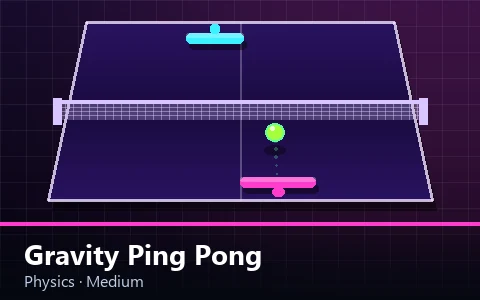
A full match with the gravity halved. The ball floats, arcs flatten, and the net becomes a much bigger problem.
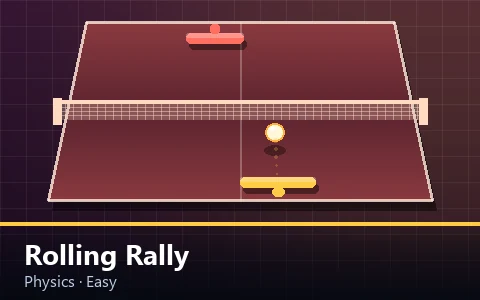
The slowest standard-gravity variant. High drag and a dead bounce make every exchange long and deliberate.
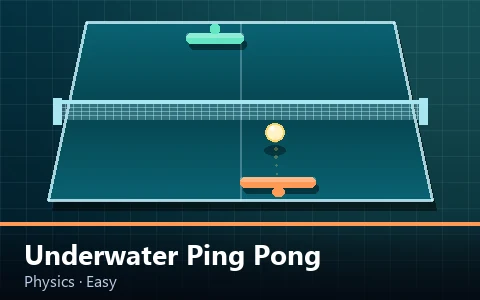
The slowest game on the site. Buoyancy and heavy drag turn every exchange into something you can genuinely think about.
The fastest two-player variant, in an original pixel-flavoured arena. Sharp, quick and unforgiving.
Every game in this category ships with a Players toggle above the table. Set it to 1P and the far paddle is driven by the computer opponent; set it to 2P and the same paddle starts reading Player 2's keys instead. Nothing else changes — not the scoring, not the physics, not the table.
The word 'style' in the category name is there for a reason. These are multiplayer-style arcade games in the sense that arcade cabinets were: two players sharing one machine. If you are looking for online play against someone in another building, this site does not offer it and never will without a backend to run it.
All five run the same match mode — first to eleven, two clear points, service alternating every two points — and each changes one thing about the world it is played in. That is a deliberate structure: a shared game is easier to learn when only one variable moves.
Changing gravity or drag changes how much time a player has to react, which is the single most effective way to balance a match between two people of different ability. Underwater Ping Pong gives both players roughly twice as long to reach the ball as Pixel Ping Pong does, and that is often the difference between a one-sided match and a close one.
It also keeps the category from being five copies of the same game. The underlying rules are identical on purpose, so a habit learned in one transfers to the next, while the pace of each match is genuinely different.
Switching to 2P on a phone or tablet rebuilds the control strip into four buttons: two on the left tinted for Player 1, two on the right tinted for Player 2. Both pairs are live at the same time, so two people can share a tablet with one hand each.
It works best on a tablet in landscape. On a small phone the table is narrow enough that two sets of thumbs get crowded, and the keyboard version is more comfortable if one is available.
The quickest way to balance uneven players is to give the stronger one a handicap they choose themselves — playing only cross-court, for instance, or never using the smash button. Both are easy to police because both are visible on screen.
The other option is the physics itself. Moving from Pixel Ping Pong to Underwater Ping Pong slows the ball enough to close most skill gaps, and a close match between two people who both had to work for it is a far better game than an eleven-two on a faster table.
The most recently published multiplayer-style games, newest first.
The fastest two-player variant, in an original pixel-flavoured arena. Sharp, quick and unforgiving.
The slowest game on the site. Buoyancy and heavy drag turn every exchange into something you can genuinely think about.
The slowest standard-gravity variant. High drag and a dead bounce make every exchange long and deliberate.
Four rounds, four opponents, one bracket. Lose once and it is over.
5 games
Keep the ball alive. The longer the rally, the more it is worth.
5 games
Anyone can hit it hard. These games ask you to hit it exactly there.
5 games
No. Ping Pong Arcade is a static website with no server behind it, so online play is not possible here and is not offered. The only two-player option is local play on a shared keyboard or a shared touchscreen, and it is only advertised on the games that actually implement it.
Player 1 moves with A and D. Player 2 moves with the left and right arrow keys. P pauses for both players, R restarts the match. On a touchscreen each player gets a tinted pair of buttons below the table.
Exactly the same. Both paddles use the identical contact test, the identical steering rule and the identical hit box. Neither end of the table has any advantage built into it.
Yes. Leave the toggle on 1P and the far paddle is driven by the computer opponent at whichever difficulty you select. Every game in this category is a complete single-player game as well.
Because that variant adds buoyancy and roughly triples the air drag, which is the point of it. The slower ball gives both players much longer to reach a wide shot, which makes it the best choice when the two players are at different levels.
Try a random game from this category's parent library, or browse everything with filters.