New2P Local
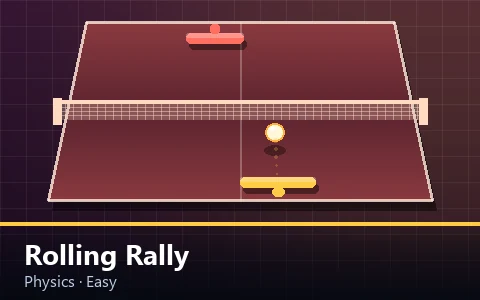
Rolling Rally
The slowest standard-gravity variant. High drag and a dead bounce make every exchange long and deliberate.
A fictional flooded arena where the ball floats and nothing happens quickly.
In two-player mode each player gets a tinted pair of buttons under the table. It works best on a tablet in landscape.
Underwater Ping Pong is set in an invented flooded arena and plays accordingly. Buoyancy pushes up against gravity so the ball's effective weight is about half normal, drag is raised to three times the standard value, and the bounce is soft. Everything takes noticeably longer to happen.
It is the slowest game on the site and, for that reason, the most approachable two-player variant. Two people of very different ability can have real rallies here, because the extra time on every ball closes most of the gap between them.
| Action | Input |
|---|---|
| Player 1 moves | A D |
| Player 2 moves | ← → |
| Smash | Space just before contact |
| Pause / resume | P or Esc |
| Restart the match | R |
On a touchscreen: In two-player mode each player gets a tinted pair of buttons under the table. It works best on a tablet in landscape.
The physics profile applies a constant upward force of twenty-six world units per second squared against a gravity of seventy-four, leaving an effective downward pull of forty-eight — a little over half the standard ninety.
Because the solver accounts for the net figure when computing a launch, shots arc gently rather than flattening out the way they do in Gravity Ping Pong. This is the key difference between the two variants: low gravity flattens arcs, buoyancy plus high drag simply slows everything down.
Drag at 0.5 is the highest on the site and removes a large proportion of the ball's speed during flight. Restitution at 0.58 makes the bounce soft without being dead.
The two together mean a ball that leaves the paddle at a reasonable speed arrives slowly and sits at a comfortable height. Long rallies are the default rather than an achievement.
Paddle speed is reduced to ninety-six from the standard hundred and eighteen, which prevents the slow ball from making the game trivial. Spin curve is also reduced, because a heavily drag-affected ball that also curved sharply would be difficult to read at this pace.
The net effect is a game that is slow in every dimension rather than one where a slow ball meets a fast paddle.
The ball carries a height as well as a table position, so it arcs, bounces off the surface and can clip the net. When a paddle strikes it, the engine picks a landing point and solves for the exact launch velocity that reaches it, which is why the aim marker on the table is honest. In Underwater Ping Pong, gravity is reduced to 74 against the site standard of 90, which flattens every arc and makes the net a much larger problem; a buoyancy force of 26 pushes up against gravity, so the ball's effective weight is roughly half normal and it hangs in the air; air drag is raised to 0.5 against the standard 0.16, so the ball arrives noticeably slower than it left; the bounce keeps only 0.58 of the ball's vertical energy against the standard 0.72, so returns sit low; the spin curve coefficient is 24 against the standard 34, which changes how sharply a spun ball bends.
The paddle is a blade that slides along your baseline. Four numbers decide how it feels: how fast it moves, how hard the ball leaves the face, how accurately a shot lands where you aimed it, and how high above the table it can still make contact. In Underwater Ping Pong the blade is 19 world units wide and travels at 96 units per second.
Where the ball meets the blade steers the return. A contact at the centre sends the ball straight down the table, and a contact at the edge sends it roughly 26 units off centre. Holding a direction key at the moment of contact adds a smaller correction on top.
The serve here is a single press. The ball is released toward the far half from wherever your paddle is standing, so where you stand when you serve decides the angle. Service alternates between the two ends where the game keeps a match score.
Underwater Ping Pong is rated Easy overall. A patient opponent with a slow paddle, a three-tenths-of-a-second reaction delay and roughly a one-in-four chance of misjudging a ball. Use the difficulty buttons above the table to change the opponent at any time; restarting applies the change immediately. Expert is deliberately hard rather than impossible.
No. It is a fictional arcade arena invented for this game. Nothing about it is a claim about how a ball would behave underwater in reality.
Three things at once: buoyancy reduces the effective gravity, drag at 0.5 removes most of the ball's speed in flight, and the paddles are slowed to match.
Gravity Ping Pong flattens arcs and makes the net dangerous. Underwater Ping Pong keeps a gentle arc and simply slows everything down. They feel completely different to play.
It is the best two-player variant on the site for players of different ability, because the extra reaction time closes most skill gaps naturally.
Yes, unlike Rolling Rally the bounce here is soft rather than dead, so balls do sit up. The smash is just slow enough that a ready opponent can return it.
Other games that use the same ideas, or that make a good next step from this one.
The slowest standard-gravity variant. High drag and a dead bounce make every exchange long and deliberate.
A full match with the gravity halved. The ball floats, arcs flatten, and the net becomes a much bigger problem.
The long-distance rally game. The ball never gets truly fast, so the only thing that ends a run is concentration.
The fastest two-player variant, in an original pixel-flavoured arena. Sharp, quick and unforgiving.
Thirty original games across six categories, all free and all playable in this browser.