Featured
Paddle Rush
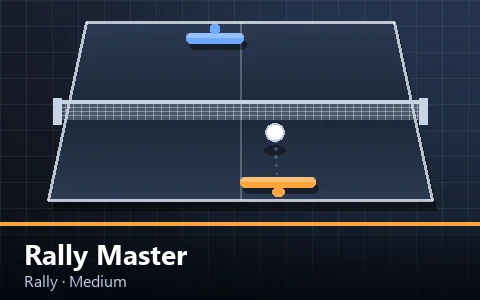
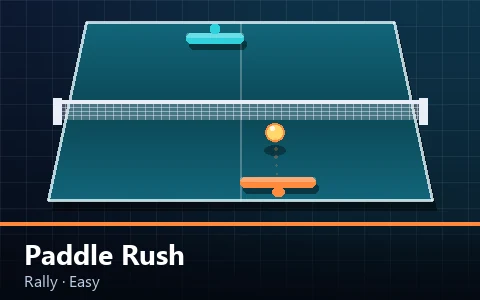
A quick, friendly rally game with a wide paddle and a patient opponent. The best place to learn how the table works.
Play Free Ping Pong Arcade Games Online
Ping Pong Arcade Games — Serve, Rally, Smash & Score
Play free ping pong arcade games featuring fast rallies, precision challenges, fictional tournaments, reflex tests, serving challenges and exciting HTML5 table-tennis gameplay. No download, no account, nothing to install.

The games we would put in front of somebody who has never played here before: one straightforward rally, one pure timing test, one placement game, one full tournament and the flagship challenge.
A quick, friendly rally game with a wide paddle and a patient opponent. The best place to learn how the table works.
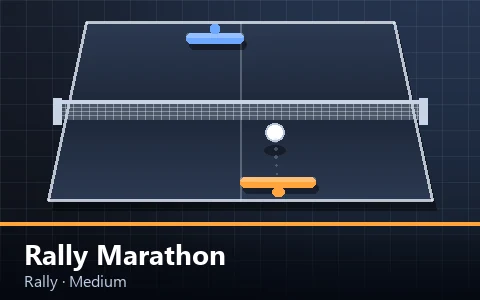
The purest rally game on the site. No match score, no bracket — just a counter that goes up until you miss.
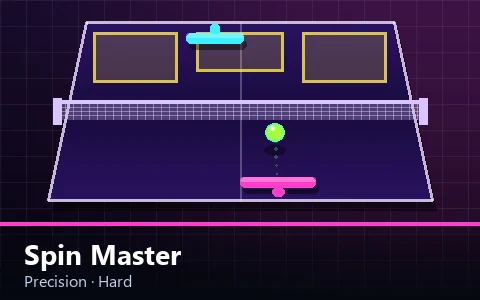
A placement game built entirely around spin. The aim marker shows where a flat ball would land — spin is what happens instead.
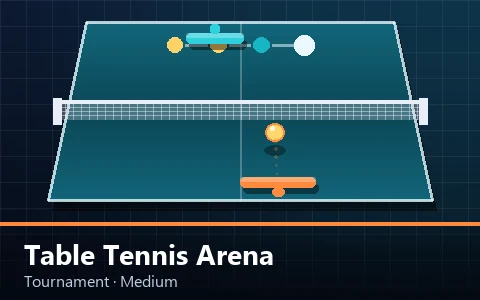
The full knockout. Quarterfinal to final against a roster drawn fresh each run, ending with the arena champion.
The most accessible game on the site. Position is handled for you — the entire game is the moment you press.
The fastest two-player variant, in an original pixel-flavoured arena. Sharp, quick and unforgiving.
The long one. Ten stages of mixed goals at rising difficulty, built for players who have already cleared the other challenge games.
Everything Ping Pong Arcade does, in one run: rallies, serving, targets, survival and points against the full difficulty range.
The most recently published games on the site, newest first. Publication dates are real — nothing here is re-dated to look fresh.
Everything Ping Pong Arcade does, in one run: rallies, serving, targets, survival and points against the full difficulty range.
The long one. Ten stages of mixed goals at rising difficulty, built for players who have already cleared the other challenge games.
The harder endless mode. Starts at Medium, ramps in under two minutes, and gives you a single life throughout.
A boss ladder where every opponent changes something about the table — and the last one changes three things at once.
The fastest two-player variant, in an original pixel-flavoured arena. Sharp, quick and unforgiving.
The slowest game on the site. Buoyancy and heavy drag turn every exchange into something you can genuinely think about.
The timing game with a narrower window and a faster ball. Same single input, considerably less room for error.
The opponent blends continuously from Easy toward Expert while you play. One mistake ends the run.
The games you have played in this browser. This list is local to your device and never leaves it.
Ordered by what you have played and saved in this browser. Before you have played anything it falls back to our editorial picks — there is no global ranking here, because a static site cannot honestly measure one.
A quick, friendly rally game with a wide paddle and a patient opponent. The best place to learn how the table works.
The purest rally game on the site. No match score, no bracket — just a counter that goes up until you miss.
A placement game built entirely around spin. The aim marker shows where a flat ball would land — spin is what happens instead.
The full knockout. Quarterfinal to final against a roster drawn fresh each run, ending with the arena champion.
A quick, friendly rally game with a wide paddle and a patient opponent. The best place to learn how the table works.
The purest rally game on the site. No match score, no bracket — just a counter that goes up until you miss.
A pure reaction test. Every ball is fired away from where you are standing, and the game tells you how quickly you moved.
The most accessible game on the site. Position is handled for you — the entire game is the moment you press.
Six categories, five games in each. Every game sits in exactly one of them, chosen by what the game actually asks you to do.
Keep the ball alive. The longer the rally, the more it is worth.
5 games
A goal, a clock, and a very clear reason you did not clear it.
5 games
Four rounds, four opponents, one bracket. Lose once and it is over.
5 games
The whole game happens in the first half second.
5 games
Anyone can hit it hard. These games ask you to hit it exactly there.
5 games
Two people, one keyboard, one table. No servers involved.
5 games
Rally games tie the ball's speed to your rally count rather than to a clock, so the tenth shot is quicker than the first because you earned it. Keep the ball alive, chase the milestone bonuses at 5, 10, 25 and 50, and find out where your concentration gives out.
A quick, friendly rally game with a wide paddle and a patient opponent. The best place to learn how the table works.
The purest rally game on the site. No match score, no bracket — just a counter that goes up until you miss.
The rally game with the pace turned up. A narrower table means the ball comes back before you have finished the last shot.
The long-distance rally game. The ball never gets truly fast, so the only thing that ends a run is concentration.
The opponent blends continuously from Easy toward Expert while you play. One mistake ends the run.
Reflex games compress table tennis into the half second between the ball leaving the far paddle and arriving at yours. One of them reports your own start time in milliseconds after every return, measured on your device.
A pure reaction test. Every ball is fired away from where you are standing, and the game tells you how quickly you moved.
The most accessible game on the site. Position is handled for you — the entire game is the moment you press.
No opponent — a rebound wall instead. Balls keep joining until you cannot cover them all.
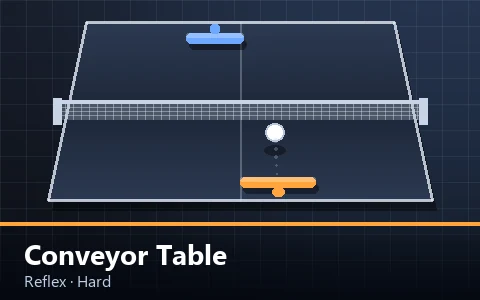
A rally game where the playing surface drifts. Four bands push in alternating directions and the pattern never settles.
The timing game with a narrower window and a faster ball. Same single input, considerably less room for error.
Placement games change what a good shot is: keeping the ball in play scores almost nothing, and putting it in a specific place scores a great deal. They all run on the same rule — where the ball meets the blade decides where it goes.
A placement game built entirely around spin. The aim marker shows where a flat ball would land — spin is what happens instead.
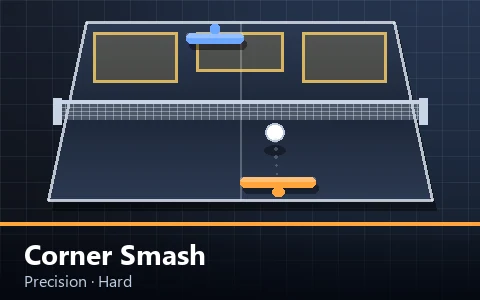
A placement game that rewards the two deep corners above everything else — and gives you a smash button to reach them with.
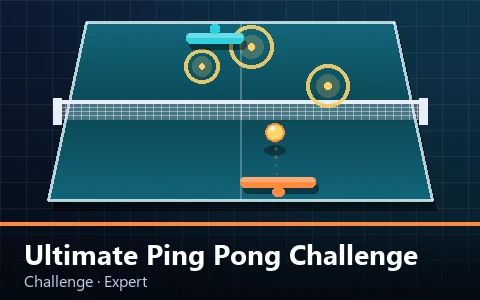
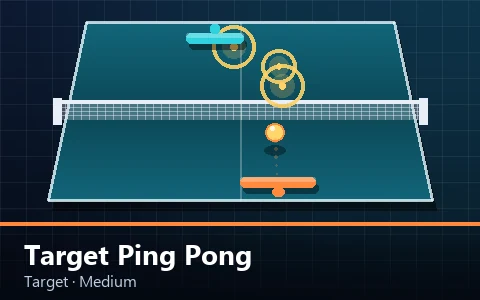
A live rally with moving scoring rings on the opponent's half. Placement under pressure, with the target refusing to stand still.
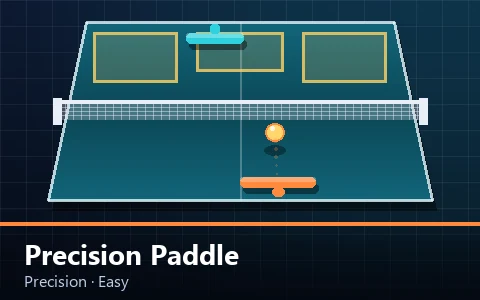
Placement, taught properly. Large zones, one called at a time, and a patient opponent while you learn the contact point.
A physics shooting range. Ten launches, waves of targets, blockers in the way, and all the time in the world to think.
Knockout brackets and boss ladders against invented opponents whose described playing styles the AI actually implements. Read the pre-match screen: it is genuine scouting, not flavour text.
A short knockout series. Three opponents, three described playing styles, and a bracket that saves itself between visits.
The full knockout. Quarterfinal to final against a roster drawn fresh each run, ending with the arena champion.
A boss ladder where every opponent changes something about the table — and the last one changes three things at once.
The harder endless mode. Starts at Medium, ramps in under two minutes, and gives you a single life throughout.
Everything Ping Pong Arcade does, in one run: rallies, serving, targets, survival and points against the full difficulty range.
Serving games hand you a fixed number of attempts, a set of scoring zones and a meter whose sweet spot sits deliberately short of maximum — so the strongest serve is never automatically the best one.
A ladder of eight arcade challenges that introduces rallying, placement, survival and pressure in that order.
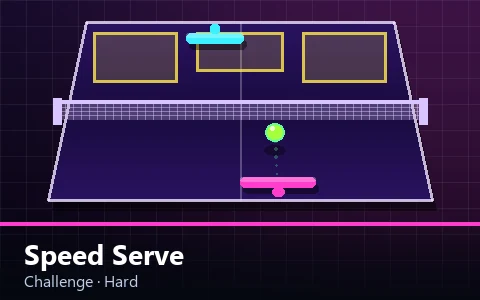
A serving range with no opponent and no rally. Aim, time the meter, and find out exactly where the ball landed.
Serving practice with the clock running. A charge meter replaces the timing bar, and overcharging costs you accuracy.
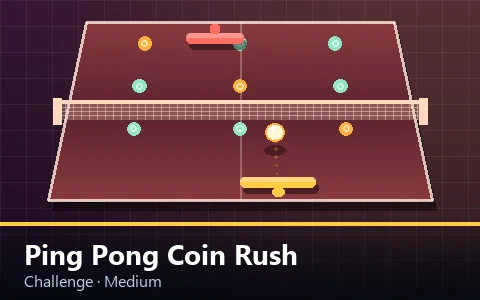
Tokens sit across the table and the ball sweeps them up as it flies. The route matters as much as where it lands.
The long one. Ten stages of mixed goals at rising difficulty, built for players who have already cleared the other challenge games.
Five habits that move most players up a level faster than anything else. They work across every game here, because every game runs the same engine.
Standing where you last hit the ball is the most common reason a rally ends. Move back toward the centre the moment your shot leaves the blade.
In a top-down view the ball tells you where it is and the shadow tells you where it will land. The shadow is the more useful of the two.
A paddle that is still moving at the moment of contact puts side spin on the ball and curves it off target. Stop it a fraction early.
Where the ball meets the blade does about seventy per cent of the aiming. A held direction key tidies up the rest.
A smash crosses the net lower than a normal shot. If the ball has not bounced up for you, the smash is a net risk with no reward.
Written explanations of how these games work and how to get better at them. Every figure in them is read out of the games themselves.
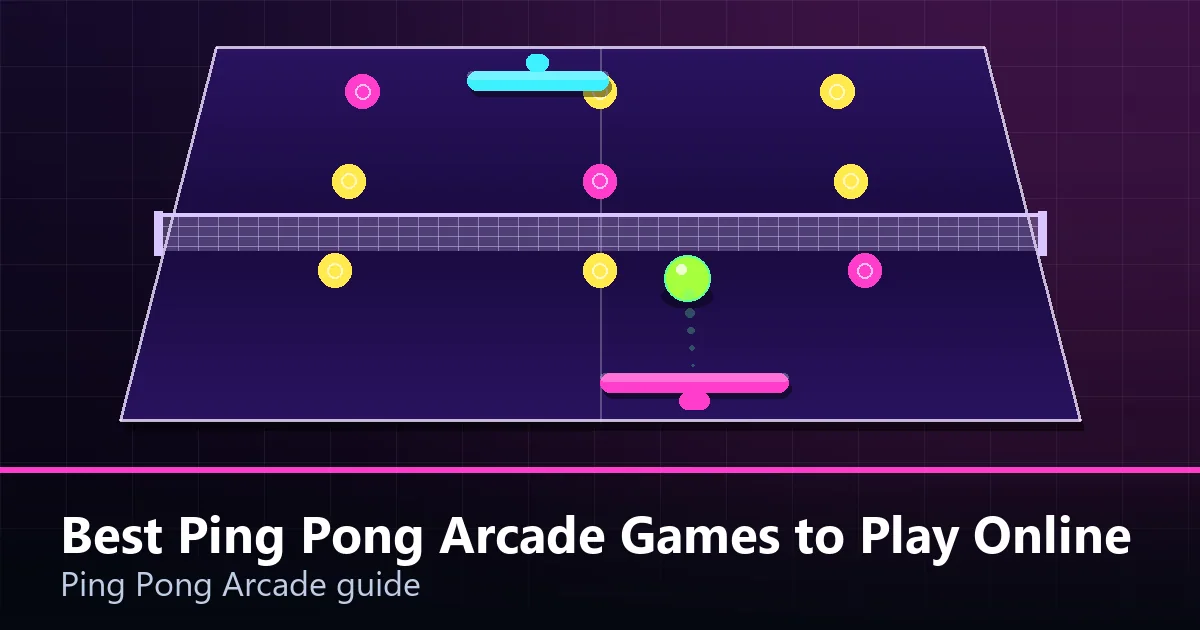
Thirty games is too many to choose from cold. These are the picks by situation — what to play first, what to play with somebody else, what to play on a phone, and what to play when you want to be beaten.

Table tennis was the first sport video games could actually represent, and the ideas it established are still visible in every paddle game made since. This is what changed and what did not.

Thirty games from one engine forces you to decide what a game actually is. These are the principles that survived the process, including the ones that were wrong the first time.

Table tennis keeps reappearing in arcade form for four structural reasons, none of which is about the sport's popularity.
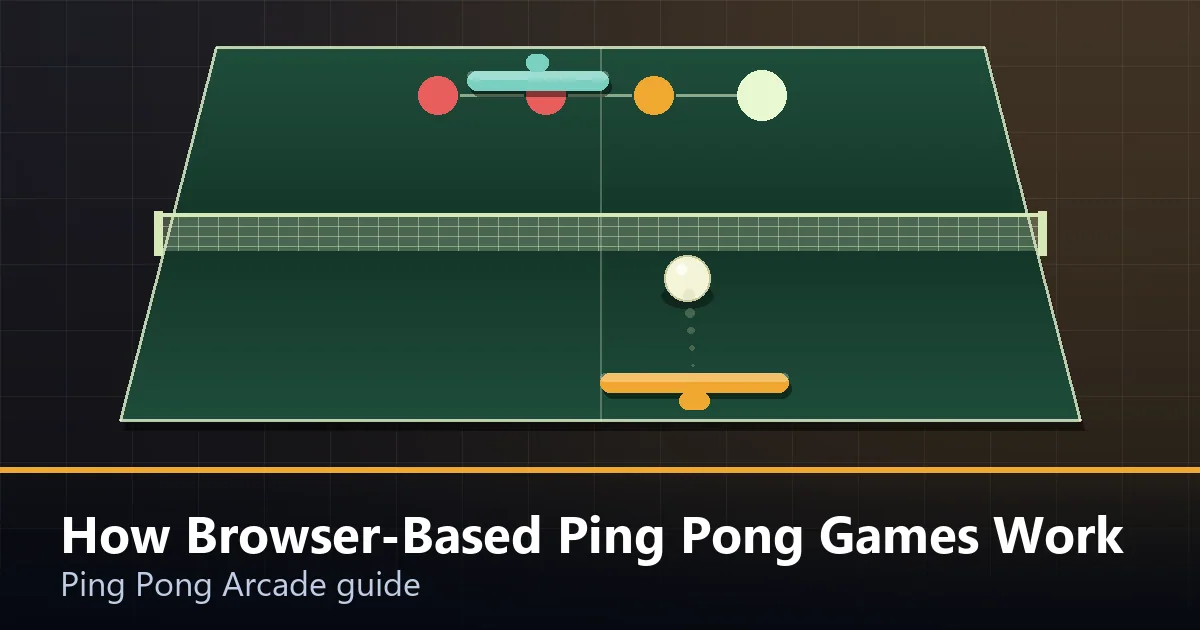
Follow a link and a game is ready almost immediately. Here is what actually happens in that second, and why it is possible without a download.

Your scores live in your browser and nowhere else. Here is exactly what is stored, why it behaves the way it does, and what that rules out.
Table tennis is unusually well suited to becoming an arcade game, and the reason is the rally. Most sports have long gaps between moments of action; table tennis has a continuous exchange where something is decided every second or so. That maps almost perfectly onto a short browser session.
The second reason is that the skill is legible. When you lose a point in one of these games you almost always know why — you were standing in the wrong place, you hit the ball too flat, you swung early. Games where failure is opaque get closed; games where failure is obvious get replayed.
The third is that the difficulty curve writes itself. Because the ball speeds up with the rally count rather than with a timer, every run builds its own curve around how well you are actually playing. A good run gets hard because it is a good run.
And finally, a round is short. Most runs here last between one and five minutes, which means there is always time for one more — and one more is the whole point of an arcade.
Every game on this site runs on one shared engine. Understanding the four pieces below means understanding all thirty.
As well as a position on the table, the ball carries an altitude. That single extra number is what makes a bounce, a net clip and a lob possible in a top-down view, and it is why the shadow under the ball tells you so much.
When a paddle strikes the ball, the engine picks a landing point and calculates the exact launch that gets there. That is why aiming is honest: the marker on the table is where a flat ball will land.
How far from the centre of the blade the ball landed decides the direction of the return. Edge contacts go wide, centre contacts go straight, and holding a direction adds a smaller correction.
A paddle that is sliding when it hits the ball puts side spin on it, which curves the path away from the aim marker. Stopping the blade before contact takes it off again.
Yes, completely. Every game on this site is free to play in your browser with no download, no account, no subscription and no in-game purchases of any kind.
No. All thirty games are HTML5 and run directly in the browser using canvas. There is no plugin, no app store and no installer — the page loads and the game is ready.
Yes, all of them. Each game has touch controls sized for fingers, the playfield scales to the screen width, and there is no horizontal scrolling at any size down to 320 pixels wide.
Local two-player, yes — five games support two people on one keyboard or one touchscreen. There is no online multiplayer anywhere on this site, because it is a static site with no server behind it.
In your own browser, using localStorage. They never leave your device and there is no global leaderboard, so the score you are chasing is your own previous best.
No. Every opponent, tournament and arena here is invented for Ping Pong Arcade. No real athlete, club, federation or competition appears anywhere on the site.
Paddle Rush if you want a straightforward rally, One-Tap Ping Pong if you want the simplest possible controls, or Precision Paddle if you want to learn how shot placement works before anything else.
No. They use an arcade physics model tuned for responsiveness and readability on a screen. It keeps the bounce, the net and the curve from spin, and deliberately drops the rest.
Everything else in the arcade. Thirty games in total, and the browse page has filters for difficulty, gameplay type, game mode and mechanic.
A ladder of eight arcade challenges that introduces rallying, placement, survival and pressure in that order.
The rally game with the pace turned up. A narrower table means the ball comes back before you have finished the last shot.
A serving range with no opponent and no rally. Aim, time the meter, and find out exactly where the ball landed.
A placement game that rewards the two deep corners above everything else — and gives you a smash button to reach them with.
A pure reaction test. Every ball is fired away from where you are standing, and the game tells you how quickly you moved.
First to eleven, alone or with a friend on one keyboard. The smash is the strongest on the site and the net is the price.
A short knockout series. Three opponents, three described playing styles, and a bracket that saves itself between visits.
The long-distance rally game. The ball never gets truly fast, so the only thing that ends a run is concentration.
A live rally with moving scoring rings on the opponent's half. Placement under pressure, with the target refusing to stand still.
Serving practice with the clock running. A charge meter replaces the timing bar, and overcharging costs you accuracy.
Placement, taught properly. Large zones, one called at a time, and a patient opponent while you learn the contact point.
Tokens sit across the table and the ball sweeps them up as it flies. The route matters as much as where it lands.