 Alex Morgan
How these picks were chosen
These are editorial recommendations, chosen by playing the games and thinking about who each one suits. They are not ranked by popularity, because this site has no way to measure popularity — there is no server, no analytics and no visitor tracking, so any ranking claiming to reflect what other people play would be invented.
There are no ratings or scores attached, for the same reason. What follows is a set of reasons rather than a leaderboard, and you should disagree with them where your preferences differ from ours.
Every game named here is free, runs in the browser with no download, and is original to this site.
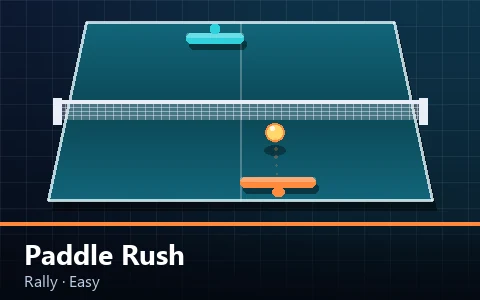
Best first game: Paddle Rush
If you have never played a ping pong game in a browser, start here. It has the widest blade on the site at twenty units, an opponent on the Easy rating that returns almost everything down the middle, and the gentlest tempo ramp of any rally game.
Those three choices exist for one reason: to make a new player's mistakes into near-misses rather than clean misses. That is the difference between learning and giving up, and it is why the game is deliberately generous.
Aim for a rally of ten on your first session. Most people get there within two or three attempts, which is exactly the point at which the game becomes interesting rather than confusing.
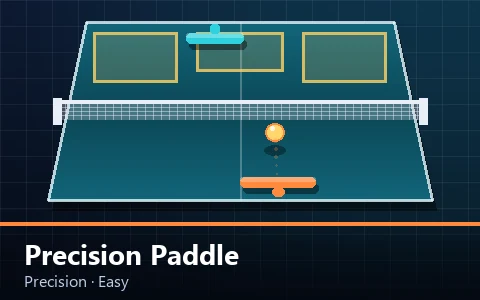
Best for learning to aim: Precision Paddle
Every game on this site uses the same aiming rule, and this is the one built to teach it. Large named zones, one called at a time, an Easy opponent, four lives, and spin reduced to roughly half strength so shots land close to where you pointed them.
That last detail is the important one. Learning contact point and paddle speed simultaneously is how people conclude that placement is random. Halving the spin removes one variable and makes the other obvious within a few minutes.
Spend your first run ignoring the called zone entirely and just hitting the ball at different points on the blade to see where it goes. That single exercise is worth more than an hour of ordinary play.
Best with somebody else: Paddle Attack
Five games support genuine local two-player, and this is the one to start with. Standard physics, a wide blade for both players, first to eleven with a two-point cushion, and the strongest smash on the site.
Player 1 uses A and D, Player 2 uses the arrow keys, and both paddles run identical code — same width, same speed, same contact test. In a shared game, any asymmetry becomes an argument, so there is none.
If the two players are at different levels, switch to Underwater Ping Pong instead. Buoyancy and triple drag give both players roughly twice as long on every ball, which closes most skill gaps without needing a formal handicap.
Best on a phone: One-Tap Ping Pong
One input, no drag gesture, no simultaneous actions, and a purely visual timing cue. The paddle tracks the ball for you and the whole game is when you press.
It is the most accessible game on the site by design rather than by accident, and that happens to make it the best phone game here too — one thumb and one large button is a far better fit for a small screen than a precise gesture.
Watch the ring closing on your paddle rather than the ball. Press when it touches the blade, not when it looks close: typical early presses are about eighty milliseconds ahead of the window.
Best long session: Rally Marathon
Five lives, the gentlest tempo ramp on the site capped at 1.45 times the starting speed, raised drag so the ball arrives slower, and a hundred-rally target worth a thousand points.
Nothing in it is fast. What ends a run is attention rather than reaction — a rally of a hundred takes three to five minutes of unbroken focus, and the mistakes that end it are almost always moments where a player stopped recovering to the middle because nothing had gone wrong for a while.
It is the most meditative game here and the best one to have open while thinking about something else, which is either a recommendation or a warning depending on your temperament.
Best challenge: Ultimate Ping Pong Challenge
Ten stages, five goal types, difficulty climbing from Medium to Expert, and base ball speed rising five per cent per stage until the final one runs at 1.45 times the opening pace.
It assumes you have played the rest of the site. Stage two expects the contact-point habit from Precision Paddle; stage seven expects the patience Pong Tournament teaches; stage ten asks for a rally of thirty-five at the fastest sustained ball in any non-endless game here.
Stage nine is where most players stop — eight ring hits at 1.4× speed against an Expert opponent requires placement and rally survival simultaneously, which is the hardest combination on the site.
Best for a short burst: Reflex Rally
One ball at a time, fired deliberately away from wherever you are standing, getting faster with every return, three lives. A run lasts a minute or two.
It also reports your own start time in milliseconds after every return — the interval between the ball being released and your paddle beginning to move. That figure is yours, measured on your device, and it is never compared to anybody else's.
The single biggest improvement available is to watch the far paddle rather than the ball. Its position tells you the direction about a tenth of a second before the ball exists, which is roughly a third of a typical choice reaction.
Best oddity: Conveyor Table
The playing surface is divided into four bands that push the ball sideways in alternating directions, with the strength oscillating over time. Nothing you hit travels in a straight line.
Unlike spin, this is not something you control — it is a property of the table. The arrows drawn on each band show which way it is currently pushing, and the only way to place a ball is to account for the bands it will cross.
A rally of fifteen here is a good one, roughly half what the same player would manage in Rally Master. It is the hardest game on the site to be accurate in, as distinct from the hardest to survive.
Best if you want to be beaten: Endless Table Tennis
One life, starting at the Medium rating, reaching Expert in a hundred and five seconds, with a ball ten per cent faster than standard and lower drag holding that speed.
Sixty seconds is a respectable run. Ninety means you have been playing an almost-Expert opponent on a single life, which very few players manage early on.
Play Endless Rally first. It is the same mechanics with a gentler ramp starting from Easy, which is where the habits get built.
The complete list by category
If none of the above matches what you want, the six categories are a faster way in than a list of thirty names.
| If you want… | Category | Start with |
|---|---|---|
| To keep a ball alive | Rally | Paddle Rush |
| A specific goal to clear | Challenges | Serve Challenge |
| Opponents to beat in sequence | Tournaments | Table Tennis Arena |
| To test your reactions | Reflex | Reflex Rally |
| To practise placement | Precision | Precision Paddle |
| To play with somebody else | Multiplayer-style | Paddle Attack |
Key takeaways
- These are editorial picks with stated reasons, not a popularity ranking — this site cannot measure popularity and does not pretend to.
- Start with Paddle Rush for the widest blade and gentlest ramp, then Precision Paddle to learn the aiming rule.
- Paddle Attack is the best two-player game; Underwater Ping Pong is better when the players are uneven.
- One-Tap Ping Pong is the best phone game because a single large button beats a precise gesture on a small screen.
- Rally Marathon is the longest, calmest session; Reflex Rally is the shortest, sharpest one.
- Ultimate Ping Pong Challenge assumes you have played the games that teach its individual mechanics.
Frequently asked questions
How were these games ranked?
They were not ranked. These are editorial picks by situation, with the reasoning stated. This site has no analytics and no server, so any popularity ranking would be invented.
Which game should an absolute beginner play?
Paddle Rush. It has the widest blade, the most forgiving opponent and the gentlest tempo ramp on the site, all chosen so that a new player's mistakes are near-misses rather than clean misses.
What is the best two-player game?
Paddle Attack for evenly matched players, and Underwater Ping Pong when one player is much better — its buoyancy and heavy drag give both players about twice as long on every ball.
Which game works best on a phone?
One-Tap Ping Pong. It needs a single press, has no drag gesture and uses a purely visual timing cue, which suits a small screen and one thumb better than anything else here.
What is the hardest game on the site?
Endless Table Tennis is the hardest moment to moment because of the single life and fast ramp. Ultimate Ping Pong Challenge is the hardest to finish because of its length. Conveyor Table is the hardest to be accurate in.
Are all of these free?
Yes, all thirty games on this site are free with no account, no download and no purchases of any kind.