Featured
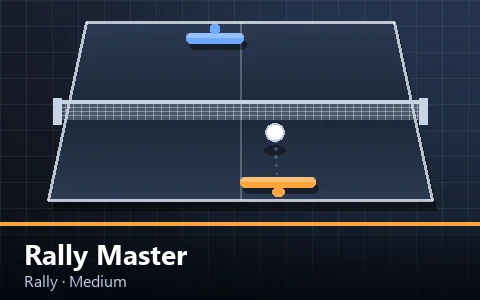
Rally Master
The purest rally game on the site. No match score, no bracket — just a counter that goes up until you miss.
A fast paddle-and-ball rally that speeds up as you get better.
Drag anywhere on the table to slide your paddle, or use the left, right and hit buttons under the game.
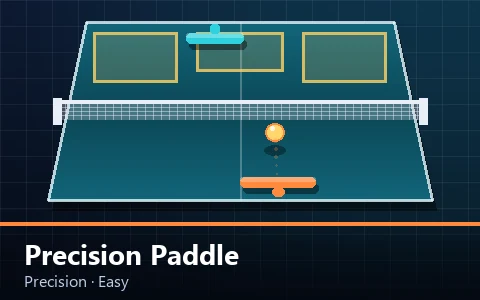
Paddle Rush is the first game most people should play on this site. It hands you a paddle that is wider than standard, puts a patient opponent on the far side of the table, and then gets out of the way. Every ball comes back, and the only question is how long you can keep answering it.
The tempo rises with your rally count rather than with a stopwatch, so the game only becomes hard once you have proved you can handle it. A rally of five is gentle. A rally of thirty is genuinely quick. Both are the same game — you just got there.
| Action | Input |
|---|---|
| Move your paddle | ← → or A D, or drag on the table |
| Power shot (optional) | Space at the moment of contact |
| Pause / resume | P or Esc |
| Restart the run | R |
| Sound on or off | The sound button under the table |
On a touchscreen: Drag anywhere on the table to slide your paddle, or use the left, right and hit buttons under the game.
Paddle Rush uses a blade about twenty per cent wider than the site standard. That extra width is not there to make the game trivial — it is there so that a new player's mistakes are near-misses rather than clean misses, which is the difference between learning and giving up.
It also changes the steering slightly. Because the offset is measured as a fraction of the blade's half-width, a wider paddle gives you finer control over small angles and makes extreme angles harder to reach. That is a reasonable trade for a game meant to be somebody's first.
Each successful return multiplies the speed of the next shot by a small factor, capped at roughly 1.85 times the starting pace. The step here is the gentlest on the site, so the acceleration is noticeable without being alarming, and the cap arrives somewhere around the fortieth return.
Once the cap is reached the game stops getting faster and starts being about concentration instead. Most first-time players lose their run somewhere between returns twelve and twenty, which is exactly where the ball first becomes quick enough to punish standing still.
The far paddle runs on the Easy rating: a slow blade, a three-tenths-of-a-second reaction delay, a loose read on where the ball will land and a roughly one-in-four chance of misjudging a ball outright. It returns most things down the middle and rarely attacks.
That misjudgement rate is what gives you your points. When the opponent misreads a ball it plays a weak return that sits up near the net, and those are the balls worth putting away rather than rallying with.
The ball carries a height as well as a table position, so it arcs, bounces off the surface and can clip the net. When a paddle strikes it, the engine picks a landing point and solves for the exact launch velocity that reaches it, which is why the aim marker on the table is honest. In Paddle Rush the physics run at the site's standard values, which makes it a good reference point for the variants that change them.
The paddle is a blade that slides along your baseline. Four numbers decide how it feels: how fast it moves, how hard the ball leaves the face, how accurately a shot lands where you aimed it, and how high above the table it can still make contact. In Paddle Rush the blade is 20 world units wide and travels at 124 units per second.
Where the ball meets the blade steers the return. A contact at the centre sends the ball straight down the table, and a contact at the edge sends it roughly 26 units off centre. Holding a direction key at the moment of contact adds a smaller correction on top.
The serve here is a single press. The ball is released toward the far half from wherever your paddle is standing, so where you stand when you serve decides the angle. Service alternates between the two ends where the game keeps a match score.
Paddle Rush is rated Easy overall. A patient opponent with a slow paddle, a three-tenths-of-a-second reaction delay and roughly a one-in-four chance of misjudging a ball. Use the difficulty buttons above the table to change the opponent at any time; restarting applies the change immediately. Expert is deliberately hard rather than impossible.
No. The ball returns automatically when it touches the blade, so Paddle Rush is a positioning game rather than a timing game. Pressing Space at the moment of contact still adds a small power and accuracy bonus, but it is optional.
Ten. It is the first milestone that requires real positioning rather than luck, and most players reach it within two or three attempts. Twenty-five is a reasonable next goal once ten is routine.
Because the paddle was still sliding when it struck the ball. A moving blade adds side spin proportional to its speed, which curves the shot. Steady the paddle a fraction before contact and the ball goes where the contact point points it.
No. The tempo multiplier is capped, so past roughly forty returns the ball stops accelerating. From that point the run is limited by concentration rather than by reaction speed.
No. It is stored in this browser's localStorage and never leaves your device. There is no leaderboard, no account and no global ranking anywhere on this site.
Other games that use the same ideas, or that make a good next step from this one.
The purest rally game on the site. No match score, no bracket — just a counter that goes up until you miss.
The rally game with the pace turned up. A narrower table means the ball comes back before you have finished the last shot.
The most accessible game on the site. Position is handled for you — the entire game is the moment you press.
Placement, taught properly. Large zones, one called at a time, and a patient opponent while you learn the contact point.
Thirty original games across six categories, all free and all playable in this browser.