 Alex Morgan

What a rally counter actually counts
A rally is the number of successful returns since the serve. In these games it is reset when a point is decided and incremented every time either paddle makes contact, which means it counts the exchange rather than only your own shots.
That definition is worth stating precisely because it changes the arithmetic. A rally of twenty is ten shots from you and ten from the opponent, not twenty of yours. It also means a rally can only grow when both sides keep succeeding, which is why a very weak opponent produces short rallies as reliably as a very strong one.
That last point surprises people. Against the Easy rating the opponent misjudges roughly one ball in four, so rallies end early because it fails rather than because you do. The Medium rating is the sweet spot for long rallies precisely because it is competent enough to keep returning without being good enough to win the point.
The tempo multiplier
Every successful return raises a multiplier applied to the speed of the next shot. On this site the default step is about 2.2 per cent per return, and it is capped so a rally cannot spiral into something unplayable.
The cap is as important as the step. Without one, every player eventually hits a wall of physically impossible speed, and every run ends the same way for the same reason — which measures nothing. With one, the game reaches a fast but sustainable rhythm and the challenge changes from reaction to concentration.
| Game | Step per return | Cap | Cap reached at |
|---|---|---|---|
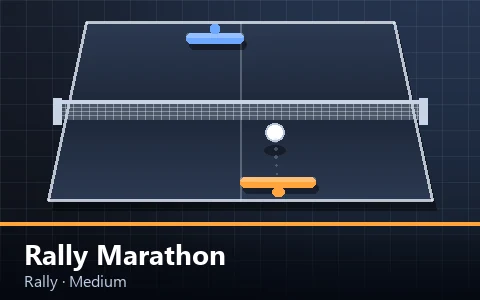
| Rally Marathon | 1.0% | 1.45× | ~45 returns |
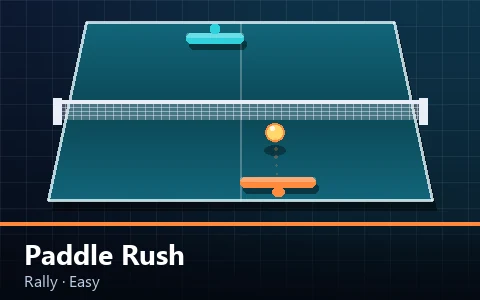
| Paddle Rush | 1.8% | 1.85× | ~47 returns |
| Conveyor Table | 1.8% | 1.70× | ~39 returns |
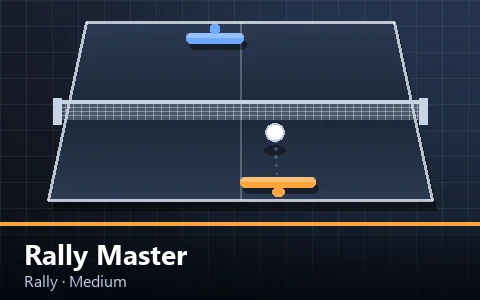
| Rally Master | 2.2% | 2.05× | ~48 returns |
| Ping Pong Jump | 2.6% | — | n/a |
| Table Tennis Dash | 3.0% | 2.00× | ~33 returns |
Reading that table tells you what each game is for. Rally Marathon barely accelerates, so it is an endurance test where concentration fails before reactions do. Table Tennis Dash reaches its ceiling in two thirds the time, so it is a short, intense run. Rally Master sits deliberately in the middle with its fifty-rally target placed just past the point where acceleration stops.
Why difficulty is tied to the rally and not to a clock
A timer-based ramp gives every player the same experience regardless of how they are doing. Somebody struggling at thirty seconds gets the same difficulty as somebody cruising, which means the game is hardest for the people least equipped to handle it and easiest for the people who want a challenge.
Tying the ramp to the rally count inverts that. The game gets harder only as a consequence of you succeeding, which means every run is calibrated to its own player automatically and the hardest moment of a good run is always the moment just before it ends.
There is a design consequence worth noticing: it makes the score curve and the difficulty curve the same curve. The returns that are hardest to make are also the ones worth the most, which is a much cleaner relationship than most scoring systems manage.
Editor’s note
Difficulty tied to performance is the oldest idea in arcade design and still the most reliable. It solves the calibration problem without a difficulty menu.
Milestone bonuses
Rally games on this site pay a bonus at 5, 10, 15, 25, 40, 50, 75, 100, 150 and 200 returns, announced on screen with a short label and added directly to the score.
The spacing is deliberately uneven. Early milestones are close together because a new player needs feedback quickly; later ones stretch out because by then the rally itself is providing the tension. The gap between 50 and 75 is the longest stretch without a reward in any game here, and it is where most long runs end.
They exist for a practical reason. A long rally is a long time to go without confirmation that anything is happening, and a counter ticking upward is not, by itself, very satisfying. Milestones turn a continuous quantity into a series of discrete achievements, which is a much better fit for how people actually experience progress.
They also give you something to aim at when a run is going badly. Missing a personal best by forty returns is discouraging; missing the next milestone by three is what makes somebody press restart.
How rally length converts into score
When a point ends in your favour, the rally that produced it is converted to points with a formula that grows faster than linearly: roughly ten points per return plus 0.6 times the square of the length.
The quadratic term is what makes long rallies worth chasing. A rally of ten is worth about 160 points; a rally of twenty is worth about 440, not 320; a rally of fifty is worth about 2,000. Doubling the rally roughly triples the score.
| Rally length | Points banked | Points per return |
|---|---|---|
| 5 | ~65 | 13 |
| 10 | ~160 | 16 |
| 20 | ~440 | 22 |
| 35 | ~1,085 | 31 |
| 50 | ~2,000 | 40 |
| 100 | ~7,000 | 70 |
This is the single most useful table on the site for anyone trying to raise a score. It says, unambiguously, that one long rally beats several short ones — and that abandoning a rally of thirty to try a risky winner is almost always the wrong decision.
The combo multiplier, and how it differs
Alongside the rally counter, most games run a combo multiplier. It rises with consecutive successful actions, caps at eight, and lapses if you go about three and a half seconds without scoring anything.
It is not the same thing as the rally, and confusing the two costs points. The rally counts returns; the combo counts successes, where a success can be a clean return, a target hit, a landed serve or a perfectly timed shot. A well-timed return raises the combo faster than an ordinary one.
The other difference is what breaks them. A rally resets when the point ends, win or lose, and the score it earned is banked. A combo only breaks when you make a mistake — so winning a point keeps the multiplier, and losing one destroys it.
That asymmetry is the reason to protect a combo above almost everything else. At a multiplier of six, every point you score is worth six times as much, and a single careless shot takes it back to one.
How to build longer rallies
Three habits account for most of the difference between a player who rallies to eight and one who rallies to thirty, and none of them is about reaction speed.
Recover to the middle
The most common reason an early rally ends is that the player is still standing where they last hit the ball. Moving back toward the centre the moment your shot leaves the blade roughly halves the distance you need to cover for the next one.
It feels like wasted movement when the ball is going the other way. It is not: the middle is the position from which the fewest balls are unreachable, and getting there early is free time you spend before you need it.
Aim down the middle while you are learning
A ball hit to the centre of the far half comes back to the centre of yours, which means you are already in position for it. A ball hit wide comes back wide, and if you have not recovered, it beats you.
That is the correct strategy in a rally game even though it scores less per return, because the rally length term dominates the scoring. Start playing wide once recovery is automatic, not before.
Stop the paddle before contact
A blade that is still sliding when it strikes the ball puts side spin on the shot, which curves it away from where the contact point pointed. In a rally game that is almost never what you wanted.
Arriving early enough to be stationary at the moment of contact is the same skill as recovering to the middle, viewed from a different angle. Both are about buying time before you need it.
When long rallies are the wrong goal
Not every game rewards them. In a precision game a rally is a means to an end — the score comes from landing shots in the called zone, and a long safe rally that hits nothing scores almost nothing. In a match game the rally bonus is small compared to the point value, so ending the rally in your favour matters more than extending it.
The clearest case is Reflex Rally, where the exchange ends the moment you return the ball. There is no rally at all: the whole game is the first half second after each serve, and trying to build a rally there is a misunderstanding of what is being asked.
The general rule is to look at what the HUD is showing you. If a rally counter is prominent, the game wants length. If the prominent number is targets, zones or points, it wants something else.
Key takeaways
- A rally counts every return by both paddles, so a rally of twenty is ten shots each.
- The Medium opponent produces the longest rallies, because Easy misjudges too often to sustain one.
- Tempo is tied to the rally count rather than a clock, which calibrates difficulty to each run automatically.
- Rally scoring grows quadratically, so doubling a rally roughly triples what it is worth.
- The combo multiplier is separate: it breaks on mistakes rather than on the point ending, which makes it worth protecting.
- Recovering to the middle, aiming centrally while learning and steadying the blade account for most rally improvement.
Frequently asked questions
Does the rally counter include the opponent's shots?
Yes. It counts every successful return in the exchange by either paddle, so a rally of twenty is roughly ten from each side.
Which difficulty produces the longest rallies?
Medium, usually. Easy misjudges about one ball in four, so it ends rallies by failing; Hard and Expert end them by winning points. Medium is competent enough to keep returning without being good enough to finish the point.
Is one long rally better than several short ones?
Substantially. Rally scoring has a quadratic term, so a rally of fifty is worth roughly twelve times a rally of ten rather than five times. Abandoning a long rally for a risky winner is almost always wrong.
Why does the rally reset when I win the point?
Because the rally measures a single exchange. The score it earned is banked permanently at that moment, which is what makes a run worth continuing after a rally breaks.
What is the difference between the rally counter and the combo?
The rally counts returns and resets whenever a point ends. The combo counts successful actions, caps at eight, lapses after about three and a half seconds without scoring, and only breaks when you make a mistake.
Do rallies get infinitely fast?
No. Every rally game caps its tempo multiplier, typically between 1.45× and 2.05× the starting speed, reached somewhere between the thirty-third and forty-eighth return. Past that the game stops accelerating.