 Alex Morgan
The four components
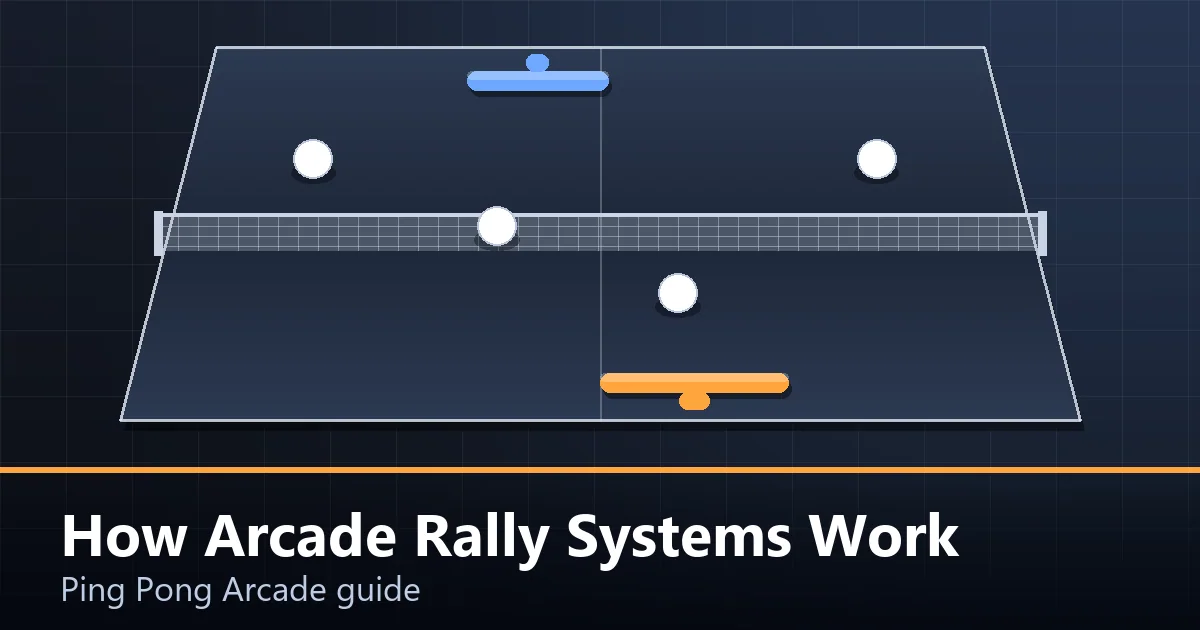
Every rally system on this site is built from the same four pieces, and games differentiate themselves by tuning them rather than by replacing them.
- A counter, which increments on every successful return by either paddle
- A tempo multiplier, derived from the counter and applied to shot speed
- A milestone list, which pays a bonus when the counter hits certain values
- A conversion formula, which turns the counter into points when the rally ends
Separating them explains a lot. A game with a gentle multiplier and a generous conversion is an endurance game. A game with a steep multiplier and modest conversion is a pressure game. Both use identical code.
The counter
The counter tracks returns in the current exchange by both paddles, resetting when a point is decided regardless of who won it.
Counting both sides rather than only yours is a deliberate choice. It means the counter describes the exchange rather than your contribution, which is what makes it a shared measure of how good the rally was.
It also has a consequence for difficulty selection. A very weak opponent produces short rallies because it fails, and a very strong one produces short rallies because it wins. The Medium rating, which returns competently but rarely finishes a point, produces the longest rallies.
The multiplier
The multiplier is computed as one plus the counter times a per-return step, clamped to a cap. It multiplies the speed of every shot, by either paddle.
Steps across the site range from one per cent in Rally Marathon to three per cent in Table Tennis Dash, and caps from 1.45 to 2.05. Multiplying those out gives the point at which a game stops accelerating — between roughly the thirty-third and forty-eighth return depending on the title.
The multiplier also feeds the opponent, scaled down slightly, so the AI's paddle speed rises alongside the ball. Without that, long rallies would become easier rather than harder as the opponent fell behind the pace.
Milestones
Bonuses pay at 5, 10, 15, 25, 40, 50, 75, 100, 150 and 200 returns, each announced on screen with a short label and added directly to the score.
The spacing is uneven on purpose. Early milestones cluster because a new player needs feedback quickly; later ones stretch out because by then the rally itself supplies the tension. The gap from 50 to 75 is the longest unrewarded stretch in any game here.
Milestones are paid at face value rather than multiplied by the combo, because they are already scaled by the achievement that earned them.
Conversion to score
When a point ends in your favour, the rally converts at roughly ten points per return plus 0.6 times the square of the length.
The quadratic term is what makes long rallies worth chasing rather than merely satisfying. A rally of ten banks around 160 points; a rally of fifty banks around 2,000. Doubling the rally roughly triples the reward.
Losing the point banks nothing from that rally, though everything scored during it — per-return points, milestones, target hits — is already in the total. That split is what makes a run worth continuing after a rally breaks.
How games tune it
Reading the four parameters tells you what a game is for before you play it.
| Game | Step | Cap | Character |
|---|---|---|---|
| Rally Marathon | 1.0% | 1.45× | Endurance; attention fails before reactions |
| Paddle Rush | 1.8% | 1.85× | Gentle learning curve |
| Conveyor Table | 1.8% | 1.70× | Lower cap because the drift supplies difficulty |
| Rally Master | 2.2% | 2.05× | The standard, with a 50-rally target |
| Table Tennis Dash | 3.0% | 2.00× | Short and intense; cap at return 33 |
Key takeaways
- A rally system is a counter, a multiplier, a milestone list and a conversion formula.
- The counter includes both paddles, which is why the Medium opponent produces the longest rallies.
- The multiplier feeds the opponent's speed too, so long rallies do not become easier.
- Milestones cluster early and stretch later, and are paid at face value rather than multiplied.
- Conversion is quadratic, so doubling a rally roughly triples what it banks.
Frequently asked questions
Does the rally counter include the opponent's returns?
Yes. It counts the exchange rather than your contribution, so a rally of twenty is roughly ten shots from each side.
Does the opponent get faster during a long rally?
Yes, its paddle speed scales with the tempo multiplier, though slightly less than the ball does. Without that, long rallies would get easier as the AI fell behind.
Do I lose my rally points if I lose the point?
You lose the end-of-rally conversion bonus. Everything scored during the rally — per-return points, milestones, target hits — is already banked and stays.
Why do milestones stop being announced above 200?
They do not stop paying, but the announced list ends at 200 because beyond that the rally itself is the reward and further labels add nothing.