Featured
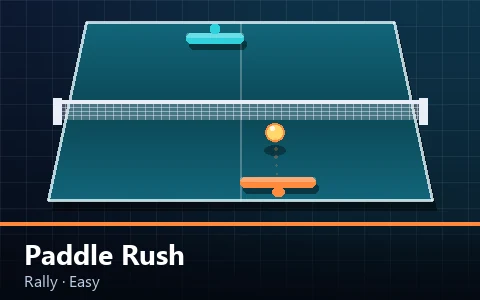
Paddle Rush
A quick, friendly rally game with a wide paddle and a patient opponent. The best place to learn how the table works.
A shorter table, a quicker ball, and no time to think about either.
Drag anywhere on the table to slide your paddle, or use the left, right and hit buttons under the game.
Table Tennis Dash narrows the playing surface and raises the base shot speed by about fifteen per cent. The effect is not subtle. A shorter distance across the table means less flight time, and less flight time means the ball is back at your paddle before the previous shot has really finished.
It also changes what a good shot is. On a full-width table, moving the ball wide is the reliable way to earn a weak return. Here the wide angles simply do not exist, so the only real weapon is depth — hitting the ball closer to the far baseline so the opponent has less time, not less reach.
| Action | Input |
|---|---|
| Move your paddle | ← → or A D, or drag on the table |
| Power shot (optional) | Space at the moment of contact |
| Pause / resume | P or Esc |
| Restart the run | R |
| Sound on or off | The sound button under the table |
On a touchscreen: Drag anywhere on the table to slide your paddle, or use the left, right and hit buttons under the game.
Reducing the table's width from the standard seventy-six world units to sixty-two does three things at once. It shortens every cross-court shot, it reduces the amount of paddle travel needed to cover the whole surface, and it shrinks the angles available to both players.
The net effect is a game where positioning is easy and timing is hard, which is the exact inverse of Paddle Rush. Players who are used to winning points by moving the opponent around find the first few runs frustrating for precisely that reason.
The physics profile here lowers air drag from the standard value, so the ball keeps more of its speed through the flight. Combined with the shorter distance, a shot that would take three-quarters of a second on a standard table arrives in roughly half that.
Lower drag also flattens the arc slightly, which raises the chance of clipping the net on a hard, flat shot. Taking a little pace off is often the safer play even though the game is asking you to be quick.
At three per cent per return, the tempo step is the steepest on the site. The cap of 2.0 is reached at around the thirty-third return rather than the high forties, so the game arrives at its ceiling considerably sooner.
That is the design: Table Tennis Dash is meant to be a short, intense run rather than a long endurance test. A rally of thirty here is roughly as hard as a rally of fifty in Rally Master.
The ball carries a height as well as a table position, so it arcs, bounces off the surface and can clip the net. When a paddle strikes it, the engine picks a landing point and solves for the exact launch velocity that reaches it, which is why the aim marker on the table is honest. In Table Tennis Dash, air drag is lowered to 0.12 against the standard 0.16, so the ball keeps more of its speed through the flight.
The paddle is a blade that slides along your baseline. Four numbers decide how it feels: how fast it moves, how hard the ball leaves the face, how accurately a shot lands where you aimed it, and how high above the table it can still make contact. In Table Tennis Dash the blade is 15 world units wide and travels at 132 units per second.
Where the ball meets the blade steers the return. A contact at the centre sends the ball straight down the table, and a contact at the edge sends it roughly 26 units off centre. Holding a direction key at the moment of contact adds a smaller correction on top.
The serve here is a single press. The ball is released toward the far half from wherever your paddle is standing, so where you stand when you serve decides the angle. Service alternates between the two ends where the game keeps a match score.
Table Tennis Dash is rated Hard overall. Reads the ball quickly, covers the table well and punishes a loose return, with an error rate around seven per cent. Use the difficulty buttons above the table to change the opponent at any time; restarting applies the change immediately. Expert is deliberately hard rather than impossible.
Because it is. Table Tennis Dash uses a table about eighteen per cent narrower than the site standard, which shortens every cross-court shot and is the main source of its difficulty.
Yes, meaningfully. The base shot speed is higher, the tempo climbs faster, the blade is narrower and the opponent is rated Hard rather than Medium. A rally of thirty here is comparable to fifty in Rally Master.
Lower drag flattens the arc, and a flat ball is a ball that clips the tape. Taking a little pace off the shot raises the arc enough to clear it, and costs less than a lost point.
Rarely. A smash is even flatter than an ordinary shot, so on this table it is mostly a net risk. Save it for a ball that is genuinely sitting up high near the net.
Easier in the sense that there is less ground to cover, harder in the sense that you have less time to cover it. Most players find the positioning trivial and the timing punishing.
Other games that use the same ideas, or that make a good next step from this one.
A quick, friendly rally game with a wide paddle and a patient opponent. The best place to learn how the table works.
A pure reaction test. Every ball is fired away from where you are standing, and the game tells you how quickly you moved.
The purest rally game on the site. No match score, no bracket — just a counter that goes up until you miss.
A rally game where the playing surface drifts. Four bands push in alternating directions and the pattern never settles.
Thirty original games across six categories, all free and all playable in this browser.