Featured
Paddle Rush
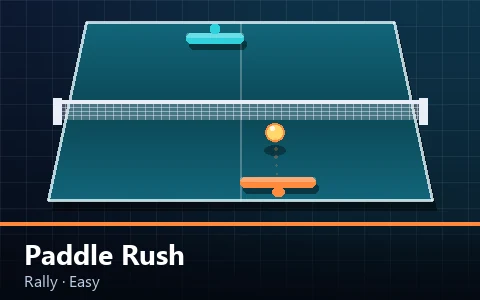
A quick, friendly rally game with a wide paddle and a patient opponent. The best place to learn how the table works.
One number matters: how long you can keep the ball alive.
Drag anywhere on the table to slide your paddle, or use the left, right and hit buttons under the game.
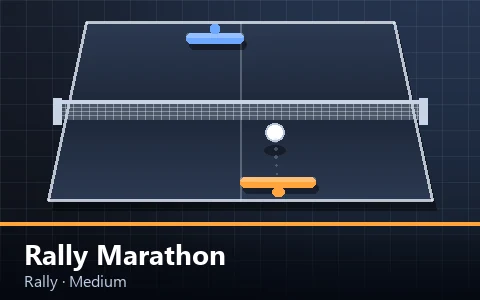
Rally Master exists to grow one number. There is no match to win and nothing else to protect — the rally counter in the HUD is the score, the goal and the entire reason to press restart. Reaching fifty returns in a single rally pays a thousand-point bonus and is the target the game is built around.
The opponent is rated Medium, which means it returns most things competently and punishes a loose ball perhaps one time in eight. That is deliberately the most interesting setting for a rally game: strong enough to keep the ball coming back, fallible enough that the rally is genuinely in your hands rather than the computer's.
| Action | Input |
|---|---|
| Move your paddle | ← → or A D, or drag on the table |
| Power shot (optional) | Space at the moment of contact |
| Pause / resume | P or Esc |
| Restart the run | R |
| Sound on or off | The sound button under the table |
On a touchscreen: Drag anywhere on the table to slide your paddle, or use the left, right and hit buttons under the game.
When a point ends, the rally counter goes back to zero but the score you built from it is banked permanently. That split is what makes a bad run still worth finishing: three rallies of fifteen are worth more than one rally of thirty that you threw away chasing a winner.
It also removes the temptation to restart the moment a rally breaks, which is the failure state of a lot of streak games. Here, the run continues and the next rally starts from a cold counter but a warm score.
Alongside the rally counter, Rally Master runs a combo multiplier that climbs with consecutive successful actions and lapses if you stop scoring for about three and a half seconds. It caps at eight.
In practice the combo tracks the rally closely, but it is not the same thing: a perfectly timed return or a clean smash raises it faster than an ordinary one. Losing a point breaks it immediately and completely.
The speed multiplier tops out at 2.05 here, the highest cap among the rally games, and it arrives at around the forty-eighth return. That is a deliberate choice: the fifty-rally target sits just past the point where the ball stops accelerating, so the hardest section of the run is the ten returns immediately before the goal.
Once you pass fifty, the game is as fast as it will ever get, and a hundred is considerably more achievable than the first fifty suggests.
The ball carries a height as well as a table position, so it arcs, bounces off the surface and can clip the net. When a paddle strikes it, the engine picks a landing point and solves for the exact launch velocity that reaches it, which is why the aim marker on the table is honest. In Rally Master the physics run at the site's standard values, which makes it a good reference point for the variants that change them.
The paddle is a blade that slides along your baseline. Four numbers decide how it feels: how fast it moves, how hard the ball leaves the face, how accurately a shot lands where you aimed it, and how high above the table it can still make contact. In Rally Master the blade is 17 world units wide and travels at 118 units per second.
Where the ball meets the blade steers the return. A contact at the centre sends the ball straight down the table, and a contact at the edge sends it roughly 26 units off centre. Holding a direction key at the moment of contact adds a smaller correction on top.
The serve here is a single press. The ball is released toward the far half from wherever your paddle is standing, so where you stand when you serve decides the angle. Service alternates between the two ends where the game keeps a match score.
Rally Master is rated Medium overall. A balanced opponent that returns most things competently and misjudges perhaps one ball in eight. Use the difficulty buttons above the table to change the opponent at any time; restarting applies the change immediately. Expert is deliberately hard rather than impossible.
There is no ceiling. The speed multiplier stops at 2.05 around the forty-eighth return, so beyond that the difficulty is constant and the rally can in principle run indefinitely. Milestone bonuses continue to 200 and then keep paying at the 200 rate.
No, they are separate. The rally counter is a raw count of returns; the combo is a score multiplier that rises with consecutive successful actions and lapses after about three and a half seconds without one.
Usually because the tempo has just crossed a threshold where your current recovery habit is no longer fast enough. Try returning to the middle a fraction earlier rather than trying to move faster — it is almost always a positioning problem rather than a speed one.
Yes, with practice. It typically takes players a few sessions. The ten returns immediately before it are the hardest part of the game because the ball is at its fastest and the bonus is close enough to make people rush.
Paddle Rush, if you are new. It has a wider blade, a gentler tempo step and a much more forgiving opponent. Rally Master assumes you already recover to the middle without thinking about it.
Other games that use the same ideas, or that make a good next step from this one.
A quick, friendly rally game with a wide paddle and a patient opponent. The best place to learn how the table works.
The long-distance rally game. The ball never gets truly fast, so the only thing that ends a run is concentration.
The opponent blends continuously from Easy toward Expert while you play. One mistake ends the run.
The rally game with the pace turned up. A narrower table means the ball comes back before you have finished the last shot.
Thirty original games across six categories, all free and all playable in this browser.