 Alex Morgan

The two phases of a long rally
Every rally game caps its tempo multiplier somewhere between the thirty-third and forty-eighth return. That cap divides a long rally into two quite different halves.
Before it, the game is changing under you. Every few shots the ball is measurably quicker, and the challenge is adapting to something new. Execution is the limiting factor.
After it, nothing changes. The ball is as fast as it will get, the opponent is playing as it did five shots ago, and the challenge is repeating something familiar without lapsing. Attention is the limiting factor.
Why runs end after a good stretch
The most common shape of a long-rally failure is not a gradual decline — it is thirty seconds of everything going well followed by an abrupt miss.
That is attention drift, and the mechanism is straightforward. When nothing has challenged your recovery habit for a while, the habit relaxes. You stop returning fully to the middle because you have not needed to. Then a genuinely wide ball arrives and you are thirty units further away than you would have been.
The signal is worth learning to recognise: if you notice that you have not thought about your positioning for a while, that is the moment to consciously check it rather than the moment to relax further.
Pacing your own shots
One of the few levers you have in a long rally is how hard you hit the ball, and the correct setting is slower than most players use.
A slower return takes longer to reach the opponent, which gives you longer to recover. Their return of a slow ball also tends to be slower, which compounds. Over twenty shots the difference in how much time you have is substantial.
It also raises the arc over the net, which removes the second most common way long rallies end. The cost is a slightly lower per-return score, which is trivial compared to the quadratic value of the rally continuing.
Where to aim
Down the middle, for as long as the rally matters more than the score.
A ball returned centrally comes back centrally, which means you are already in position for it. The rhythm stays undisturbed and no shot requires a large recovery.
That is dull and it is correct. In a rally game the length is the score, and the difference between a central return worth ten points and a wide one worth fifteen is nothing against the value of the rally reaching fifty.
Using milestones as checkpoints
Bonuses pay at 5, 10, 15, 25, 40, 50, 75, 100, 150 and 200 returns, each announced on screen.
Those announcements are useful as attention checkpoints as well as rewards. Each one is a natural moment to consciously re-check your positioning, because it interrupts the rhythm briefly without breaking it.
The gap from 50 to 75 is the longest unrewarded stretch in any game here, and it is where a disproportionate number of long runs end. Knowing that in advance is worth a deliberate effort to stay alert through it.
When to stop
This is the advice most players ignore and it is genuinely worth taking.
A run ended deliberately banks its score and leaves you able to start another one. A run lost at ninety-four returns because you were tired banks the same score and leaves you frustrated, which affects the next run too.
The signals that you are past your useful limit are specific: your eyes start jumping between the two paddles rather than tracking the shadow; you notice you have stopped recovering; you find yourself surprised by balls you should have read. Any of those is a reason to finish the point and stop.
Which game suits long rallies
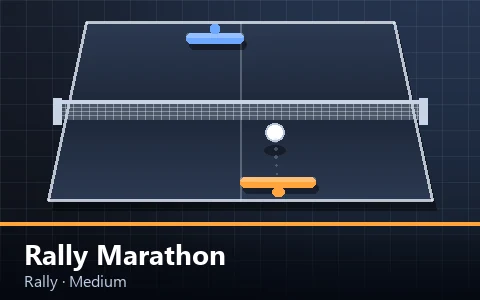
Rally Marathon is built for this specifically: a one per cent tempo step, a 1.45 cap, raised drag, five lives and a hundred-rally target worth a thousand points.
Nothing in it is fast, which is the point. A rally of a hundred there takes three to five minutes and is limited entirely by concentration.
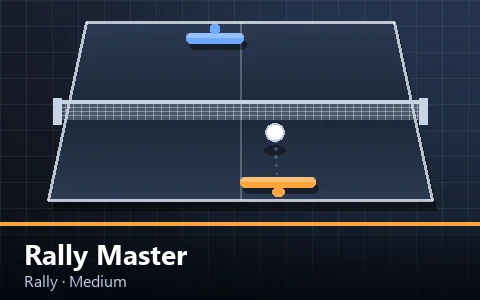
Rally Master is the standard alternative, with a steeper ramp and a fifty-rally target placed just past the tempo cap — deliberately positioning the hardest ten returns of the run immediately before the biggest bonus.
Key takeaways
- The tempo cap divides a long rally into an execution phase and an attention phase.
- Runs usually end abruptly after a comfortable stretch, which is attention drift rather than fatigue.
- Hitting slower compounds: it buys you time on your shot and on the return.
- Aim centrally while the rally matters more than the score, because a central ball comes back centrally.
- The stretch from 50 to 75 is the longest unrewarded gap and where a disproportionate number of runs end.
Frequently asked questions
Why do I always lose the rally right after a good stretch?
Attention drift. When nothing has challenged your recovery habit for a while it relaxes, and the next genuinely wide ball finds you further out of position than you realised.
Does hitting softer really help?
Yes, and it compounds. A slower shot gives you more time, tends to produce a slower return, and raises the arc over the net — which removes the second most common cause of a lost rally.
Should I aim wide to score more per return?
Not while the rally is the score. Rally value grows quadratically, so a rally reaching fifty is worth far more than the small per-return difference between central and wide shots.
How long does a rally of a hundred take?
Three to five minutes in Rally Marathon, which is the game built for it. It is the longest single objective on the site.