New
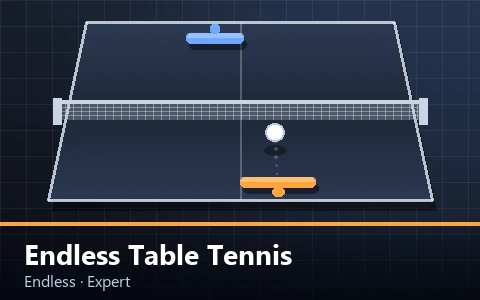
Endless Table Tennis
The harder endless mode. Starts at Medium, ramps in under two minutes, and gives you a single life throughout.
One life, and an opponent that gets better for as long as you last.
Drag anywhere on the table to move, and use the smash button under the game for a power shot.
Endless Rally gives you one life and an opponent that improves continuously for as long as you keep it. Over about two and a half minutes the AI blends from the Easy rating all the way to Expert — not in steps, but smoothly, so there is never a single frame where the game becomes a different game.
Score accrues from three sources at once: points won, rally length, and simply surviving. That last one matters more than it sounds. A player who lasts three minutes without winning a single point still outscores one who wins four points in forty seconds.
| Action | Input |
|---|---|
| Move your paddle | ← → or A D, or drag on the table |
| Smash | Space or Shift just before contact |
| Pause / resume | P or Esc |
| Restart the run | R |
| Sound on or off | The sound button under the table |
On a touchscreen: Drag anywhere on the table to move, and use the smash button under the game for a power shot.
Every quarter of a second the game recomputes the opponent's settings by interpolating between two adjacent difficulty presets. Paddle speed, reaction delay, prediction accuracy, error rate, placement, shot speed, spin skill and smash chance all move together.
The result is that the opponent at ninety seconds is genuinely between Medium and Hard rather than being one or the other. A stepped system would produce moments where a run ends because the difficulty jumped; this one does not.
Alongside the opponent, the rally tempo cap rises from 1.7 to 2.4 across the ramp and your own shot speed increases by twelve per cent. So the ball gets quicker whether or not the rally is long.
That is what stops a defensive strategy from working indefinitely. Playing safe returns down the middle is correct early and stops being sufficient somewhere around the two-minute mark.
Five points are awarded per second survived, paid in quarter-second increments so the score ticks up visibly. A point won is worth two hundred plus eight per return in the rally that produced it.
The balance is deliberate: over a three-minute run, survival contributes around nine hundred points, which is roughly four won points. Neither strategy dominates, and the best runs do both.
The ball carries a height as well as a table position, so it arcs, bounces off the surface and can clip the net. When a paddle strikes it, the engine picks a landing point and solves for the exact launch velocity that reaches it, which is why the aim marker on the table is honest. In Endless Rally the physics run at the site's standard values, which makes it a good reference point for the variants that change them.
The paddle is a blade that slides along your baseline. Four numbers decide how it feels: how fast it moves, how hard the ball leaves the face, how accurately a shot lands where you aimed it, and how high above the table it can still make contact. In Endless Rally the blade is 17 world units wide and travels at 118 units per second.
Where the ball meets the blade steers the return. A contact at the centre sends the ball straight down the table, and a contact at the edge sends it roughly 26 units off centre. Holding a direction key at the moment of contact adds a smaller correction on top.
The serve here is a single press. The ball is released toward the far half from wherever your paddle is standing, so where you stand when you serve decides the angle. Service alternates between the two ends where the game keeps a match score.
Endless Rally is rated Expert overall. A patient opponent with a slow paddle, a three-tenths-of-a-second reaction delay and roughly a one-in-four chance of misjudging a ball. The opponent rating is set by the game itself rather than by a switch, because it changes as you progress. Expert is deliberately hard rather than impossible: it keeps both a reaction delay and an error rate, because an opponent that never misses is a wall rather than a challenge.
About 150 seconds — two and a half minutes — from the Easy rating to Expert. Beyond that the opponent stays at Expert and the run continues.
It is the point of the mode. Survival scoring means a long, cautious run is genuinely rewarded, and a single life is what makes caution the correct strategy rather than a boring one.
No. Every setting is interpolated continuously and recomputed four times a second, so the transition from Medium to Hard is gradual rather than a step.
Two minutes puts you near the Hard tier and is a solid run. Three minutes means you have survived into the Expert range, which most players reach after several sessions.
Endless Rally starts at Easy and is about surviving a rising opponent. Endless Table Tennis starts at Medium, ramps faster and frames the run as a continuous match rather than a rally.
Other games that use the same ideas, or that make a good next step from this one.
The harder endless mode. Starts at Medium, ramps in under two minutes, and gives you a single life throughout.
The purest rally game on the site. No match score, no bracket — just a counter that goes up until you miss.
The long-distance rally game. The ball never gets truly fast, so the only thing that ends a run is concentration.
A boss ladder where every opponent changes something about the table — and the last one changes three things at once.
Thirty original games across six categories, all free and all playable in this browser.