Guide library

Ping Pong Arcade Guides

Written explanations of how these games work and how to get better at them. Every figure in them is read out of the games themselves rather than estimated, and every guide says plainly when it is describing our arcade model rather than the real sport.

70 guides — 20 in-depth pillar guides and 50 focused explainers

In-depth guides

The long-form guides. Each one covers a whole topic from first principles.

An arcade ping pong table seen from above with paddles at each end and the ball mid-rally

What Are Ping Pong Arcade Games?

A ping pong arcade game keeps the readable parts of table tennis — the rally, the bounce, the net, the curve — and throws away everything that would make a browser game feel slow. This is what that actually means in practice.

Pillar guide10 min read
Diagram-style illustration of a ping pong table showing the ball's arc, the net and both paddles

How Ping Pong Arcade Games Work

Underneath all thirty games on this site sits one engine with about six moving parts. Learn those six and you understand every game here — and most of the ping pong games you will find anywhere else.

Pillar guide11 min read
A ping pong rally counter climbing beside a table with the ball mid-flight

How Rally Mechanics Work in Arcade Games

A rally counter looks like a number going up. It is actually the difficulty system, the scoring system and the pacing system all at once — and understanding that changes how you should play.

Pillar guide8 min read
A ping pong serve about to be struck, with a timing meter and service zones marked on the far half

Ping Pong Serving Mechanics Explained

The serve is the only moment in a rally where you have complete control, which is why it gets its own system in almost every ping pong game. Here is how the five serve styles work and how to use each one.

Pillar guide8 min read
A ping pong ball curving through the air with a spin indicator showing side spin

Spin Mechanics in Ping Pong Arcade Games

Spin is the mechanic players notice last and benefit from most. Here is exactly how the arcade model works, where the curve comes from, and why steadying your paddle is a real technique.

Pillar guide8 min read
A rising ping pong arcade score display with a combo multiplier beside the table

How to Improve Your Ping Pong Arcade Score

Most players leave more points on the table through bad risk management than through slow reactions. This is what actually moves a score, in rough order of how much difference it makes.

Pillar guide8 min read
A ping pong paddle blade shown with its contact zones and the resulting shot directions

How Paddle Physics Work

A paddle in these games is five numbers and one collision test. Understanding both explains why your shots go where they go — and why the same paddle feels completely different in two games.

Pillar guide9 min read
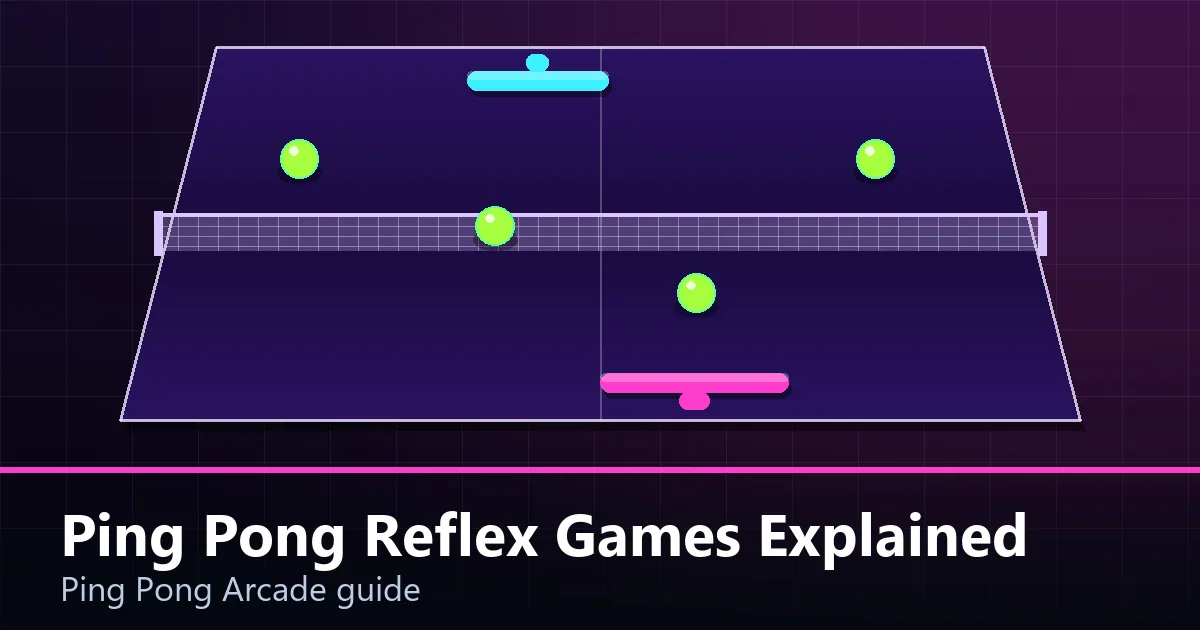
A ping pong ball fired wide across the table with a reaction timer displayed

Ping Pong Reflex Games Explained

Reflex games compress table tennis into the half second between the ball leaving one paddle and arriving at the other. Here is what they measure, what the millisecond figures mean, and how to move them.

Pillar guide8 min read
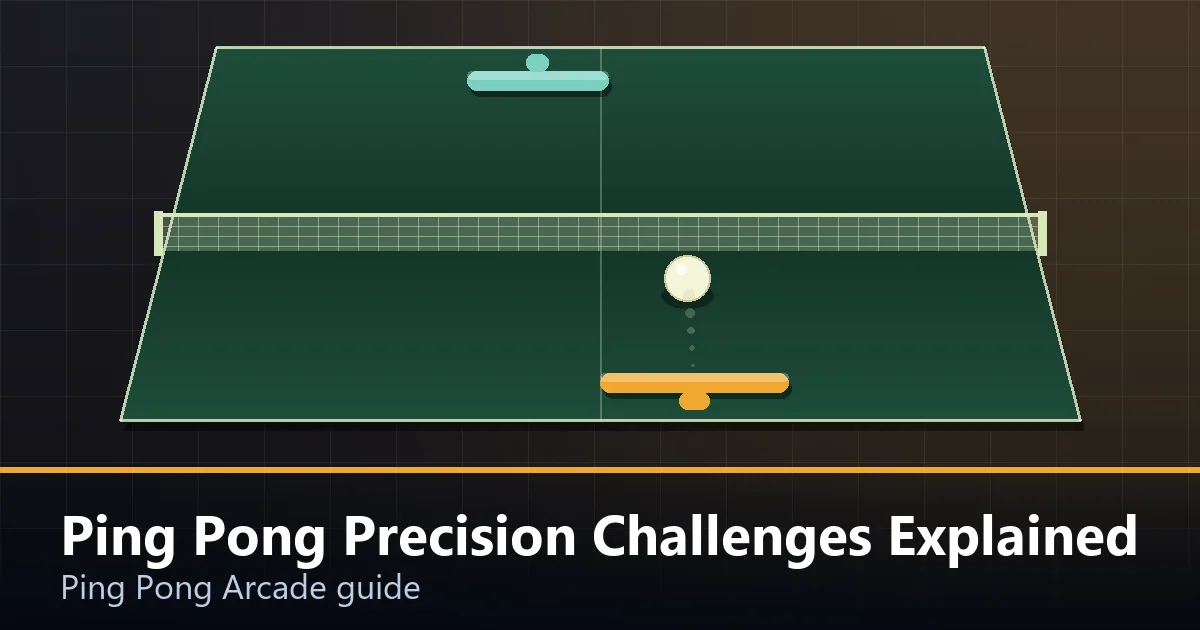
A ping pong table marked with corner scoring zones and a target ring on the far half

Ping Pong Precision Challenges Explained

Precision games change what a good shot is: keeping the ball in play scores almost nothing, and putting it in an exact place scores a great deal. Here is how the scoring works and how to actually hit things.

Pillar guide8 min read
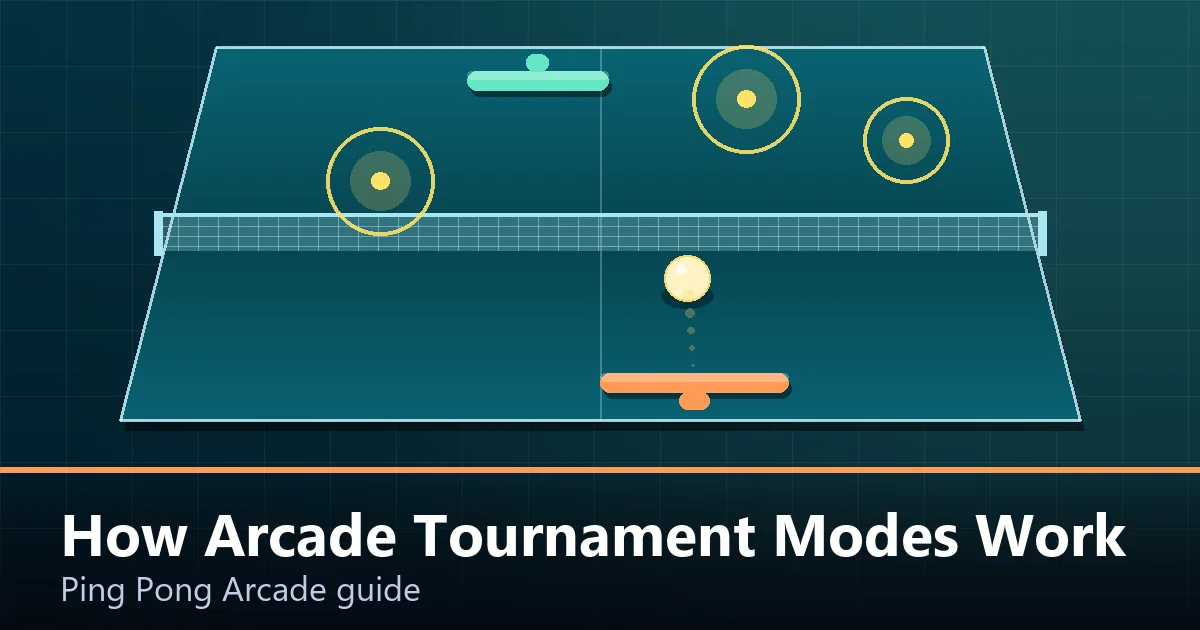
An arcade ping pong knockout bracket showing four rounds with the final highlighted

How Arcade Tournament Modes Work

A tournament turns one match into a run, which changes what a point is worth. Here is how brackets and boss ladders are built, why progress is saved locally, and how to actually win one.

Pillar guide7 min read
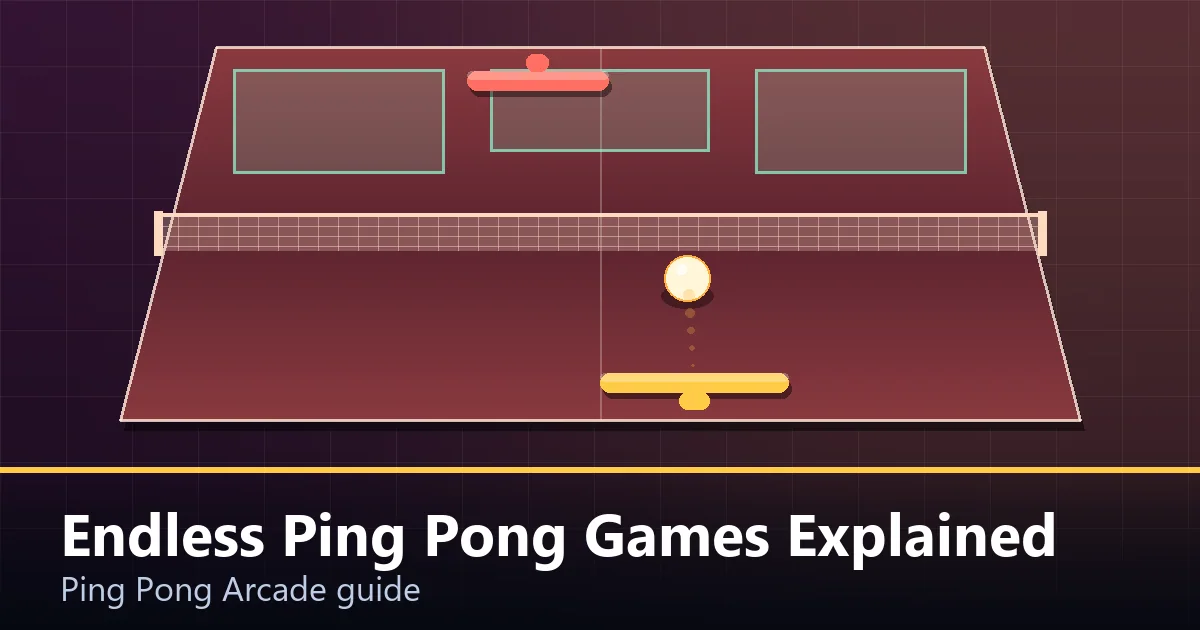
A ping pong difficulty ramp bar climbing beside a table during a long survival run

Endless Ping Pong Games Explained

An endless game has no finish line, which means it has to solve a problem a finite game does not: how do you keep raising difficulty without ever making the game impossible? Here is how it is done.

Pillar guide7 min read
A one-button ping pong game showing a timing ring closing on the paddle

One-Tap Ping Pong Games Explained

Take away movement and a ping pong game becomes a pure timing problem — and, not coincidentally, the most accessible thing on the site. Here is how one-button table tennis is built and how to be good at it.

Pillar guide7 min read
An HTML5 canvas element rendering a ping pong table in a browser window

HTML5 Ping Pong Games Explained

"HTML5 game" has become shorthand for "plays in a browser without a plugin". Here is what that actually involves — the five browser features these games are built from, and why the constraints produce better games.

Pillar guide8 min read
A ping pong arcade game running on a phone screen with large touch buttons below the table

Ping Pong Arcade Games for Mobile

A ping pong table is one of very few sports playfields that fits an entire phone screen without compromise. Here is how touch control is built, which games suit a small screen, and what changes about playing well.

Pillar guide7 min read
A combo multiplier display counting up beside a ping pong table

How Combo Systems Work in Ping Pong Games

A combo multiplier is the most under-used number on the HUD. It caps at eight, it breaks on mistakes, and understanding it changes which shots you should attempt — sometimes by a factor of six.

Pillar guide7 min read
A timing window closing on a ping pong paddle as the ball approaches

How to Improve Timing in Ping Pong Games

Timing is the skill that most players assume is fixed and is actually the most trainable thing on the site. Here is what the windows are, why yours drifts, and how to fix it in about twenty minutes of deliberate practice.

Pillar guide8 min read
Design sketch of a ping pong arcade game showing the table, HUD and control layout

Designing a Good Ping Pong Arcade Game

Thirty games from one engine forces you to decide what a game actually is. These are the principles that survived the process, including the ones that were wrong the first time.

Pillar guide8 min read
A stylised progression of ping pong game visuals from simple shapes to a modern arcade table

The Evolution of Table-Tennis-Inspired Arcade Games

Table tennis was the first sport video games could actually represent, and the ideas it established are still visible in every paddle game made since. This is what changed and what did not.

Pillar guide7 min read
A selection of ping pong arcade game thumbnails arranged as editorial picks

Best Ping Pong Arcade Games to Play Online

Thirty games is too many to choose from cold. These are the picks by situation — what to play first, what to play with somebody else, what to play on a phone, and what to play when you want to be beaten.

Pillar guide7 min read

Focused explainers

Shorter guides that answer one specific question about a mechanic or a technique.

A ping pong ball arriving fast with a reaction timer showing milliseconds

How to Improve Your Ping Pong Reaction Time

Most of what feels like slow reactions is actually slow decisions, and decisions are the part that improves. Here is what to change, in order of how much difference it makes.

Guide4 min read
A ping pong paddle sliding along its baseline with movement arrows

How to Master Paddle Movement

Paddle movement is the least glamorous skill on the site and the one that moves scores the most. Three habits account for nearly all of it.

Guide4 min read
A fast ping pong shot crossing the table with a motion trail

How to Return Fast Balls

When the ball is quicker than you can comfortably handle, the answer is almost never to move faster. Here are the four things that actually work.

Guide4 min read
A rally counter and tempo bar displayed alongside a ping pong table

How Arcade Rally Systems Work

A rally system is four components working together. Separating them makes it obvious why some games reward patience and others punish it.

Guide4 min read
A long ping pong rally with the counter showing a high number

How to Build a Long Rally

A rally of fifty is not fifty good shots. It is ten shots to set a rhythm, twenty to hold it, and twenty where the only skill left is not getting bored.

Guide4 min read
A ping pong serving challenge with numbered scoring zones on the far half

How Serving Challenges Work

A serving challenge is the tightest feedback loop on the site: aim, release, land, score, repeat, about twelve times a minute. Here is exactly how it is scored.

Guide4 min read
Scoring rings placed on a ping pong table with the ball approaching one

How Target Challenges Work

Target challenges look simple and hide two rules that decide most of your score: the height rule, and the relationship between ring size and your combo.

Guide4 min read
A ping pong paddle striking the ball at the exact moment of contact

How to Improve Shot Timing

Most games here return the ball automatically, so the timing bonus is optional — which is exactly why most players never learn it. It is worth about fifty per cent more per return.

Guide3 min read
A curving ping pong ball path shown against a straight reference line

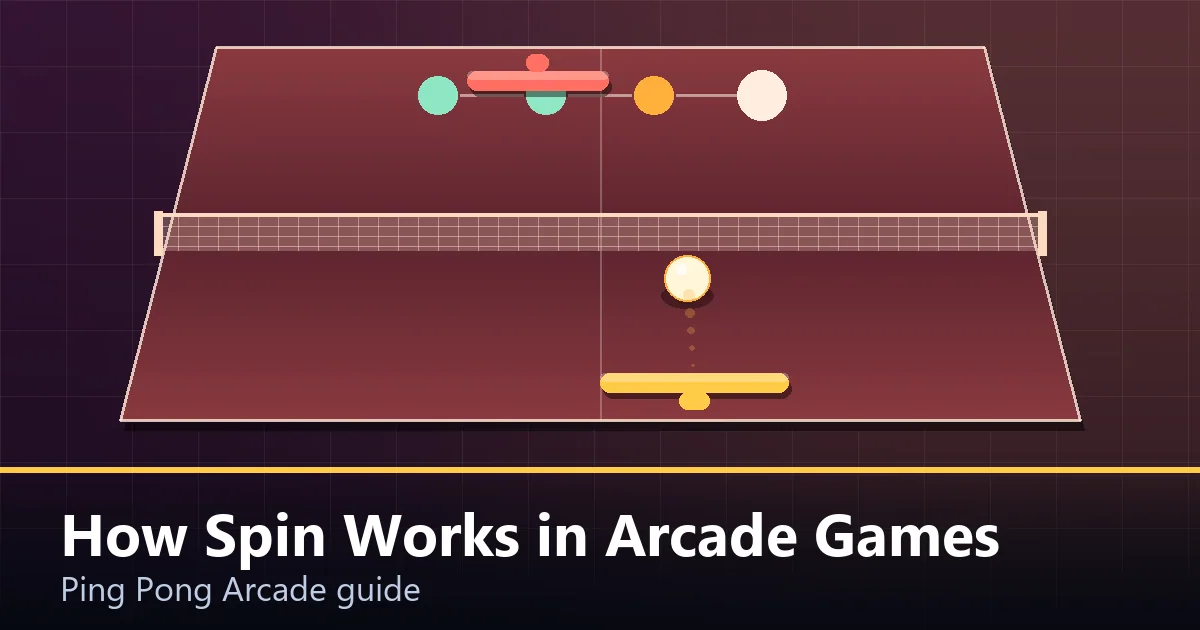
How Spin Works in Arcade Games

Real spin is fluid dynamics. Arcade spin is three accelerations. Here is why the simplification is a design decision rather than a limitation.

Guide4 min read
A top-spun ping pong ball dipping into the table and kicking forward

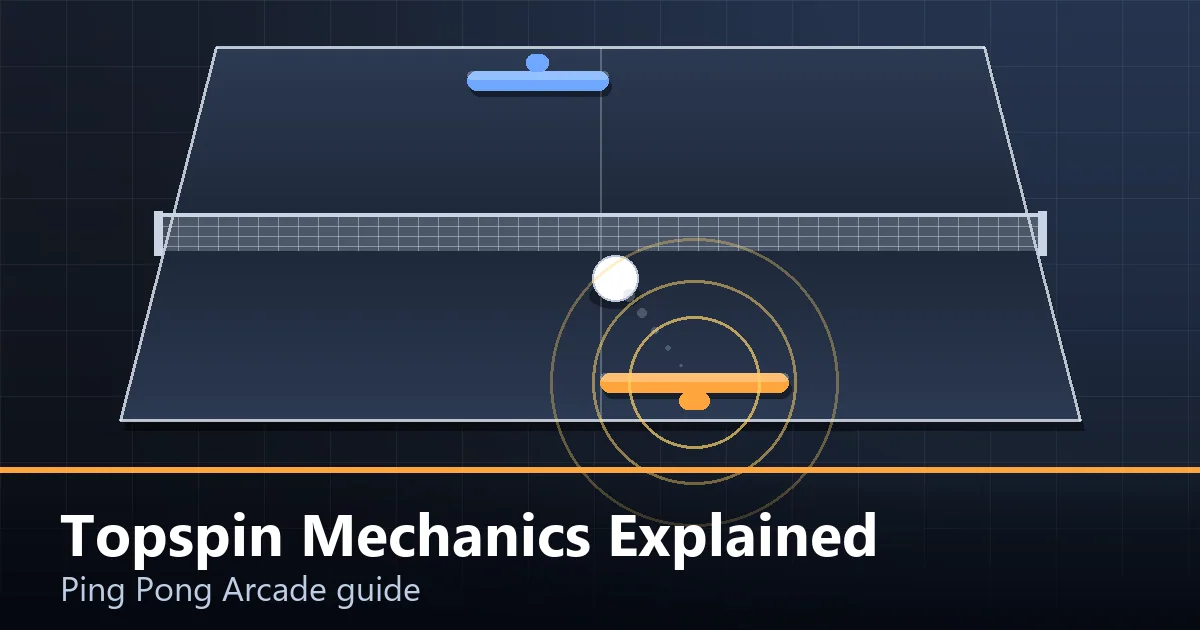
Topspin Mechanics Explained

Top spin is the spin that lets you hit harder without the ball sailing long, and the one that shortens your opponent's time after the bounce. Here is exactly what it does.

Guide4 min read
A back-spun ping pong ball floating and checking after the bounce

Backspin Mechanics Explained

Back spin is the spin you mostly receive rather than produce, and the one that produces the single most common mistake on the site: driving flat into a floating ball.

Guide5 min read
A side-spun ping pong ball curving away from a straight reference line

Sidespin Mechanics Explained

Side spin is the only mechanic on the site whose effect grows with the square of time, which is why a slow shot bends dramatically and a fast one barely at all.

Guide5 min read
A ping pong blade divided into contact zones with arrows showing resulting shot directions

How Paddle Angle Affects Shots

There is no paddle angle input in these games. What there is instead is a contact-point rule that does the same job with one fewer thing to learn — and it is the single most important mechanic on the site.

Guide5 min read
Two ping pong shot arcs compared, one fast and flat and one slow and high

How Ball Speed Affects Difficulty

Raising ball speed does not just give you less time. It flattens arcs, reduces spin drift, shrinks your effective paddle coverage and changes which shots are correct.

Guide4 min read
A computer-controlled ping pong paddle moving to intercept a predicted ball position

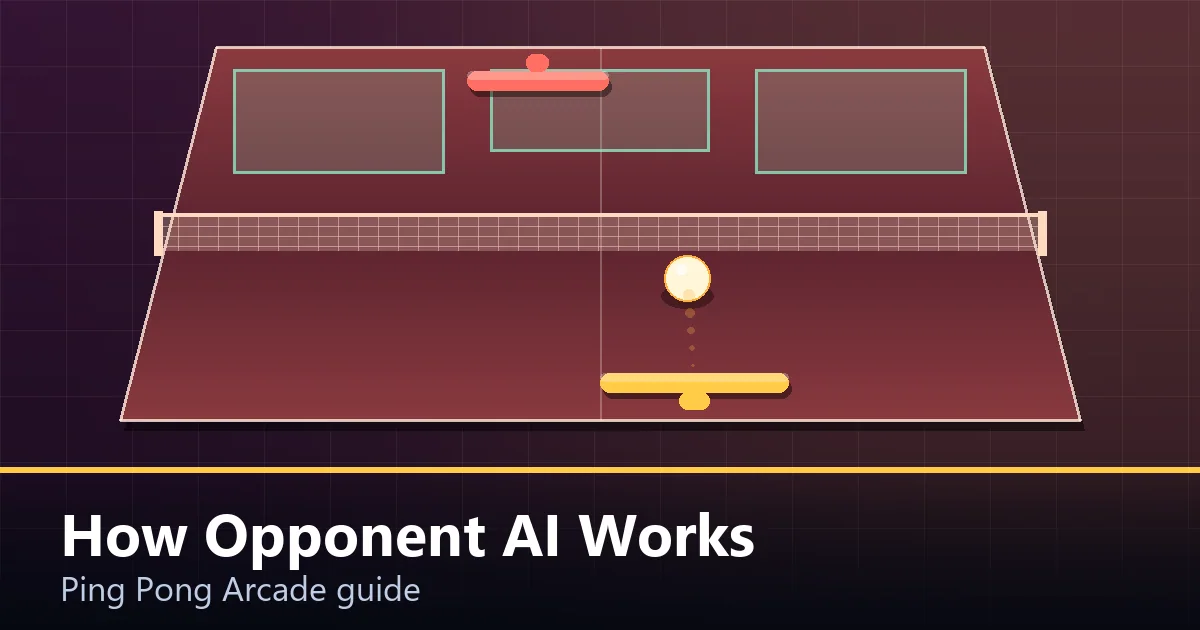
How Opponent AI Works

The computer paddle does not cheat and does not know anything you do not. Here are the five numbers that make it Easy or Expert, and the one design decision that makes it feel fair.

Guide4 min read
A rising difficulty curve shown beside a ping pong table

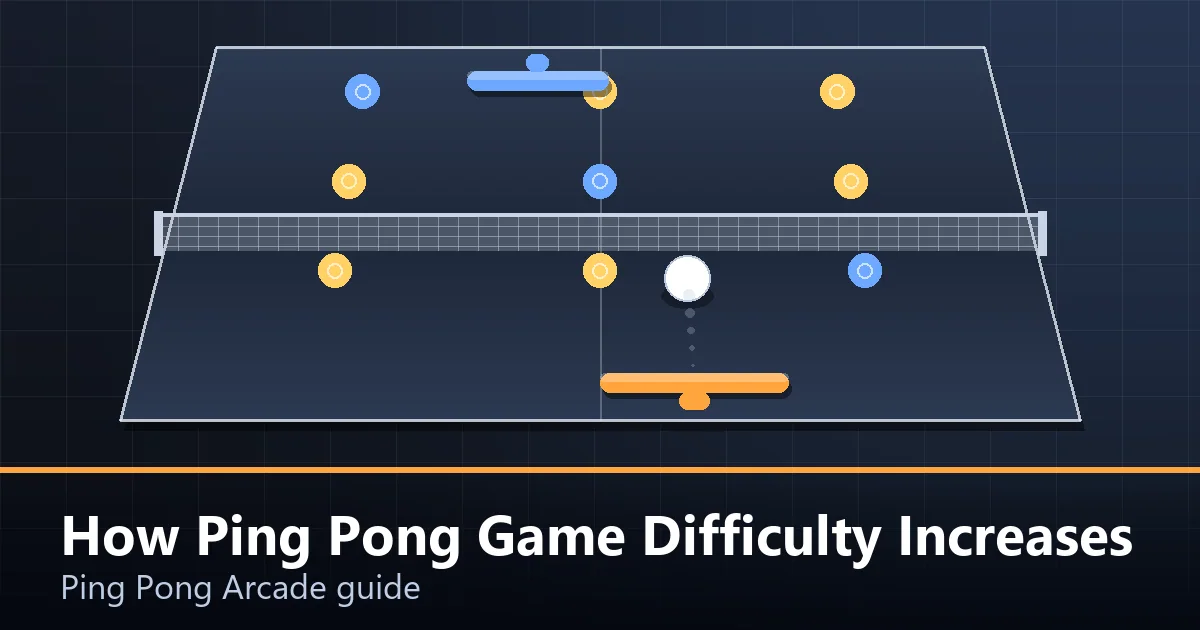
How Ping Pong Game Difficulty Increases

There are exactly four mechanisms by which any game on this site gets harder. Knowing which one is operating tells you what to change about how you are playing.

Guide4 min read
A ping pong match against a fast computer opponent at the far end of the table

How to Beat Difficult Arcade Opponents

The Expert opponent has four exploitable properties. Using all four turns an unwinnable match into a close one, and none of them requires faster reactions.

Guide4 min read
A ping pong tournament bracket with completed and upcoming rounds marked

How Tournament Progression Works

A bracket is a sequence of matches with an escalating cost of failure. Here is exactly how progression, saving and elimination work across the three tournament games.

Guide4 min read
A long ping pong rally continuing with a high rally counter displayed

How to Manage Long Rallies

Past the tempo cap a rally stops being a test of reaction and becomes a test of attention. That is a different skill and it fails in a different way.

Guide4 min read
A ping pong shot landing precisely inside a marked scoring zone

How to Improve Precision

Placement improves faster than anything else on the site with deliberate practice, and slower than anything else without it. Here is the routine that works.

Guide4 min read
A ping pong ball landing in the deep corner of the far half of the table

How to Hit Table Corners

The two deep corners are the highest-value targets on the site and the hardest to reach. Four things have to line up, and most players are missing the second one.

Guide5 min read
A one-button ping pong game with the timing ring about to reach the paddle

How to Master One-Tap Ping Pong

One button, one job, and about five things that separate a player who survives from one who builds a twenty-perfect streak.

Guide4 min read
A generated sequence of ping pong challenge stages with rising difficulty

How Procedural Challenges Work

A formula never runs out of content and never has taste. The useful approach is to generate the numbers and author the shape — here is what that means in practice.
Guide4 min read
A ping pong ball's arc shown with its height, bounce and landing marked

Ping Pong Physics Explained

The whole physics model is five constants and one integration step. Here is what each number does, what happens when you change it, and why it is not a simulation.

Guide5 min read
An HTML5 canvas rendering a ping pong ball with its physics values overlaid

How HTML5 Canvas Handles Game Physics

Canvas is a drawing surface with no opinion about physics. Everything that makes a browser game feel solid happens in the loop around it.

Guide4 min read
A finger dragging a ping pong paddle on a touchscreen with control buttons below

How Touch Controls Work

Touch control in a browser game is mostly about four details that are invisible when they work and obvious when they do not.

Guide4 min read
A ping pong arcade game being played on a phone held in portrait

Mobile Ping Pong Arcade Tips

Playing on a phone is not desktop play on a smaller screen. Five things genuinely differ, and adapting to them is worth more than any amount of practice.

Guide4 min read
A keyboard layout showing the keys used by ping pong arcade games

Desktop Ping Pong Controls

Every key these games use, what each one does, and why a keyboard is meaningfully better than touch for the placement games.

Guide4 min read
Two players sharing one keyboard for a ping pong match on a shared screen

Local Two-Player Ping Pong Games

There is no online play on this site and there never will be without a server. What there is instead is five games with genuine local two-player, on one keyboard or one screen.

Guide4 min read
A stylised ping pong arena showing table, net, lighting and colour palette

Designing a Ping Pong Arcade Arena

An arena's job is to make the ball readable. Everything else is decoration, and decoration that competes with the ball is a bug.

Guide5 min read
An invented arcade ping pong opponent shown as a coloured paddle with a name label

Designing a Fictional Table-Tennis Opponent

A good invented opponent is a paragraph of description and a set of numbers that agree with each other. When they disagree, players stop reading the description.

Guide4 min read
Three ping pong blades of different widths compared side by side

Designing Arcade Paddle Mechanics

Three numbers define a paddle and they do not act independently. Understanding how they interact is most of what separates a game that feels tight from one that feels vague.

Guide4 min read
A ping pong arcade score display showing points, combo and rally counters

How Scoring Systems Work

Scoring is how a game tells you what it wants. Here is every value on the site, and what each one is asking you to do.

Guide4 min read
A combo multiplier counter with a draining timer bar above a ping pong table

How Combo Multipliers Work

The combo is the most under-used number on the HUD, and the one whose arithmetic most directly changes which shots you should attempt.

Guide4 min read
A milestone bonus being awarded during a ping pong rally

How Bonus Points Work

Bonuses are the part of a score that arrives all at once, and they are almost always where a good run separates from an average one.

Guide4 min read
A fast ping pong challenge with a charge meter and a countdown

How Speed Challenges Work

Speed on its own is not a challenge — it is just a faster version of the same thing. What makes a speed challenge interesting is what it is paired with.

Guide4 min read
A countdown timer running above a ping pong table during a stage

How Timed Ping Pong Challenges Work

There are two kinds of clock in these games and they demand opposite behaviour. Confusing them is the fastest way to fail a stage you could have cleared.

Guide4 min read
Scoring rings of different sizes distributed across a ping pong table

How Target Systems Work

A target looks like a circle on the table. Underneath it is a spawn rule, a hit test, a height threshold and a pool — and each one is a design decision.

Guide4 min read
A reaction challenge with a ball fired unpredictably across a ping pong table

How Reaction Challenges Work

Building a reaction test is mostly about removing things: rhythm, predictability, and any way for the player to succeed without actually reacting.

Guide4 min read
A ping pong game over screen showing a score just short of a personal best

How Arcade Games Create Replayability

Replayability is not a feature you add. It is what is left when the cost of starting again is near zero and there is something specific you nearly achieved.

Guide4 min read
A short ping pong arcade run ending with a score summary

Why Short Gaming Sessions Work Well

Browser games converge on short sessions for reasons that have nothing to do with attention spans and everything to do with the cost of failure.

Guide4 min read
A player tracking a ping pong ball's shadow across the table

How to Improve Hand-Eye Coordination in Games

Coordination in a paddle game is mostly a tracking problem, and tracking is a habit rather than a talent. Here is what improves it and what we cannot claim about it.

Guide4 min read
A timing practice session in a one-button ping pong game

How to Practice Timing in Arcade Games

Timing improves faster than almost anything else with the right practice and barely at all with the wrong kind. The difference is whether you isolate it.

Guide4 min read
A difficulty selection showing four tiers beside a ping pong table

How Difficulty Affects Replayability

A game is most replayable when the player believes the next run could go better. That belief depends almost entirely on how difficulty is tuned.

Guide4 min read
Four ping pong opponent difficulty tiers compared as a chart

How to Create Balanced Arcade Opponents

Making an AI harder is trivial. Making it harder in a way players accept is the actual problem, and it comes down to when its mistakes are decided.

Guide4 min read
A one-button ping pong game shown as an accessible control scheme

How Accessibility Improves Browser Games

Every accessibility decision on this site made the games better for everybody. That is not a coincidence — it is what happens when you remove assumptions.

Guide4 min read
A personal best score displayed on a ping pong game ready screen

How Local High Scores Work

Your scores live in your browser and nowhere else. Here is exactly what is stored, why it behaves the way it does, and what that rules out.

Guide4 min read
A browser window loading a ping pong game page

How Browser-Based Ping Pong Games Work

Follow a link and a game is ready almost immediately. Here is what actually happens in that second, and why it is possible without a download.

Guide4 min read

Stop reading, start playing

Thirty original ping pong arcade games, free, in your browser, with nothing to install.