 Alex Morgan

What a combo actually multiplies
The combo is a multiplier applied to most points you score. A ring worth 150 at a multiplier of four pays 600; a return worth 10 at the same multiplier pays 40.
It does not multiply everything. Rally bonuses banked when a point ends, milestone bonuses, stage-clear bonuses and match-win bonuses are all paid at face value, because those are already scaled by the achievement that earned them.
That split matters for strategy. In a rally game, where most of the score comes from banked rally bonuses, the combo is a useful extra. In a precision game, where most of the score comes from individual placements, the combo is the dominant term — it can easily be worth more than everything else on the HUD combined.
How it builds
Every successful action raises a counter, and when the counter reaches the step size — one, in every game on this site — the multiplier increases by one. It caps at eight.
What counts as a successful action depends on the game: a clean return, a target hit, a landed serve, a collected token, a won point, a perfectly timed shot. The list is deliberately generous, because a multiplier that only rises on spectacular play is a multiplier most players never see.
There is no difference in how much different successes are worth to the combo. Hitting a 250-point small ring raises it by the same amount as a 10-point safe return. That is intentional: it means keeping the combo alive is always possible, even during a stretch where nothing ambitious is available.
The lapse timer
A combo above one lapses if about three and a half seconds pass without a scoring action. When it lapses it drops all the way back to one — it does not decay by a step.
The timer exists to stop the multiplier becoming a permanent state. Without it, a careful player would reach eight early and keep it for the whole run, at which point it is no longer a multiplier but a constant and the mechanic has stopped doing anything.
Three and a half seconds is roughly four to five exchanges at typical rally speed, which means an ordinary rally sustains the combo comfortably. What breaks it is a long pause — a serve sequence, a stage transition, or a stretch where you are purely defending without scoring.
A bar above the table shows the remaining time whenever the multiplier is above one. It draining is the cue to take a scoring action rather than another safe return.
Editor’s note
If your combo keeps lapsing rather than breaking, you are playing too passively. A clean return counts as a success — you do not need a spectacular shot to keep it alive.
What breaks it
A mistake breaks the combo immediately and completely. Losing a point, faulting a serve, missing a ball in the multi-ball game, or failing a stage all reset it to one.
That is a harsher rule than the lapse, and it is the source of all the interesting decisions. A lapse costs you the multiplier after several seconds of not scoring; a break costs it instantly, at the exact moment you were trying to do something.
| Event | Effect on combo | Effect on rally |
|---|---|---|
| Clean return | Raises it | Raises it |
| Target or zone hit | Raises it | No change |
| Won point | Raises it | Resets, score banked |
| 3.5s without scoring | Lapses to one | No change |
| Lost point | Breaks to one | Resets, no bank |
| Faulted serve | Breaks to one | n/a |
The row worth noticing is 'won point'. Winning the point keeps your multiplier and banks your rally — it is the only event that is unambiguously good for both numbers. Losing one destroys both.
The risk rule
This is the part that actually changes how you play, and it follows directly from the multiplier's arithmetic.
Consider a choice between a small ring worth 250 and a large ring worth 150, where you hit the small one about half the time and the large one about eighty per cent of the time. At a multiplier of one, attempting the small ring has an expected value of 125 against 120 — near enough identical, so take the risk.
At a multiplier of six, the small ring's expected value is 750, the large ring's is 720 — still close. But missing the small ring does not merely cost you 750: it breaks the multiplier, so every subsequent scoring action for the next several exchanges pays one sixth of what it would have.
Once that downstream cost is included, the safe target wins comfortably at a high multiplier and the risky one wins at a low one. The rule reduces to a sentence: attempt the hard target when you have nothing to lose, and take the easy one when you do.
Why it caps at eight
An uncapped multiplier produces runaway scores. A player who strings together forty successes would be scoring forty times face value, which makes every earlier point in the run irrelevant and makes the score a record of one lucky streak rather than of a whole run.
Eight is high enough that the multiplier genuinely matters — the difference between one and eight is large — and low enough that it is reachable in normal play rather than being a theoretical maximum.
It also has a pacing effect. Because the cap is reachable in eight successful actions, most players hit it during a decent rally, which means the interesting question stops being 'how high can I get it' and becomes 'how long can I hold it'. That is a better question, because holding it is a decision you make on every shot.
How different games use it
The same system does noticeably different work depending on what a game scores.
- Rally games — a useful bonus on top of the banked rally score, but rarely the dominant term
- Precision games — frequently the largest single factor in a score, because placements are individually multiplied
- Serving games — compounds across a clean run, so twelve landed serves is worth far more than double six
- Collection games — every token is multiplied, so a clean sweep at a high multiplier is the biggest single event in the game
- Reflex games — matters less, because the score is dominated by speed and reaction bonuses
- Match games — a modest contribution, since point and match bonuses are paid at face value
The practical consequence is that the combo deserves most of your attention in precision, serving and collection games, and rather less in rally and match games where other terms dominate.
Combos versus rally counters
These two numbers sit next to each other on the HUD and are frequently confused, which costs points.
A rally counts returns and resets whenever a point ends — win or lose. A combo counts successes and only breaks on a mistake. Winning the point therefore resets one and preserves the other.
They also respond differently to caution. A cautious player builds long rallies and a steady combo. An aggressive player builds shorter rallies and a spikier combo that climbs quickly and breaks often.
Which is better depends entirely on the game, and the answer is on the game page's scoring section. A minute reading that before a run is worth more than several minutes of playing on instinct.
Practising combo discipline
Combo management is a habit rather than a skill, which means it can be built deliberately in a couple of runs.
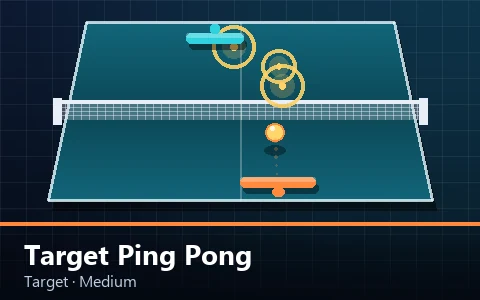
Play a run of Target Ping Pong with a rule: never attempt a small ring once the multiplier passes four. Score the run. Then play one with the opposite rule — always attempt the small ring — and score that.
Most players find the disciplined run scores between thirty and sixty per cent higher, which is a large enough difference to change behaviour permanently. Seeing it in your own numbers is far more convincing than reading the arithmetic.
Key takeaways
- The combo multiplies individual scoring actions but not banked rally, milestone or match bonuses.
- Any success raises it equally, so keeping it alive never requires a spectacular shot.
- It lapses after about three and a half seconds without scoring and breaks instantly on a mistake.
- The correct risk level falls as the multiplier rises, because a break costs the multiplier on everything that follows.
- It caps at eight so a single streak cannot dominate a run, which turns the question into how long you hold it.
- It matters most in precision, serving and collection games and least in reflex and match games.
Frequently asked questions
What is the maximum combo multiplier?
Eight, in every game on this site. It is reachable in eight successful actions, so the interesting question is how long you hold it rather than how high you get it.
Does a safe return count toward the combo?
Yes. Any success raises it by the same amount, so a plain return counts as much as a 250-point ring hit. That is deliberate, so the combo is sustainable during stretches where nothing ambitious is available.
What is the difference between lapsing and breaking?
A lapse happens after about three and a half seconds without scoring; a break happens instantly when you make a mistake. Both drop the multiplier to one, but only the break happens at a moment of your choosing.
Should I attempt risky shots when my combo is high?
Usually not. Missing does not just cost that shot — it breaks the multiplier, so everything you score for the next several exchanges pays a fraction of what it would have.
Does winning a point break my combo?
No, the opposite. Winning the point raises the combo and banks the rally score. Losing a point is what destroys both.
In which games does the combo matter most?
Precision, serving and collection games, where individual scoring actions are multiplied and dominate the total. In rally and match games, banked bonuses paid at face value usually matter more.