Precision Paddle
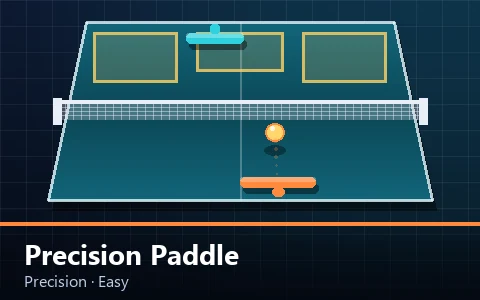
Placement, taught properly. Large zones, one called at a time, and a patient opponent while you learn the contact point.
Rings that drift across the far half while somebody keeps hitting the ball back.
Drag anywhere on the table to slide your paddle, or use the left, right and hit buttons under the game.
Target Ping Pong puts three scoring rings on the far half of the table and then makes them drift. Land a return inside one and it clears for a big score; a new ring appears a couple of seconds later somewhere else. Meanwhile the opponent is still playing the ball back, so none of this happens in your own time.
Roughly a third of the rings that spawn are the small variant, which is about sixty per cent of the standard radius and worth two hundred and fifty points instead of a hundred and fifty. Choosing between a safe large ring and a valuable small one is the decision the game keeps asking you to make.
| Action | Input |
|---|---|
| Move your paddle | ← → or A D, or drag on the table |
| Power shot (optional) | Space at the moment of contact |
| Pause / resume | P or Esc |
| Restart the run | R |
| Sound on or off | The sound button under the table |
On a touchscreen: Drag anywhere on the table to slide your paddle, or use the left, right and hit buttons under the game.
A ring counts as hit when the ball passes over it low enough to be considered a landing — within about two and a half ball radii of the surface. That is slightly more generous than requiring an exact bounce inside the circle, and deliberately so: a top-down view makes precise height judgement hard, and a rule that punished near-misses invisibly would feel unfair.
What it does not do is count a ball passing high overhead. A lob that crosses a ring at altitude scores nothing, which is why placement still beats loft.
Each ring picks an axis at random when it spawns and oscillates along it with a range of about twelve world units at a speed between 0.6 and 1.3. Some drift sideways, some up and down the table, and the two feel quite different to hit.
A sideways-drifting ring needs you to lead it, and the amount depends on your shot's flight time — which is itself a function of how hard you hit. A ring drifting up and down the table mostly changes the depth you need, which is a much subtler adjustment.
About thirty per cent of spawns are small: 4.65 world units of radius against 7.5, worth 250 against 150. The small ring is roughly forty per cent the area of the large one for sixty-seven per cent more points.
Whether that trade is worth taking depends on your combo. With a multiplier of six running, a missed small ring costs far more than the extra points would have been worth, because breaking the combo loses the multiplier on every subsequent hit too.
The ball carries a height as well as a table position, so it arcs, bounces off the surface and can clip the net. When a paddle strikes it, the engine picks a landing point and solves for the exact launch velocity that reaches it, which is why the aim marker on the table is honest. In Target Ping Pong the physics run at the site's standard values, which makes it a good reference point for the variants that change them.
The paddle is a blade that slides along your baseline. Four numbers decide how it feels: how fast it moves, how hard the ball leaves the face, how accurately a shot lands where you aimed it, and how high above the table it can still make contact. In Target Ping Pong the blade is 17 world units wide and travels at 118 units per second.
Where the ball meets the blade steers the return. A contact at the centre sends the ball straight down the table, and a contact at the edge sends it roughly 26 units off centre. Holding a direction key at the moment of contact adds a smaller correction on top.
The serve here is a single press. The ball is released toward the far half from wherever your paddle is standing, so where you stand when you serve decides the angle. Service alternates between the two ends where the game keeps a match score.
Target Ping Pong is rated Medium overall. A balanced opponent that returns most things competently and misjudges perhaps one ball in eight. Use the difficulty buttons above the table to change the opponent at any time; restarting applies the change immediately. Expert is deliberately hard rather than impossible.
No. The ball has to be low over the ring — within about two and a half ball radii of the surface — which in practice means it has to be landing there rather than passing overhead.
Roughly its own width for a sideways drift, though the exact amount depends on how fast your shot travels. Keeping a consistent shot pace makes the lead much easier to learn.
Early in a run, yes. Once your combo multiplier is above about four, no — breaking the combo costs more than the extra hundred points gains.
It disappears immediately and a replacement spawns somewhere else after about two seconds, up to a maximum of three rings on the table at once.
Moderately. Precision Paddle uses large static zones and calls one at a time; here three rings drift simultaneously and you choose which to attack.
Other games that use the same ideas, or that make a good next step from this one.
Placement, taught properly. Large zones, one called at a time, and a patient opponent while you learn the contact point.
A placement game that rewards the two deep corners above everything else — and gives you a smash button to reach them with.
A physics shooting range. Ten launches, waves of targets, blockers in the way, and all the time in the world to think.
A placement game built entirely around spin. The aim marker shows where a flat ball would land — spin is what happens instead.
Thirty original games across six categories, all free and all playable in this browser.