Target Ping Pong
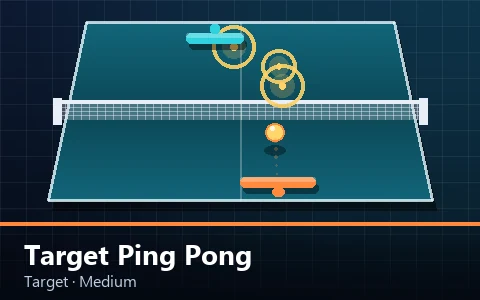
A live rally with moving scoring rings on the opponent's half. Placement under pressure, with the target refusing to stand still.
No opponent, no clock. Just an angle, a power meter and a table full of targets.
Use the aim buttons under the game to move the crosshair, then press and hold the serve button.
Paddle Cannon takes the trajectory solver that runs underneath every game on this site and exposes it as a puzzle. There is no opponent, no rally and no clock. You get ten launches, a table covered in targets, blockers standing between you and them, and as long as you like to think about the angle.
Clearing an entire wave refunds three shots, which is what makes long runs possible. Each new wave adds a row of targets, shrinks them slightly, and from wave two onward introduces blockers that stop a shot dead — moving ones from wave four.
| Action | Input |
|---|---|
| Aim left and right | ← → or A D |
| Change depth | ↑ ↓ or W S |
| Serve or launch | Space — press to release, hold to charge where a meter is shown |
| Pause / resume | P or Esc |
| Restart the run | R |
On a touchscreen: Use the aim buttons under the game to move the crosshair, then press and hold the serve button.
The solver computes the launch velocity that lands the ball exactly where the crosshair sits, at the speed you chose. Higher speed means a shorter flight, which means a flatter arc; lower speed means a longer, higher one.
That relationship is the whole puzzle. A blocker ten units high in the middle of the table can be cleared by a slow, lofted shot and cannot be cleared by a fast, flat one aimed at the same point.
Wave one has a single row of five large targets. Each subsequent wave adds rows up to a maximum of three, shrinks the radius by about 0.3 units, and raises the value of each target by twenty-five points. From wave three, some targets take two hits.
Clearing a wave pays 400 times the number of waves cleared and refunds three shots. With ten to start, a player who clears every wave can keep going indefinitely in principle — which is the intended long-run shape.
Blockers appear from wave two, up to three of them, and are ten world units high. Any ball that reaches one below that height stops immediately and the shot is over. From wave four they oscillate sideways.
They are placed between the net and the target rows, which means the usual flat shot stops working and the lofted arc becomes necessary. That progression is deliberate: the game teaches the flat shot first and then takes it away.
The ball carries a height as well as a table position, so it arcs, bounces off the surface and can clip the net. When a paddle strikes it, the engine picks a landing point and solves for the exact launch velocity that reaches it, which is why the aim marker on the table is honest. In Paddle Cannon the physics run at the site's standard values, which makes it a good reference point for the variants that change them.
The paddle is a blade that slides along your baseline. Four numbers decide how it feels: how fast it moves, how hard the ball leaves the face, how accurately a shot lands where you aimed it, and how high above the table it can still make contact. In Paddle Cannon the blade is 17 world units wide and travels at 118 units per second.
Where the ball meets the blade steers the return. A contact at the centre sends the ball straight down the table, and a contact at the edge sends it roughly 26 units off centre. Holding a direction key at the moment of contact adds a smaller correction on top.
Serving uses a hold-to-charge meter with the sweet spot short of maximum. Charging past the marked line reduces the accuracy multiplier and flattens the arc, so a full charge is always the wrong answer.
Paddle Cannon is rated Medium overall. A balanced opponent that returns most things competently and misjudges perhaps one ball in eight. Use the difficulty buttons above the table to change the opponent at any time; restarting applies the change immediately. Expert is deliberately hard rather than impossible.
No. Paddle Cannon is the only game on the site with no clock and no opponent. The only limited resource is your remaining shots.
Loft the ball over it by releasing the power meter earlier. Lower launch speed means a longer flight and a higher arc, which is the whole trick of the game.
No. Targets are knocked out by any contact while the ball is low, which means a single shot travelling through a cluster can clear several at once.
Yes, when the counter reaches zero the run ends. Clearing a full wave refunds three, so a good player can extend a run considerably.
Because in this mode the power meter is mostly controlling the shape of the arc rather than a score multiplier. Choosing the right arc matters more than hitting the marked point.
Other games that use the same ideas, or that make a good next step from this one.
A live rally with moving scoring rings on the opponent's half. Placement under pressure, with the target refusing to stand still.
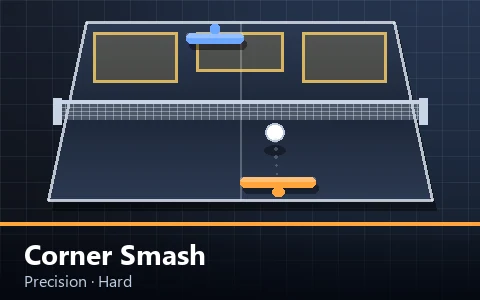
A placement game that rewards the two deep corners above everything else — and gives you a smash button to reach them with.
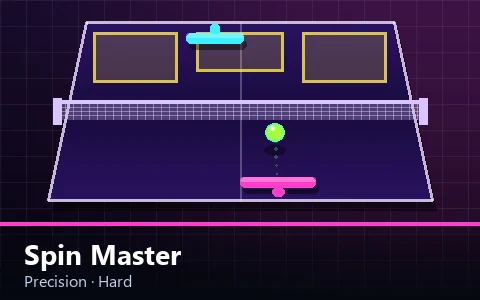
A placement game built entirely around spin. The aim marker shows where a flat ball would land — spin is what happens instead.
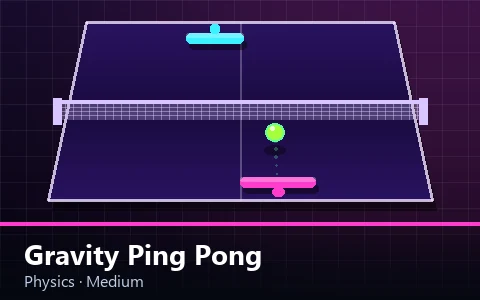
A full match with the gravity halved. The ball floats, arcs flatten, and the net becomes a much bigger problem.
Thirty original games across six categories, all free and all playable in this browser.