Precision Paddle
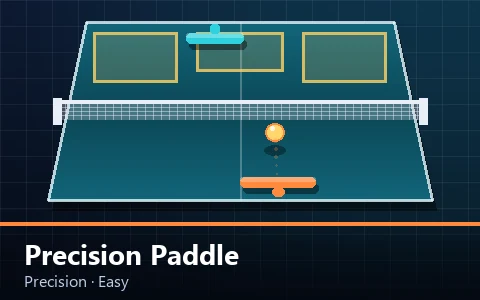
Placement, taught properly. Large zones, one called at a time, and a patient opponent while you learn the contact point.
Find the corners, then find them again while somebody is trying to stop you.
Drag anywhere on the table to move, and use the smash button under the game for a power shot.
Corner Smash is about the two hardest places to put a table tennis ball: the far left and far right corners of the opponent's half. Both are worth two hundred and sixty points, both require close to the full steering range of the blade, and both sit far enough away that the arc flattens on the way and the net becomes a genuine threat.
Unlike the other precision games, this one gives you a smash button. A smash flies flatter and faster, which is exactly what you want for reaching a corner and exactly what makes clipping the tape more likely. Deciding when that trade is worth taking is the whole game.
| Action | Input |
|---|---|
| Move your paddle | ← → or A D, or drag on the table |
| Smash | Space or Shift just before contact |
| Pause / resume | P or Esc |
| Restart the run | R |
| Sound on or off | The sound button under the table |
On a touchscreen: Drag anywhere on the table to move, and use the smash button under the game for a power shot.
The steering range here is set to thirty-two world units, the widest on the site, which means a contact right at the edge of the blade sends the ball roughly to the corner. Holding a direction key at the moment of contact adds a further twelve units.
Both inputs together give you just about the full width of the table. What they cannot do is compensate for being in the wrong place: an edge contact from the wrong side of the table sends the ball into the opposite corner, which is usually not the one that was called.
A smash multiplies shot speed by 1.5 and aims deeper than a normal return. The higher speed shortens the flight time, which flattens the arc, which is how a smash reaches the corner that an ordinary shot falls short of.
The cost is height at the net. The solver computes the launch that lands the ball where you aimed, so a faster shot necessarily crosses the net lower. Smashing a ball that is already low is the most common way to lose a life in this game.
The Hard-rated opponent covers the corners reasonably well but is slow to recover toward the middle afterwards. That creates the game's central pattern: hitting the same corner twice in a row is often worse than alternating, because the second ball arrives while the opponent is still standing there.
Alternating corners also happens to be what the game asks for, since the called zone never repeats twice in succession.
The ball carries a height as well as a table position, so it arcs, bounces off the surface and can clip the net. When a paddle strikes it, the engine picks a landing point and solves for the exact launch velocity that reaches it, which is why the aim marker on the table is honest. In Corner Smash the physics run at the site's standard values, which makes it a good reference point for the variants that change them.
The paddle is a blade that slides along your baseline. Four numbers decide how it feels: how fast it moves, how hard the ball leaves the face, how accurately a shot lands where you aimed it, and how high above the table it can still make contact. In Corner Smash the blade is 17 world units wide and travels at 118 units per second.
Where the ball meets the blade steers the return. A contact at the centre sends the ball straight down the table, and a contact at the edge sends it roughly 32 units off centre. Holding a direction key at the moment of contact adds a smaller correction on top.
The serve here is a single press. The ball is released toward the far half from wherever your paddle is standing, so where you stand when you serve decides the angle. Service alternates between the two ends where the game keeps a match score.
Corner Smash is rated Hard overall. Reads the ball quickly, covers the table well and punishes a loose return, with an error rate around seven per cent. Use the difficulty buttons above the table to change the opponent at any time; restarting applies the change immediately. Expert is deliberately hard rather than impossible.
Because a faster shot has a flatter arc. The solver aims the ball at the point you chose, and a higher speed gets there in less time, which means it crosses the net lower. Smash only balls that have bounced up high.
You mostly do not, and that is intentional. Get behind the ball first so the corner you want is on your own side of the blade, then use the edge contact. Reaching across is the hardest shot in the game.
A flat ten points for the return, the same as any other rally shot. The rally continues normally — only the bonus is lost.
Almost never. The expected value is negative once you account for how often it finds the tape. Take the ordinary shot and wait for a ball that sits up.
Precision Paddle. It uses larger zones and a gentler opponent, so you can practise the edge contacts without also managing a Hard opponent.
Other games that use the same ideas, or that make a good next step from this one.
Placement, taught properly. Large zones, one called at a time, and a patient opponent while you learn the contact point.
A placement game built entirely around spin. The aim marker shows where a flat ball would land — spin is what happens instead.
A live rally with moving scoring rings on the opponent's half. Placement under pressure, with the target refusing to stand still.
First to eleven, alone or with a friend on one keyboard. The smash is the strongest on the site and the net is the price.
Thirty original games across six categories, all free and all playable in this browser.