Featured
Spin Master
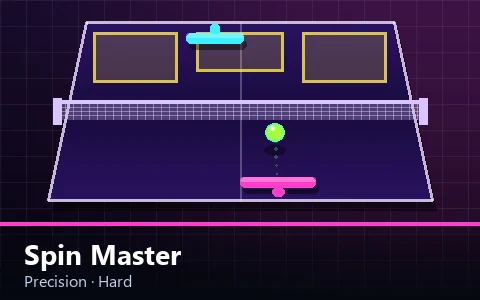
A placement game built entirely around spin. The aim marker shows where a flat ball would land — spin is what happens instead.
Precision games
Anyone can hit it hard. These games ask you to hit it exactly there.
Precision games change what a good shot is. Keeping the ball in play scores almost nothing here; putting it in a specific place scores a great deal. The result is a category where the hardest opponent is your own contact point, and where the difference between a two-hundred-point shot and a ten-point shot is about four millimetres of paddle.
The mechanic underneath all five games is the same one every other game on this site uses: where the ball meets the blade decides where it goes. Precision games simply make that rule the entire point, and then give you a reason to care about it.
A placement game built entirely around spin. The aim marker shows where a flat ball would land — spin is what happens instead.
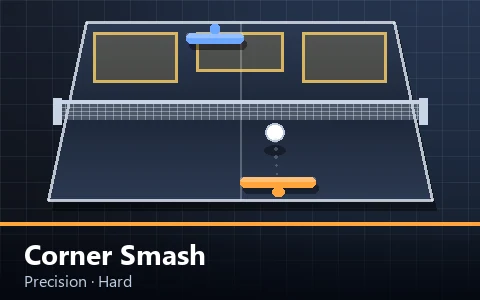
A placement game that rewards the two deep corners above everything else — and gives you a smash button to reach them with.
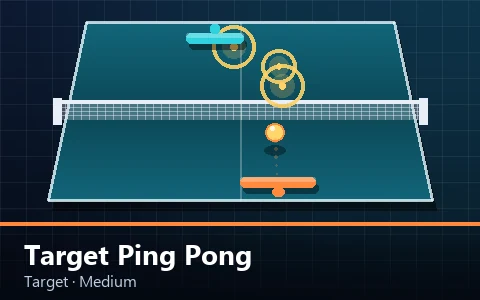
A live rally with moving scoring rings on the opponent's half. Placement under pressure, with the target refusing to stand still.
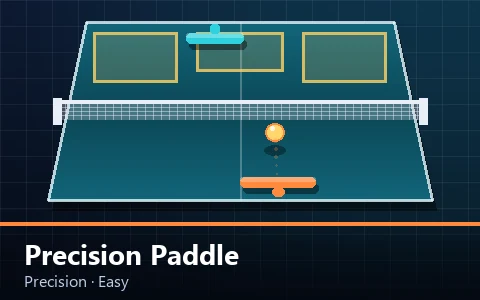
Placement, taught properly. Large zones, one called at a time, and a patient opponent while you learn the contact point.
A physics shooting range. Ten launches, waves of targets, blockers in the way, and all the time in the world to think.
When the ball touches your paddle, the game measures how far from the centre of the blade it landed, as a value between minus one and plus one. That offset is multiplied by a steering range and added to the centre of the far half to produce the landing point. Strike the ball on the left of the blade and it goes left; strike it dead centre and it goes down the middle.
Holding a direction key at the moment of contact adds a smaller second nudge, which is how you fine-tune a shot you have already set up. The two together give you roughly the full width of the table to aim at, and the reason precision games feel demanding is that both inputs happen in the same tenth of a second.
Two different scoring shapes appear in this category. Zones are rectangles that divide the far half into named areas — far left, far right, deep centre, short left, short right — and one of them is called before each exchange. Rings are circles that sit anywhere on the far half and are worth more when they are smaller.
Both are judged on the first bounce after your shot, not on where the ball ends up. That distinction matters: a ball that lands in the corner and then skids wide has still scored, and a ball that lands outside the zone and rolls into it has not.
Spin makes the ball curve in flight, which means a spun shot does not land where the aim marker says it will. That is a cost when you are trying to hit a zone and an advantage when you are trying to get around an opponent who has already read your shot.
In Spin Master the mechanic is the whole game. In Corner Smash and Precision Paddle it is a complication you can choose to take on: a still paddle puts almost no spin on the ball and lands close to the marker, while a paddle that is sliding as it strikes adds side spin proportional to its speed. Learning to stop the paddle before contact is a real and useful skill.
Paddle Cannon removes the opponent and the clock entirely. You get a fixed number of launches, a table full of targets, blockers in the way, and as long as you like to think about the angle. It is the only place on the site where the trajectory solver is fully exposed as a puzzle rather than a reflex.
It is also the fastest way to build an intuition for the arc. The same solver runs in every other game, so time spent working out how power and angle trade off here pays back directly in the rally games where you have a fraction of a second to make the same decision.
Pick one zone and hit only that zone for a whole run, even when the game calls a different one. Scores will be poor and the learning will be fast, because repeating a single contact point until it is reliable is far more useful than chasing whatever the game asks for next.
Then reverse it: alternate strictly between the two far corners on consecutive shots. That forces you to move the contact point from one edge of the blade to the other under time pressure, which is the actual skill precision games are testing.
The most recently published precision games, newest first.
A physics shooting range. Ten launches, waves of targets, blockers in the way, and all the time in the world to think.
Placement, taught properly. Large zones, one called at a time, and a patient opponent while you learn the contact point.
A live rally with moving scoring rings on the opponent's half. Placement under pressure, with the target refusing to stand still.
A goal, a clock, and a very clear reason you did not clear it.
5 games
The whole game happens in the first half second.
5 games
Four rounds, four opponents, one bracket. Lose once and it is over.
5 games
Usually the opposite. A faster shot has a flatter arc, which raises the risk of clipping the net, and it gives spin less time to pull it back on line. Controlled speed into the correct contact point beats power almost everywhere in this category.
Side spin. The aim marker shows where a flat ball would land, and spin curves the flight after launch. Stop the paddle moving before contact to take spin off the shot, or aim slightly into the curve to use it.
Yes. Zones and rings are judged on the first bounce after your shot. Where the ball travels afterwards has no effect on the score.
Yes. A dashed landing marker appears on the table once the ball is on its way down, which is the same information the opponent AI uses to move. It is drawn from the live physics, not from a prediction that ignores spin.
Precision Paddle. The zones are large, the opponent is patient, and the game calls one zone at a time so you always know what you are aiming at. Corner Smash and Spin Master both assume you already have the contact-point habit.
Try a random game from this category's parent library, or browse everything with filters.