Reflex Rally
A pure reaction test. Every ball is fired away from where you are standing, and the game tells you how quickly you moved.
Reflex games
The whole game happens in the first half second.
Reflex games compress table tennis down to its shortest moment: the gap between the ball leaving the far paddle and arriving at yours. There is no rally to settle into and no rhythm to find, because every ball starts from scratch and every one of them is trying to be somewhere you are not.
Reaction is a genuinely trainable skill, and these games are honest about measuring it. Reflex Rally shows you your own start time in milliseconds after every return — the gap between the ball being released and your paddle beginning to move. That number is yours, produced on your device, and it is never compared to anyone else's.
A pure reaction test. Every ball is fired away from where you are standing, and the game tells you how quickly you moved.
The most accessible game on the site. Position is handled for you — the entire game is the moment you press.
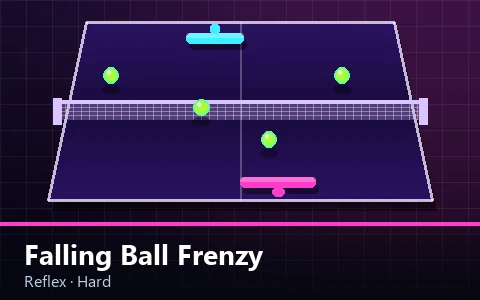
No opponent — a rebound wall instead. Balls keep joining until you cannot cover them all.
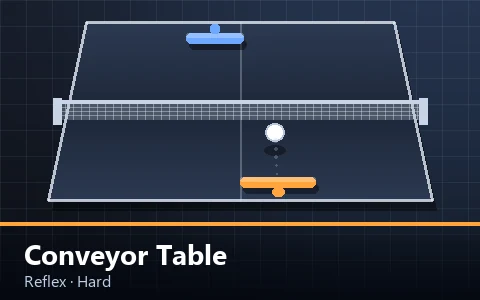
A rally game where the playing surface drifts. Four bands push in alternating directions and the pattern never settles.
The timing game with a narrower window and a faster ball. Same single input, considerably less room for error.
There are two separate things people call reaction time in a game like this, and they respond to practice differently. The first is simple reaction: how long it takes you to start moving once something changes. The second is choice reaction: how long it takes you to work out which way to move and then commit.
Reflex Rally measures the second one, which is the harder and more useful of the two, because the ball is deliberately fired away from wherever your paddle currently is. The reported figure is the interval between the ball being released and your paddle's first movement, so it includes your decision as well as your reaction.
Reflex Rally is the pure version: one ball at a time, fired wide, getting steadily faster, three lives. One-Tap Ping Pong removes movement entirely and leaves only timing — the paddle tracks the ball for you and the single button is the whole game. Falling Ball Frenzy replaces speed with quantity, putting up to six balls on the table at once. Conveyor Table keeps the ball count low but makes the surface itself push the ball sideways while it travels.
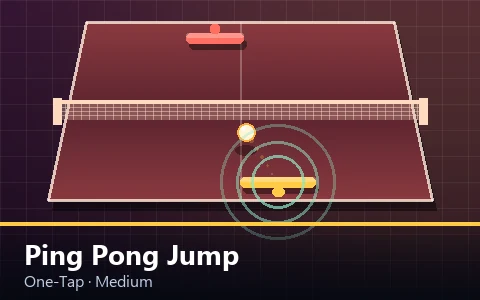
Ping Pong Jump sits between them, using a timing window that moves rather than a ball that moves, which trains the same skill from a different angle.
One-Tap Ping Pong is the most accessible game on the site, and that is by design rather than by accident. It needs exactly one input, works identically with a key, a tap, a mouse click or a switch, and never requires two things at once. The shrinking ring around the paddle gives the timing cue visually, so sound is optional rather than necessary.
The same principles apply across the category as far as the mechanics allow. Every game can be paused, none of them requires a drag gesture, and reduced motion is respected so the particle effects thin out for anyone who has asked their system for less animation.
The largest single improvement most players make is not in their reaction at all — it is in where they are looking. Watching the far paddle rather than the ball gives you roughly a tenth of a second of advance warning, because the paddle's position tells you which half of the table the ball is going to before the ball exists.
The second improvement is refusing to move before you have read the direction. A guess that is wrong costs you the full width of the table, while a start that is fifty milliseconds later but correct almost always gets there. In choice reaction, accuracy beats speed more often than people expect.
The millisecond figures these games report are measured from the browser's own high-resolution clock and include the whole chain: the frame in which the ball was released, your reaction, your input device and the frame in which the game noticed. They are useful for comparing your own runs against each other on the same device.
They are not a clinical measurement and should not be read as one. A different screen refresh rate, a different input device or a busy machine will all move the number, which is exactly why nothing on this site compares your figure to anybody else's.
The most recently published reflex games, newest first.
The timing game with a narrower window and a faster ball. Same single input, considerably less room for error.
A rally game where the playing surface drifts. Four bands push in alternating directions and the pattern never settles.
No opponent — a rebound wall instead. Balls keep joining until you cannot cover them all.
Keep the ball alive. The longer the rally, the more it is worth.
5 games
Anyone can hit it hard. These games ask you to hit it exactly there.
5 games
A goal, a clock, and a very clear reason you did not clear it.
5 games
Most players settle somewhere between 250 and 400 milliseconds for a choice reaction of this kind, and improve by thirty to fifty milliseconds over a few sessions before flattening out. Treat your own first session as the baseline — that is the only comparison the games are designed to support.
It climbs from the starting speed with every successful return and then stops at a ceiling. The ceiling is set so that a good player can keep going indefinitely on concentration rather than on pure reaction speed.
They are different rather than harder. Dragging the paddle with a thumb is more direct than pressing keys, which helps, but a smaller screen means less physical distance to read the ball's direction. One-Tap Ping Pong plays identically on both.
Choice reaction is naturally variable, and it gets worse when the ball is fired close to where you are already standing — because you have to decide whether to move at all. The quickest recorded starts in a run are usually the widest balls.
Practice reliably improves performance at the specific task you practise. Whether that carries over to unrelated activities is not something this site can claim, and we have not tested it, so we do not.
Try a random game from this category's parent library, or browse everything with filters.