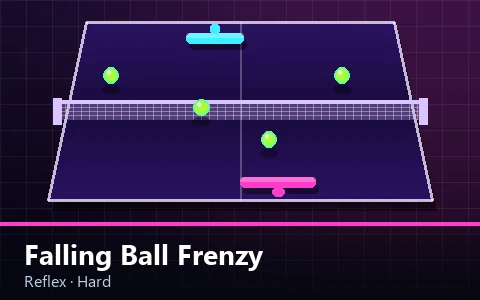
Falling Ball Frenzy
No opponent — a rebound wall instead. Balls keep joining until you cannot cover them all.
The table itself pushes the ball sideways, and the direction keeps changing.
Drag anywhere on the table to slide your paddle, or use the left, right and hit buttons under the game.
Conveyor Table divides the playing surface into four bands that push the ball sideways in alternating directions, and then makes the strength of that push oscillate over time. Nothing you hit travels in a straight line, and the amount it bends changes depending on which part of the table it crosses and when.
Unlike the spin games, this is not something you control. The drift is a property of the table rather than of your shot, which makes the mode a reading exercise: the arrows drawn on each band show which way it is pushing, and the only way to place a ball is to account for the bands it will cross on the way.
| Action | Input |
|---|---|
| Move your paddle | ← → or A D, or drag on the table |
| Power shot (optional) | Space at the moment of contact |
| Pause / resume | P or Esc |
| Restart the run | R |
| Sound on or off | The sound button under the table |
On a touchscreen: Drag anywhere on the table to slide your paddle, or use the left, right and hit buttons under the game.
The table is split into four equal horizontal bands. Even-numbered bands push right, odd-numbered ones push left, and the strength of each is modulated by a sine wave that runs at 0.85 cycles per second with a per-band phase offset.
The push is applied as a sideways acceleration on the ball for as long as it is over that band. A ball crossing the whole table therefore passes through four alternating pushes, and the net effect depends entirely on the timing of the crossing.
Each band draws a row of arrows that drift in the direction it is currently pushing, at a speed proportional to the push. When a band is between phases and pushing gently, the arrows barely move.
That is the information the game gives you, and it is complete: what you see on the band is what will happen to the ball. Learning to glance at the band nearest your target rather than at the whole table is the main skill.
Most rally games cap the tempo multiplier at around 2.0. Here it is 1.7, because the drift already supplies a large amount of the difficulty and stacking a full speed ramp on top would make long rallies a coin flip rather than a skill.
The tempo step is also gentler than usual. The intent is a game that stays readable while remaining genuinely hard, rather than one that simply becomes too fast to track.
The ball carries a height as well as a table position, so it arcs, bounces off the surface and can clip the net. When a paddle strikes it, the engine picks a landing point and solves for the exact launch velocity that reaches it, which is why the aim marker on the table is honest. In Conveyor Table, the table surface itself pushes the ball sideways in alternating bands.
The paddle is a blade that slides along your baseline. Four numbers decide how it feels: how fast it moves, how hard the ball leaves the face, how accurately a shot lands where you aimed it, and how high above the table it can still make contact. In Conveyor Table the blade is 17 world units wide and travels at 140 units per second.
Where the ball meets the blade steers the return. A contact at the centre sends the ball straight down the table, and a contact at the edge sends it roughly 26 units off centre. Holding a direction key at the moment of contact adds a smaller correction on top.
The serve here is a single press. The ball is released toward the far half from wherever your paddle is standing, so where you stand when you serve decides the angle. Service alternates between the two ends where the game keeps a match score.
Conveyor Table is rated Hard overall. Reads the ball quickly, covers the table well and punishes a loose return, with an error rate around seven per cent. Use the difficulty buttons above the table to change the opponent at any time; restarting applies the change immediately. Expert is deliberately hard rather than impossible.
Yes, identically. The push is a property of the table and applies to the ball regardless of who hit it, so the opponent's shots bend exactly as much as yours do.
No. Unlike spin, this is not something you generate — it is something the table does. Your only control is choosing a line that accounts for it.
Because the pushes on either side of the centre tend to oppose each other, so a ball crossing near the middle experiences less net drift than one going wide.
It is the hardest to be accurate in. Falling Ball Frenzy is harder to survive; Conveyor Table is harder to place a ball in.
Fifteen is a solid result, which is roughly half what the same player might manage in Rally Master. The drift makes every return a fresh calculation.
Other games that use the same ideas, or that make a good next step from this one.
No opponent — a rebound wall instead. Balls keep joining until you cannot cover them all.
A pure reaction test. Every ball is fired away from where you are standing, and the game tells you how quickly you moved.
A placement game built entirely around spin. The aim marker shows where a flat ball would land — spin is what happens instead.
The rally game with the pace turned up. A narrower table means the ball comes back before you have finished the last shot.
Thirty original games across six categories, all free and all playable in this browser.