Reflex Rally
A pure reaction test. Every ball is fired away from where you are standing, and the game tells you how quickly you moved.
Up to six balls at once, and a wall at the far end that never misses.
Drag anywhere on the table to slide your paddle, or use the left, right and hit buttons under the game.
Falling Ball Frenzy replaces the opponent with a wall. The far end of the table returns everything, aimed at a random point on your half, so the ball count only ever goes up. You start with two and a new one joins every eleven seconds until there are six.
It is the busiest game on the site, which makes it the one where the fixed timestep matters most. The physics run at a constant 120 steps per second regardless of how many balls are on the table, so a slow phone gets exactly the same difficulty curve as a fast desktop.
| Action | Input |
|---|---|
| Move your paddle | ← → or A D, or drag on the table |
| Power shot (optional) | Space at the moment of contact |
| Pause / resume | P or Esc |
| Restart the run | R |
| Sound on or off | The sound button under the table |
On a touchscreen: Drag anywhere on the table to slide your paddle, or use the left, right and hit buttons under the game.
The far end is a solid wall rather than a paddle. Any ball that reaches it is immediately relaunched toward a random point on your half, between fourteen units past the net and twelve units short of your paddle line.
Its speed starts at 130 and rises by 1.6 for every return you make, so the game accelerates with your own success in the same way the rally games do — it just does it across every ball at once.
Unlike every other game on the site, the left and right edges of the table are solid here. A ball that reaches them bounces back in rather than going out. Only your own baseline is open.
That changes the geometry considerably. A ball can cross the table two or three times before it reaches you, which makes tracking several at once genuinely difficult, and it means there is no such thing as a ball that is safely out of play.
With six balls on the table you cannot cover everything, so the game becomes a triage problem: which ball is closest to your baseline, and can you reach it before it crosses?
The answer is almost always the lowest ball on the screen, not the fastest one. Chasing the fast ball across the table and losing two slow ones behind it is the most common way a run ends.
The ball carries a height as well as a table position, so it arcs, bounces off the surface and can clip the net. When a paddle strikes it, the engine picks a landing point and solves for the exact launch velocity that reaches it, which is why the aim marker on the table is honest. In Falling Ball Frenzy the physics run at the site's standard values, which makes it a good reference point for the variants that change them.
The paddle is a blade that slides along your baseline. Four numbers decide how it feels: how fast it moves, how hard the ball leaves the face, how accurately a shot lands where you aimed it, and how high above the table it can still make contact. In Falling Ball Frenzy the blade is 18 world units wide and travels at 146 units per second.
Where the ball meets the blade steers the return. A contact at the centre sends the ball straight down the table, and a contact at the edge sends it roughly 26 units off centre. Holding a direction key at the moment of contact adds a smaller correction on top.
There is no serve in this game. Play begins immediately and the far end keeps the ball supply coming, so there is never a pause to set up.
Falling Ball Frenzy is rated Hard overall. Reads the ball quickly, covers the table well and punishes a loose return, with an error rate around seven per cent. Use the difficulty buttons above the table to change the opponent at any time; restarting applies the change immediately. Expert is deliberately hard rather than impossible.
No. The far end is a wall that returns every ball automatically, so the ball count never falls except when you lose one past your own baseline.
Six. A new ball joins every eleven seconds until that limit, and the limit is not raised later in a run.
The one closest to your baseline, almost always. Speed is less important than proximity, because proximity is what decides which ball costs a life next.
It should not. The simulation runs at a fixed 120 steps per second and the particle system is pooled, so frame time stays essentially flat regardless of ball count.
You cannot — a new ball is spawned immediately if the table would otherwise be empty. The run ends when the third life is gone, not when the balls run out.
Other games that use the same ideas, or that make a good next step from this one.
A pure reaction test. Every ball is fired away from where you are standing, and the game tells you how quickly you moved.
A rally game where the playing surface drifts. Four bands push in alternating directions and the pattern never settles.
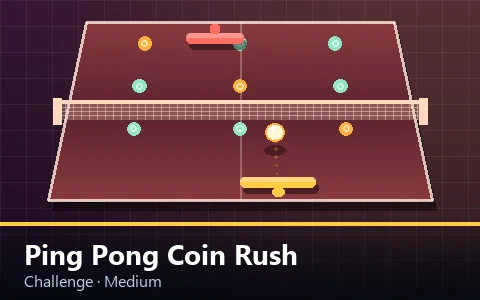
Tokens sit across the table and the ball sweeps them up as it flies. The route matters as much as where it lands.
The most accessible game on the site. Position is handled for you — the entire game is the moment you press.
Thirty original games across six categories, all free and all playable in this browser.