 Alex Morgan

Why the serve gets its own system
Everything else in a ping pong game is reactive. The ball arrives, you respond, and the quality of your response is bounded by how much time you had. The serve is the one moment where none of that applies: the ball is stationary, nobody is applying pressure, and you can take as long as you like.
That makes it the natural place to put a skill mechanic that would be unfair anywhere else. A timing meter during a rally would be frustrating; a timing meter on a serve is a fair test, because you chose when to start it.
It also matters competitively. In a first-to-eleven match you serve on roughly half the points, so a serve that reliably produces a weak return is worth more than any single improvement to your rally play.
The five serve styles
Games on this site use one of five serve implementations, chosen to fit the game rather than for variety's sake.
| Style | Input | What it tests | Used by |
|---|---|---|---|
| Instant | One press | Nothing — it gets play started | Most rally and match games |
| Timed | Stop a sweeping needle | Timing under no pressure | Serve Challenge |
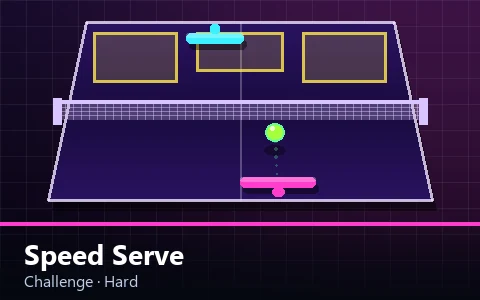
| Power | Hold to charge, release | Restraint | Speed Serve, Paddle Cannon |
| Aimed | Move a crosshair, then release | Spatial judgement | Deliberate placement games |
| Target | Aim at a specific scoring zone | Accuracy against a stated goal | Serving challenges |
The instant serve is the most common and the least interesting, deliberately. In a rally game the serve is not the point, so it takes one press and the ball goes roughly where your paddle was standing. Making it more elaborate would put a skill check in front of the thing the player actually came to do.
How the timing meter works
A needle sweeps back and forth across a bar at a fixed rate — 1.25 full sweeps per second in Serve Challenge. A highlighted band marks the sweet spot, positioned at seventy-eight per cent of the bar's travel rather than in the middle or at the end.
Stopping the needle inside the band produces a good serve; stopping it within about a third of the band's width of dead centre produces a perfect one. The result is a quality value that multiplies the score of whichever zone you land in, ranging from about 0.6 for a loose release to 1.25 for a perfect one.
The sweet spot's position is the interesting design choice. Putting it at the end would mean holding for maximum is always correct, which is not a decision. Putting it off centre means you have to learn where it is and stop deliberately, which is.
How the charge meter works
The power style replaces the sweeping needle with a meter that fills while you hold the button. In Speed Serve it fills at 1.7 units per second, so a full charge takes about six tenths of a second, and the sweet spot line sits at seventy-two per cent — roughly four tenths of a second in.
Past the line, the fill turns red and an over-charge penalty applies. The accuracy multiplier falls by about 2.2 times the amount of over-charge, bottoming out at 0.35. A fully charged serve into a deep corner therefore scores less than a correctly charged one into the middle.
There is a second, subtler cost. Because the shot solver aims at a chosen landing point, a higher launch speed reaches it in less time, which flattens the arc and lowers the crossing height at the net. Over-charging does not only score less — it is more likely to find the tape.
Editor’s note
If you take one rule from this guide: the maximum-power serve is the worst serve in the game, in every serving mode on this site. That is deliberate, and it is the whole reason the meter exists.
Aiming a serve
In every style except instant, the left and right keys move a crosshair across the far half, and up and down change how deep it sits. The marker shows where a flat ball would land — honest, because the same solver that draws it is the one that launches the ball.
Aim speed varies by game. Serve Challenge moves the crosshair at forty world units per second, which is deliberate enough to place precisely. Speed Serve moves it at fifty-two, which is faster to set up and much easier to overshoot — that is the pressure version of the same mechanic.
The most common mistake is trying to aim and watch the meter simultaneously. Set the aim first, then look at the meter. Splitting attention between the two is why most first runs land in the middle of the table with mediocre timing.
Service zones and what they are worth
Serving games divide the far half into value zones. The pattern is consistent across the site and the values reflect genuine difficulty rather than arbitrary weighting.
| Zone | Value | Why | Risk |
|---|---|---|---|
| Deep left / right corner | 300 | Longest flight, hardest to reach | Net or long |
| Deep centre | 200 | Full depth without the sideline risk | Long |
| Short left / right | 150 | Easy to reach, sits close to the net | Low |
| On the table, outside a zone | 50 | Landed but unplaced | None |
| Net, short or long | 0 | Fault — breaks the combo too | — |
Reading that table as a beginner, the deep centre is the target worth learning first. A perfectly timed serve there scores 250; a badly timed one into a corner scores about 180. Timing is worth more than ambition until the timing is reliable.
In a real rally the short zones would hand an opponent an easy attacking ball, which is why they score less despite being easier. The values encode that trade even in the modes where no opponent is present.
The combo, and why serving runs reward consistency
Landed serves build the combo multiplier exactly as returns do, capping at eight. A fault — net, short or long — breaks it completely.
This is why a run of twelve consecutive landed serves is worth far more than double a run of six. The multiplier compounds across the run, so the last serves in a clean session are worth several times the first.
It also changes the correct risk profile as a run progresses. Early on, attempting a corner is cheap: you have little multiplier to lose. Late in a clean run, a greedy corner attempt at serve fourteen can cost more than the previous four serves earned.
Serving in a match
In the match games, service alternates every two points — shown by a small dot beside the on-canvas scoreboard — and the serve itself is the instant style, aimed by where your paddle is standing.
That last detail is easy to miss and worth using. The instant serve targets the far half from wherever the server is positioned, so standing wide before you press serve produces a wide serve. Moving to the corner you want to serve to is the entire aiming mechanism in a match.
A deep serve to the corner is the most reliable way to force a weak return from the AI at any difficulty, because it moves the opponent out of position before the rally has started. Against the Expert rating, where a neutral rally rarely produces an attackable ball, it is frequently the only way you will get one.
How to practise serving
Serving is the easiest thing on this site to improve deliberately, because Serve Challenge isolates it completely. There is no opponent, no rally to keep alive and no clock — twelve attempts, immediate feedback on each, and about ninety seconds per run.
A useful practice pattern is to spend one run ignoring the score entirely and aiming every serve at the same zone, watching where each one actually lands relative to the marker. Then spend a run doing nothing but the meter, releasing at the same point every time regardless of aim.
Separating the two skills is far more effective than attempting both at once, which is the same principle that makes Precision Paddle reduce spin while it teaches placement. Once each is reliable on its own, combining them takes very little time.
Key takeaways
- The serve is the only uncontested moment in a rally, which is why it carries a skill mechanic that would be unfair elsewhere.
- Five styles exist; instant serves get play started, and timed, power, aimed and target serves test a specific skill.
- Both meters place their sweet spot short of maximum, so full power is always the wrong answer.
- Over-charging costs accuracy and flattens the arc, which raises the chance of clipping the net.
- Deep corners score 300 and short zones 150, reflecting genuine difficulty rather than arbitrary weighting.
- In a match, the instant serve fires from wherever your paddle stands — so move to the corner you want before serving.
Frequently asked questions
Why is the maximum-power serve bad?
Two reasons. The accuracy multiplier drops sharply past the meter's sweet spot, and the extra speed flattens the arc so the ball crosses the net lower. It scores less and faults more often.
Where should I aim my serves as a beginner?
The deep centre zone. It is worth 200 rather than the corners' 300, but it has no sideline risk, and a perfectly timed serve there outscores a badly timed corner attempt.
How do I aim in games with an instant serve?
By where you stand. The instant serve fires from your paddle's position toward the far half, so moving wide before you press serve produces a wide serve.
What counts as a fault?
Clipping the net, landing on your own half, or landing beyond the far baseline or outside the sidelines. All three score nothing and break your combo multiplier.
Does a serve keep its combo if it lands outside a zone?
Yes. Landing anywhere on the far half scores at least 50 points and counts as a success, so the combo survives. Only a fault breaks it.
Which game is best for practising serves?
Serve Challenge. It removes the opponent, the rally and the clock, giving twelve attempts with immediate feedback in about ninety seconds — by far the fastest feedback loop on the site.