 Alex Morgan

The structure
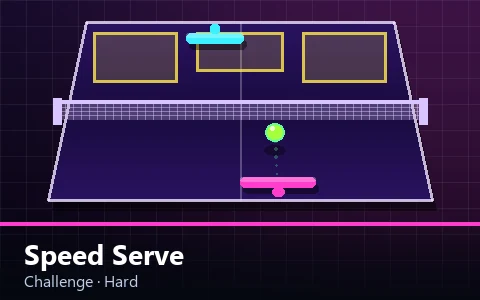
A serving challenge removes the opponent and the rally. What remains is a fixed number of attempts, a set of scoring zones on the far half, and a meter that decides how much power goes into each ball.
Serve Challenge gives twelve attempts with a sweeping timing needle. Speed Serve gives eighteen with a hold-to-charge meter and faster aim movement. Both report a session accuracy percentage at the end.
The short attempt count is deliberate. Twelve serves takes about ninety seconds, which means a full run of deliberate practice fits into a gap rather than needing a session.
Zone values
The far half is divided into five rectangles whose values reflect genuine difficulty.
| Zone | Value | Why it is worth that |
|---|---|---|
| Deep left / right corner | 300 | Longest flight; risks both the net and the baseline |
| Deep centre | 200 | Full depth without sideline risk |
| Short left / right | 150 | Easy to reach but would give an opponent an attacking ball |
| On the table, no zone | 50 | Landed but unplaced |
| Fault | 0 | Net, short or long — also breaks the combo |
The short zones score less despite being easier because in a real rally they would hand the opponent a short, high ball. The values encode that trade even in a mode where no opponent exists.
The quality multiplier
Your zone score is multiplied by how well you released the meter, from about 0.6 for a loose release to 1.25 for a perfect one.
That range is wide enough to matter more than zone selection for a new player. A perfectly released serve into the deep centre scores 250; a badly released one into a corner scores about 180. Timing beats ambition until the timing is reliable.
On the charge meter there is an additional penalty. Charging past the sweet spot reduces the multiplier by roughly 2.2 times the over-charge, bottoming out at 0.35 — which is why a full charge is always the worst serve available.
Why combos matter more here
Landed serves build the combo exactly as returns do, capping at eight, and a fault breaks it completely.
In a rally game the combo is a useful extra on top of banked rally bonuses. In a serving game it is the dominant term, because every serve's score is individually multiplied and there is nothing else contributing.
The practical consequence is that a clean run of twelve is worth far more than double a run of six, and that a greedy corner attempt late in a clean run can cost more than the previous four serves earned.
What counts as a fault
Three things score nothing and break the combo: clipping the net, landing on your own half, and landing beyond the far baseline or outside the sidelines.
Net faults come from too much speed, because the shot solver flattens the trajectory as speed rises. If you are finding the tape repeatedly, release the meter earlier rather than aiming differently.
Long faults come from aiming too deep for the speed chosen. Aim shallower rather than reducing power, because depth and power are separate controls here.
How to practise
Split the two skills rather than attempting both at once. This is the same principle that makes Precision Paddle reduce spin while it teaches placement.
Spend one run aiming only: release the meter at the same point every time regardless of where the needle is, and concentrate entirely on where the ball lands relative to the crosshair.
Spend the next run timing only: leave the aim in the middle and concentrate on the meter, ideally by counting a beat rather than watching it so your eyes stay free.
Then combine them. Most players find the combined run is immediately better than their previous best, because the interference between the two tasks was most of the problem.
Key takeaways
- A serving challenge is a fixed number of attempts with no opponent and no rally.
- Deep corners score 300 and short zones 150, reflecting the ball each would give an opponent.
- The quality multiplier ranges from 0.6 to 1.25, so timing beats zone choice while you are learning.
- The combo is the dominant scoring term here, so consistency beats ambition.
- Net faults mean too much speed; long faults mean too much depth for the speed chosen.
Frequently asked questions
How many serves do I get?
Twelve in Serve Challenge and eighteen in Speed Serve. Both report a session accuracy percentage when the run ends.
Is a corner always the best target?
No. A perfectly timed serve into the deep centre scores 250 against about 180 for a badly timed corner, so timing is worth more than ambition until it is reliable.
Why does my serve keep hitting the net?
Too much power. A faster serve reaches its landing point in less time, which flattens the arc and lowers the crossing height at the net. Release the meter earlier.
Does landing outside a zone break my combo?
No. Landing anywhere on the far half scores at least 50 and counts as a success. Only a fault — net, short or long — breaks the combo.