Speed Serve
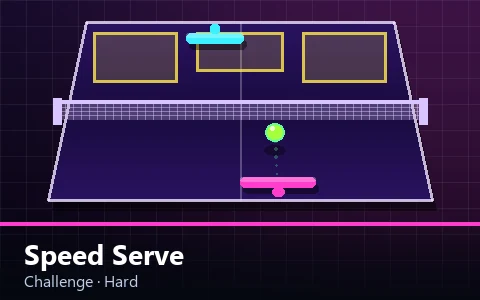
Serving practice with the clock running. A charge meter replaces the timing bar, and overcharging costs you accuracy.
Twelve serves, five zones, and nobody on the other side of the table.
Use the aim buttons under the game to move the crosshair, then press and hold the serve button.
Serve Challenge removes everything except the serve. There is no opponent, no rally and no clock — just twelve attempts, five scoring zones on the far half of the table, and a sweeping timing meter that decides how much power goes into each ball.
It is the most useful practice game on the site precisely because it is so narrow. Every attempt gives you a landing point, a zone name and a score in about a second and a half, which is a far faster feedback loop than you get in any game where you also have to survive a rally.
| Action | Input |
|---|---|
| Aim left and right | ← → or A D |
| Change depth | ↑ ↓ or W S |
| Serve or launch | Space — press to release, hold to charge where a meter is shown |
| Pause / resume | P or Esc |
| Restart the run | R |
On a touchscreen: Use the aim buttons under the game to move the crosshair, then press and hold the serve button.
The far half is divided into five rectangles. The two deep corners are worth three hundred points each and are the hardest to reach, because the flight needed to get there is long enough that the arc flattens and the net becomes a real risk. The deep centre is worth two hundred and is the safest of the deep targets.
The two short zones are worth a hundred and fifty each. They are much easier to hit but sit close to the net, which in a real rally would give an opponent an easy attacking ball — the lower score reflects that.
The highlighted band on the meter sits at seventy-eight per cent of its travel, not at the end. A release inside the band multiplies your zone score by up to 1.25; a release well outside it drops the multiplier to around 0.6.
This is the single most important rule in the game and the reason maximum power is never the correct answer. A perfectly timed serve into the deep centre outscores a badly timed one into a corner.
The serve is scored on its first bounce. If that bounce is on the far half and inside a zone, you get the zone's value multiplied by your timing quality. If it is on the far half but outside every zone, you get a flat fifty points for landing it. If it clips the net, lands short or sails long, you get nothing and the combo breaks.
Consecutive landed serves build a combo multiplier that caps at eight, so a run of accurate serves is worth considerably more than the same serves scattered among misses.
The ball carries a height as well as a table position, so it arcs, bounces off the surface and can clip the net. When a paddle strikes it, the engine picks a landing point and solves for the exact launch velocity that reaches it, which is why the aim marker on the table is honest. In Serve Challenge the physics run at the site's standard values, which makes it a good reference point for the variants that change them.
The paddle is a blade that slides along your baseline. Four numbers decide how it feels: how fast it moves, how hard the ball leaves the face, how accurately a shot lands where you aimed it, and how high above the table it can still make contact. In Serve Challenge the blade is 17 world units wide and travels at 118 units per second.
Where the ball meets the blade steers the return. A contact at the centre sends the ball straight down the table, and a contact at the edge sends it roughly 26 units off centre. Holding a direction key at the moment of contact adds a smaller correction on top.
Serving uses a sweeping timing needle. A highlighted band marks the sweet spot, and stopping the needle inside it multiplies the value of whichever zone you land in. Aim is set separately with left and right before you release.
Serve Challenge is rated Easy overall. A patient opponent with a slow paddle, a three-tenths-of-a-second reaction delay and roughly a one-in-four chance of misjudging a ball. Use the difficulty buttons above the table to change the opponent at any time; restarting applies the change immediately. Expert is deliberately hard rather than impossible.
No. The far half of the table is empty by design, so nothing happens after the ball lands. The whole game is the twelve serves and where they finish.
Not while you are learning. A perfectly timed serve into the deep centre scores 250 while a badly timed one into a corner scores about 180, so timing is worth more than ambition until the timing is reliable.
Clipping the net, landing on your own half, or landing beyond the far baseline or outside the side lines. All three score nothing and break the combo.
Because the timing multiplier ranges from about 0.6 to 1.25. Two serves that land in the same corner can differ by more than a hundred points purely on where the needle stopped.
Speed Serve, which adds a countdown timer to the same mechanic, or Ping Pong Challenge, whose ladder includes serving under pressure from an opponent.
Other games that use the same ideas, or that make a good next step from this one.
Serving practice with the clock running. A charge meter replaces the timing bar, and overcharging costs you accuracy.
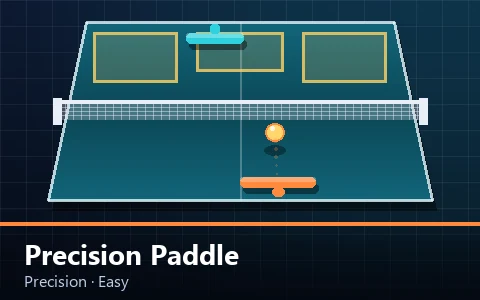
Placement, taught properly. Large zones, one called at a time, and a patient opponent while you learn the contact point.
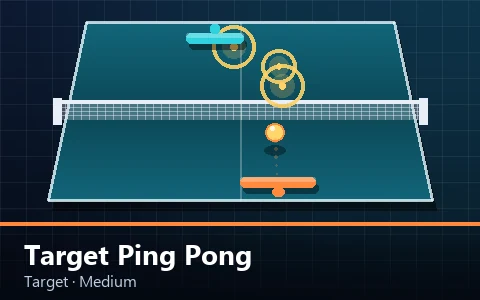
A live rally with moving scoring rings on the opponent's half. Placement under pressure, with the target refusing to stand still.
A ladder of eight arcade challenges that introduces rallying, placement, survival and pressure in that order.
Thirty original games across six categories, all free and all playable in this browser.