 Alex Morgan
The two windows you are working with
Pressing the button arms a swing for 170 milliseconds in One-Tap Ping Pong. If the ball reaches the blade during that window, it is returned. Within the first 110 milliseconds, it is perfect.
So there are two targets: a generous one that keeps the rally going and a tighter one inside it that scores. Missing the perfect window costs points; missing the outer window costs the point.
Ping Pong Jump uses the same structure with both windows cut by roughly a third — 120 and 70 milliseconds. That is the same skill under considerably less margin.
Watch the ring, not the ball
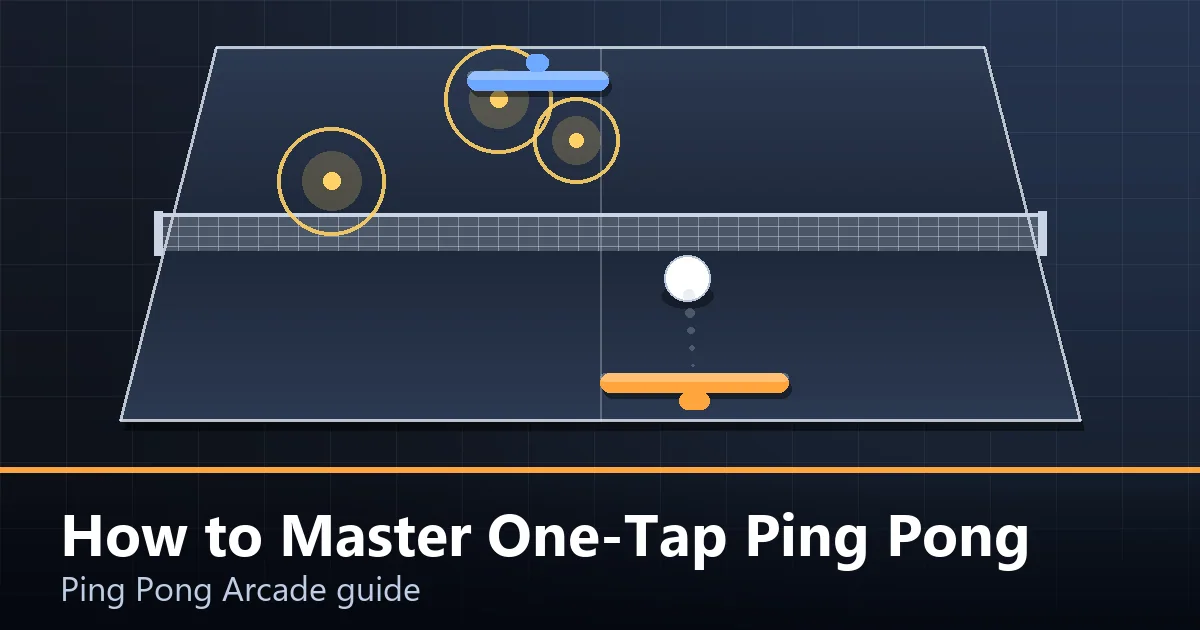
A circle is drawn around your paddle whose radius shrinks in proportion to how long the ball has left before arriving. When the ring reaches the blade, the ball is there.
It is drawn from the live physics prediction rather than from a fixed animation, which means it stays accurate as the rally tempo speeds the ball up. That is precisely what an internal rhythm cannot do.
Watching the ball feels natural and is worse, because the ball is somewhere other than the contact point for almost all of its flight. The ring is centred on the contact point by definition.
You are pressing early
Nearly every player who is missing is missing early, typically by about eighty milliseconds. The cause is that 'the ring is nearly there' triggers the press before 'the ring is there' does.
The correction feels wrong: wait until the ring has visibly touched the blade, not until it is about to. Players who deliberately force themselves to feel slightly late usually discover they have become accurate.
In the last fourteen per cent of the approach the ring changes colour, marking the perfect window. If you are pressing before the colour changes, you are early.
Do not hold the button
The swing arms on the press and lasts a fixed duration regardless of whether you keep the button down. Holding it does nothing mechanically.
What it does do is make your next press harder to judge, because you lose the rhythm of releasing and re-pressing. Players who hold tend to press the next one late.
Tap and release. On touch, lift the thumb between presses rather than resting it on the button.
Build streaks, but not at the cost of the rally
A perfect hit is worth 150 points plus 25 for each consecutive perfect before it. A streak of eight is therefore worth considerably more than eight isolated perfects.
An ordinary return does not break the streak — it simply does not extend it. Only losing the point resets it to zero.
That means there is never a reason to attempt a risky press. If you are unsure, press at the safe moment: you keep the rally, you keep the streak, and you get another opportunity on the next return.
Expect the drift
The rally tempo raises the ball's speed by about two per cent per return, so by return twenty it is arriving noticeably sooner than it did at the start.
The ring compensates automatically, which is the whole argument for watching it. But if you have been relying on rhythm — and most players do at first — your timing will start arriving late somewhere around return fifteen.
The interim fix while you build the ring habit is to consciously press a fraction earlier from about return fifteen onward. The permanent fix is to stop using rhythm.
Practise in the right order
One-Tap Ping Pong before Ping Pong Jump, always. The cue is identical and the wider window is where the habit forms.
Within One-Tap Ping Pong, spend the first run watching only the ring and accepting a poor score, the second pressing only when the ring has touched the blade, and the third chasing a perfect streak.
Then move to Ping Pong Jump, where the paddle's tracking is deliberately slower so the contact point varies. That adds a feedback loop on top of the timing, which is the next skill rather than the same one.
Key takeaways
- The return window is 170 milliseconds with a 110-millisecond perfect window inside it.
- The ring is drawn from live physics, so it tracks the ball's changing speed automatically.
- Nearly all misses are early, typically by about eighty milliseconds.
- Holding the button does nothing and makes your next press harder to judge.
- An ordinary return never breaks a streak, so there is never a reason to risk a press.
Frequently asked questions
How wide is the perfect window?
110 milliseconds in One-Tap Ping Pong and 70 in Ping Pong Jump, inside return windows of 170 and 120 respectively.
Why do I keep missing early?
Because 'the ring is nearly there' triggers the press before 'the ring is there' does. Wait until the ring has visibly touched the blade — it will feel late and it will be accurate.
Does holding the button extend the window?
No. The swing arms on the press and lasts a fixed duration. Holding only makes your next press harder to time.
Does a missed perfect break my streak?
No. An ordinary return neither extends nor breaks it; only losing the point resets it to zero.