 Alex Morgan

The honest disclaimer first
Real table tennis spin is a genuinely difficult physical problem. A hollow celluloid ball rotating at thousands of revolutions per minute interacts with the air around it through the Magnus effect, deforms on contact with the rubber, and behaves differently depending on the surface it strikes and the humidity of the room.
The model in these games does none of that. It keeps three effects a player can actually see on a screen and implements each as a single acceleration. That is a gameplay rule, not a measurement, and nothing in this guide should be read as a description of the real sport.
What it is, is learnable in about two minutes and expressive enough to reward years of play — which is the correct trade for an arcade game.
The three kinds of spin
Each type acts on a different axis and produces a different, recognisable shape.
Side spin — the curve
Side spin applies a constant sideways acceleration for as long as it lasts. Because it is an acceleration rather than a one-off deflection, the ball's path is a curve that bends more and more as it travels.
The practical consequence is that drift grows with the square of the flight time. A slow, high shot curves dramatically over the length of the table; a fast, flat one barely deviates at all. If you want a big bend, take pace off the shot rather than adding paddle speed.
Top spin — the dip and kick
Top spin presses the ball downward, adding to gravity. The ball dips into the table sooner than its launch would suggest, which lets you hit harder without the shot sailing long.
It also changes the bounce: a top-spun ball kicks forward off the table rather than continuing at the same pace, which shortens the time your opponent has after the bounce. That is a meaningful advantage against a Hard or Expert opponent, whose reaction delay is already short.
Back spin — the float and check
Back spin is top spin's negative: it works against gravity, floating the ball so it stays up longer and travels further for a given launch. After the bounce it checks, sitting up rather than running on.
In these games back spin mostly arrives from the opposite direction — it is what the chop-defender opponents put on their returns. A ball that floats toward you and then sits up after the bounce needs lifting rather than driving, and attacking it flat is the most common way to find the net against that style.
Where spin comes from
You do not select spin from a menu. It is generated by how you hit the ball, from two sources added together.
The larger source, about seventy per cent of the total, is the paddle's sliding speed at the moment of contact. A blade travelling at full pace across the table puts on close to the maximum side spin the game allows; a stationary blade puts on almost none.
The smaller source, about thirty per cent, is the contact point itself. Striking the ball toward the edge of the blade imparts a little spin in that direction on top of the direction change the contact point already produces.
Top spin comes from a third input: how loaded the shot was. An ordinary return carries about 0.25 of the available top spin, while a smash carries up to 0.9.
Editor’s note
Because paddle movement dominates, spin on this site is something you do rather than something that happens to you. Stopping the blade a fraction before contact is a genuine technique, and it is the first thing to learn in any placement game.
The numbers
For anyone who wants the specifics, these are the site-standard values, and the games that change them.
| Parameter | Standard | What it does |
|---|---|---|
| Spin curve | 34 | Sideways acceleration per unit of side spin |
| Spin dip | 46 | Extra downward pull per unit of top spin |
| Spin decay | 0.55 | Fraction of spin bled off per second |
| Paddle spin scale | 1.0 | Multiplier on spin generated by contact |
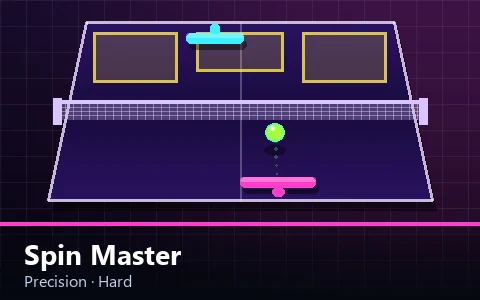
Spin Master raises the curve coefficient to 52, slows decay to 0.42 so spin persists further into the flight, and nearly doubles the paddle's spin scale to 1.9. The result is a game where a shot aimed straight at a corner lands in the middle unless you account for the bend.
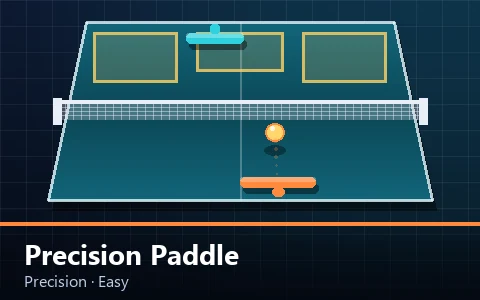
Precision Paddle goes the other way, cutting the paddle scale to 0.55. That is pedagogical: learning contact point and paddle speed simultaneously is how people conclude that placement is random. Remove one and the other becomes obvious.
Ping Pong Arcade Ultimate sits at 1.3 throughout — enough that the flagship game uses the mechanic meaningfully without becoming a spin game.
Reading spin on an incoming ball
A small meter appears at the top right of the table whenever the live ball carries meaningful spin. The horizontal needle shows side spin and which way it is curving; the pip above the bar sits high for top spin and low for back spin.
The ball itself also shows it. A short arc is drawn on the leading edge of a spinning ball, on the side the spin is pulling toward. It is subtle at low spin values and unmissable at high ones.
The most useful habit against a spun incoming ball is to intercept it earlier than feels natural. Curve grows with flight time, so meeting the ball closer to the net means it has had less distance to deviate — and the amount you have to compensate by is correspondingly smaller.
Using spin deliberately
There are three situations where putting spin on the ball is clearly correct, and one where it is clearly not.
- Against an opponent who has already read your shot — a curve gets around a paddle that is in the right place for a straight ball
- When you want depth without length — top spin dips the ball, so you can hit harder without sailing long
- When you want to reach an angle wider than the steering range allows — a curved ball finishes wider than a straight one aimed at the same point
- When you are trying to hit a called zone or a ring — here spin is purely a cost, because it pulls the ball off the marker
That last case is worth dwelling on, because it is where most players lose points without understanding why. In a precision game, an ambitious shot played with a moving paddle misses the zone by a distance that looks arbitrary. It is not arbitrary — it is the drift, and it is proportional to how fast the blade was travelling.
Countering spin
The engine includes a simple counter-spin rule: returning into heavy spin without matching it reduces the accuracy of your own shot, while matching it costs much less. Matched, the control penalty is at most a few per cent; unmatched, it can reach nearly sixty per cent against the heaviest spin in the game.
In practice, 'matching' means playing the shot the spin wants rather than fighting it. Against a ball curving to your right, aiming slightly right and letting the curve carry it rather than trying to force it back left produces a far more accurate result.
Against back spin — the floating, checking ball that the chop-defender opponents produce — the counter is to lift rather than drive. A flat drive into back spin is the single most common way to find the net against that style.
A practice routine
Spin repays deliberate practice more than any other mechanic here, and the routine is short.
Start in Precision Paddle, where spin is halved. Hit twenty shots with the paddle deliberately stopped before contact and watch how close they land to the marker. That is your baseline: the straight ball.
Then hit twenty with the paddle deliberately moving at full speed through contact, and watch the size of the drift. You now know what the full range looks like.
Then move to Spin Master, where the coefficient is nearly double, and repeat both. The difference between those four sets is the entire mechanic, and about ten minutes of attention makes it permanent.
Key takeaways
- The arcade spin model keeps three readable effects and implements each as a single acceleration — it is not a simulation.
- Side spin curves the flight, and the drift grows with the square of the flight time, so slow shots bend far more than fast ones.
- Top spin dips the ball and kicks it forward off the bounce; back spin floats it and checks it.
- About seventy per cent of spin comes from the paddle's sliding speed at contact, which makes steadying the blade a real technique.
- Spin is a weapon in rally and match games and a pure cost in precision games, where it pulls the ball off the aim marker.
- Against a spun incoming ball, intercept earlier — the curve has had less time to develop near the net.
Frequently asked questions
Is this how spin works in real table tennis?
No. Real spin involves the Magnus effect on a rotating hollow ball, contact deformation and surface friction. This model keeps three readable effects as simple accelerations. It is a gameplay rule, not physics.
How do I stop my shots curving?
Stop the paddle moving before it touches the ball. Blade speed at contact is about seventy per cent of the side spin generated, so a stationary paddle produces a nearly straight shot.
Why does my slow shot curve more than my fast one?
Because side spin is a constant sideways acceleration, and displacement under constant acceleration grows with the square of time. A slower shot is in the air longer, so it accumulates far more drift.
How do I beat an opponent who uses heavy back spin?
Lift the ball rather than driving it. A back-spun ball floats toward you and checks after the bounce; a flat drive into it is the most common way to find the net against that style.
Which game teaches spin best?
Precision Paddle first, where spin is halved so you can learn contact point in isolation, then Spin Master, where the coefficient is nearly doubled and the curve is the entire game.
Can I see how much spin is on the ball?
Yes. A meter appears at the top right whenever the live ball carries meaningful spin — the needle shows side spin, the pip above shows top or back spin — and a short arc is drawn on the ball's leading edge.