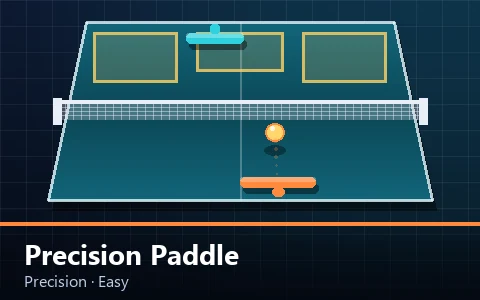
Precision Paddle
Placement, taught properly. Large zones, one called at a time, and a patient opponent while you learn the contact point.
Learn to bend the ball, then learn to aim where it will actually land.
Drag anywhere on the table to slide your paddle, or use the left, right and hit buttons under the game.
Spin Master turns the site's spin model from a complication into the main mechanic. The spin coefficient is raised by about half, the decay is slowed so spin persists further into the flight, and the paddle puts nearly twice as much of it on the ball as it does anywhere else. The result is a game where a shot aimed straight at the left corner lands in the middle unless you account for the curve.
The mode underneath is placement: one zone is called before each exchange and you score heavily for landing there. What makes it hard is that the aim marker tells you where a flat ball would land, and almost none of your balls are flat.
| Action | Input |
|---|---|
| Move your paddle | ← → or A D, or drag on the table |
| Power shot (optional) | Space at the moment of contact |
| Pause / resume | P or Esc |
| Restart the run | R |
| Sound on or off | The sound button under the table |
On a touchscreen: Drag anywhere on the table to slide your paddle, or use the left, right and hit buttons under the game.
Side spin comes from two sources added together. The larger is the paddle's own sliding speed at the moment of contact, scaled so a paddle at full travel produces roughly seventy per cent of the maximum. The smaller is the contact point itself, which contributes about thirty per cent.
Because the paddle's movement dominates, spin here is something you do rather than something that happens to you. Stopping the blade before impact is a genuine technique, and it is the first thing to learn.
Side spin applies a constant sideways acceleration for as long as it lasts, so the ball's path is a curve rather than a line. The drift grows with the square of the flight time, which means a slow, high shot curves far more than a fast, flat one over the same distance.
Top spin works on the vertical axis instead: it presses the ball down so it dips into the table sooner and kicks forward off the bounce. Back spin does the reverse, floating the ball and checking it after it lands.
A small meter appears at the top right of the table whenever the live ball carries meaningful spin. The horizontal needle shows side spin and which way it is curving; the pip above it shows top spin when it is high and back spin when it is low.
It is worth watching on incoming balls as well as outgoing ones. The opponent at the Hard rating puts real spin on its returns, and a ball that is curving toward you needs a different intercept point than a straight one.
The ball carries a height as well as a table position, so it arcs, bounces off the surface and can clip the net. When a paddle strikes it, the engine picks a landing point and solves for the exact launch velocity that reaches it, which is why the aim marker on the table is honest. In Spin Master, the spin curve coefficient is 52 against the standard 34, which changes how sharply a spun ball bends.
The paddle is a blade that slides along your baseline. Four numbers decide how it feels: how fast it moves, how hard the ball leaves the face, how accurately a shot lands where you aimed it, and how high above the table it can still make contact. In Spin Master the blade is 17 world units wide and travels at 118 units per second.
Where the ball meets the blade steers the return. A contact at the centre sends the ball straight down the table, and a contact at the edge sends it roughly 30 units off centre. Holding a direction key at the moment of contact adds a smaller correction on top.
The serve here is a single press. The ball is released toward the far half from wherever your paddle is standing, so where you stand when you serve decides the angle. Service alternates between the two ends where the game keeps a match score.
Spin Master is rated Hard overall. Reads the ball quickly, covers the table well and punishes a loose return, with an error rate around seven per cent. Use the difficulty buttons above the table to change the opponent at any time; restarting applies the change immediately. Expert is deliberately hard rather than impossible.
No. This is an arcade model designed to be readable on a screen and learnable in a few minutes. Real spin involves the ball's deformation and the air around it, and nothing here should be taken as a description of the sport's physics.
Stop the paddle moving before it touches the ball. Paddle speed at the moment of contact is the largest source of side spin, so a stationary blade produces a nearly straight shot.
It does not lie — it shows where a flat ball would land, which is the honest baseline. Spin is applied after launch and curves the ball away from that point. Learning the size of the drift is the game.
Both, deliberately. It costs accuracy against a called zone and it gains you angles that a straight ball cannot reach. Against the Hard opponent, a spun ball is much harder to read.
Yes, if placement is new to you. Precision Paddle uses the same zone system with standard spin, which lets you learn the contact-point rule before adding curve to it.
Other games that use the same ideas, or that make a good next step from this one.
Placement, taught properly. Large zones, one called at a time, and a patient opponent while you learn the contact point.
A placement game that rewards the two deep corners above everything else — and gives you a smash button to reach them with.
A live rally with moving scoring rings on the opponent's half. Placement under pressure, with the target refusing to stand still.
A physics shooting range. Ten launches, waves of targets, blockers in the way, and all the time in the world to think.
Thirty original games across six categories, all free and all playable in this browser.