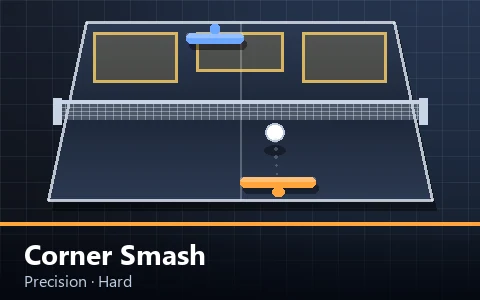
Corner Smash
A placement game that rewards the two deep corners above everything else — and gives you a smash button to reach them with.
The game that teaches the one rule every other game here depends on.
Drag anywhere on the table to slide your paddle, or use the left, right and hit buttons under the game.
Precision Paddle is the teaching game. Every other game on this site uses the same rule — where the ball meets the blade decides where it goes — and this is the one built to make that rule obvious. The zones are large, only one is called at a time, the opponent is rated Easy, and spin is dialled down to roughly half strength so shots go very close to where you aimed them.
Four lives rather than three give you room to experiment. The intention is that you spend a run deliberately trying contacts at different points on the blade and watching where the ball ends up, rather than trying to score.
| Action | Input |
|---|---|
| Move your paddle | ← → or A D, or drag on the table |
| Power shot (optional) | Space at the moment of contact |
| Pause / resume | P or Esc |
| Restart the run | R |
| Sound on or off | The sound button under the table |
On a touchscreen: Drag anywhere on the table to slide your paddle, or use the left, right and hit buttons under the game.
When the ball touches the blade, the game measures how far from the centre it landed as a value between minus one and plus one. That value is multiplied by the steering range — twenty-seven world units here — and added to the centre of the far half. The result is the landing point.
So a contact exactly at the right-hand edge sends the ball twenty-seven units right of centre, which on a seventy-six-unit-wide table puts it close to the right sideline. A contact dead centre sends it straight down the middle.
Holding a direction key at the moment of contact adds up to twelve further units in that direction. It is a smaller effect than the contact point and it exists as a correction rather than as a primary aim.
Most players discover it by accident and then over-use it. The contact point should do about seventy per cent of the aiming; the held direction should tidy up the rest.
Spin is scaled to 0.55 here against 1.0 elsewhere and 1.9 in Spin Master. That means a moving paddle still puts some curve on the ball but not enough to significantly miss a zone this large.
The reason is pedagogical. Learning two variables at once — contact point and paddle speed — is how people conclude that placement is random. Take one away and the other becomes obvious within a few minutes.
The ball carries a height as well as a table position, so it arcs, bounces off the surface and can clip the net. When a paddle strikes it, the engine picks a landing point and solves for the exact launch velocity that reaches it, which is why the aim marker on the table is honest. In Precision Paddle the physics run at the site's standard values, which makes it a good reference point for the variants that change them.
The paddle is a blade that slides along your baseline. Four numbers decide how it feels: how fast it moves, how hard the ball leaves the face, how accurately a shot lands where you aimed it, and how high above the table it can still make contact. In Precision Paddle the blade is 17 world units wide and travels at 118 units per second.
Where the ball meets the blade steers the return. A contact at the centre sends the ball straight down the table, and a contact at the edge sends it roughly 27 units off centre. Holding a direction key at the moment of contact adds a smaller correction on top.
The serve here is a single press. The ball is released toward the far half from wherever your paddle is standing, so where you stand when you serve decides the angle. Service alternates between the two ends where the game keeps a match score.
Precision Paddle is rated Easy overall. A patient opponent with a slow paddle, a three-tenths-of-a-second reaction delay and roughly a one-in-four chance of misjudging a ball. Use the difficulty buttons above the table to change the opponent at any time; restarting applies the change immediately. Expert is deliberately hard rather than impossible.
Yes. It is built to teach the contact-point rule with the fewest possible complications: big zones, a patient opponent, reduced spin and an extra life.
Spin is reduced here but not removed. A paddle moving quickly at the moment of contact still puts some side spin on the ball. Stopping the blade before impact removes almost all of it.
It adds up to twelve world units of aim, against twenty-seven from the contact point. Treat it as a correction rather than as the main aim.
Short zones are worth 170 and the deep left and right zones are worth 200. The short ones are easier to reach; the difference reflects that.
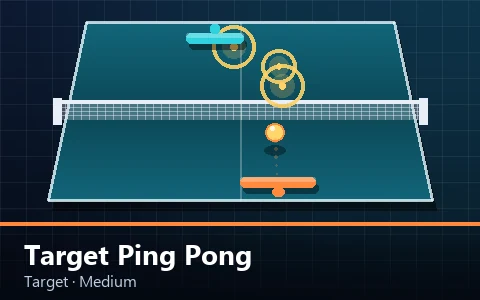
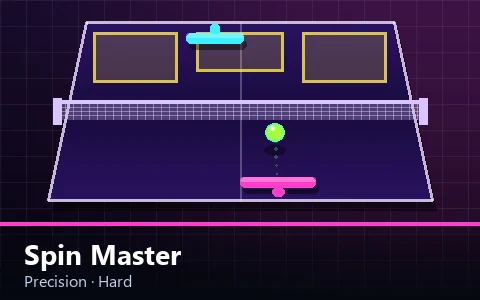
Corner Smash for tighter targets and a smash button, Target Ping Pong for moving rings, or Spin Master when you want to add curve to the mix.
Other games that use the same ideas, or that make a good next step from this one.
A placement game that rewards the two deep corners above everything else — and gives you a smash button to reach them with.
A live rally with moving scoring rings on the opponent's half. Placement under pressure, with the target refusing to stand still.
A placement game built entirely around spin. The aim marker shows where a flat ball would land — spin is what happens instead.
A serving range with no opponent and no rally. Aim, time the meter, and find out exactly where the ball landed.
Thirty original games across six categories, all free and all playable in this browser.