 Alex Morgan
What removing movement leaves behind
In an ordinary ping pong game there are two skills happening at once: getting the paddle to the right place, and hitting the ball at the right moment. They interfere with each other. A player who misses does not always know which one failed.
A one-tap game removes the first entirely. The paddle tracks the ball across the table on its own, and your only input is a single button. If you miss, it was the timing — there is nothing else it could have been.
That isolation is what makes the format good for learning as well as good for accessibility. The same timing skill is buried inside every other game here, and practising it without the positioning problem on top is much faster.
The two windows
Pressing the button arms a swing for a fixed period. If the ball reaches the blade during that period, it is returned. Inside a narrower window at the start of the arm, the return counts as perfect and scores several times as much.
| Game | Return window | Perfect window | Perfect window at 60fps |
|---|---|---|---|
| One-Tap Ping Pong | 170 ms | 110 ms | about 7 frames |
| Ping Pong Jump | 120 ms | 70 ms | about 4 frames |
Two windows rather than one is the key design choice. A single tight window would make the game a pass-fail timing test, which is punishing. A generous outer window that keeps the rally alive, with a tight inner one that scores, means a player who is approximately right keeps playing while a player who is precisely right is rewarded.
It also gives the format a natural difficulty axis. Ping Pong Jump is the same game with both windows cut by roughly a third, which is enough to make it a genuinely different challenge without changing a single mechanic.
The closing ring
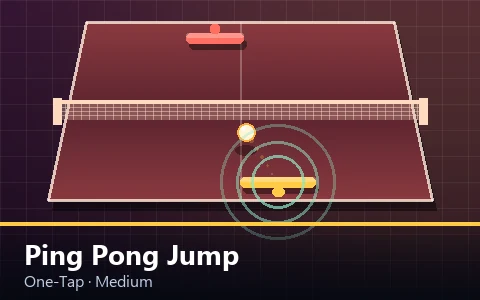
The timing cue is a circle drawn around the paddle whose radius shrinks in proportion to how long the ball has left before it arrives. When the ring reaches the blade, the ball is there.
It is drawn from the live physics prediction rather than from a fixed animation, which matters more than it sounds. As the rally tempo raises the ball's speed, the ring closes proportionally faster and stays accurate. A pre-baked animation would drift out of sync within ten returns.
In the last fourteen per cent of the approach the ring changes colour, marking the perfect window. That is the cue to press — not when the ring 'looks close', which is where most early misses come from. Typical early presses are about eighty milliseconds ahead of the window.
The cue is entirely visual because the game has to work with sound turned off. Nothing in either one-tap game depends on hearing anything.
Editor’s note
Watch the ring, not the ball. The ring is the information; the ball is just what the ring is about. Players who switch their attention to the ring typically improve immediately.
Why this is the most accessible format
One-Tap Ping Pong is the game on this site that the largest number of people can play, and that is a design goal rather than a side effect.
- It needs exactly one input, and never two at the same time
- Every input method is equivalent — a key, a tap, a mouse click, or a switch
- There is no drag gesture, no hold, and no chord
- The only timing cue is visual, so it works with sound off
- It can be paused at any moment from the keyboard, the button bar or the touch pad
- Reduced motion is respected, so the particle effects thin out substantially
Designing for one input is not a compromise. It removes the possibility of the most common accessibility failure in browser games, which is a control scheme that assumes two hands, fine motor control and simultaneous actions.
It also happens to make the game excellent on a phone, where one thumb and one large button is a far better fit than a drag gesture on a small screen.
Why the paddle still varies
The automatic tracking is not perfect, and the difference between the two games is instructive.
One-Tap Ping Pong tracks at 330 world units per second, which is fast enough to centre the blade on essentially any ball. The contact point is therefore consistent, your returns go to predictable places, and the game is purely rhythmic.
Ping Pong Jump tracks at 235, deliberately below what is needed to centre on a wide shot. The blade often arrives slightly off, which means the contact point varies, which means your return goes somewhere different, which means the next ball comes back from somewhere different.
That single number turns a rhythm game into something with a feedback loop. It is the clearest example on the site of how one parameter can change what a game is about without changing what you do.
Streaks and scoring
A perfect hit is worth 150 points plus 25 for each consecutive perfect before it, so a streak of eight is worth substantially more than eight isolated perfects.
An ordinary return neither extends nor breaks the streak — it simply keeps the rally going. Only losing a point resets it to zero.
That asymmetry produces the correct risk profile without needing a rule. There is never a reason to attempt a risky press, because an ordinary return costs you nothing except the streak's growth, while a miss costs the streak entirely.
Alongside the streak, the standard rally scoring applies, so keeping the ball alive is worth points regardless of how well you timed the hits.
Why your timing drifts late
Almost every player experiences the same thing: timing is comfortable for the first ten or fifteen returns and then starts arriving late.
The cause is the rally tempo. The ball accelerates by roughly two per cent per return like everywhere else on the site, so by return twenty it is arriving noticeably sooner than it did at the start. Your internal rhythm, built during the early returns, is now wrong.
The ring compensates automatically — it closes faster — which is precisely why watching it rather than relying on rhythm is the technique. Players who press on the ring do not experience the drift; players who press on feel do.
In Ping Pong Jump the tempo step is steeper at 2.6 per cent and the window is narrower, so the drift arrives sooner and punishes harder. Consciously pressing a fraction earlier from return fifteen onward is a real technique there.
The one-tap format beyond ping pong
One-button games have a long history in arcade design, and the reason is the same everywhere: a single input has no learning curve, so all of the difficulty can live in the timing rather than in the controls.
What table tennis adds is a natural reason for the button to exist. In many one-button games the press is abstract — it makes something jump, or flap, or fire. Here it is a paddle hitting a ball, which is a thing the player already understands, so the game needs no explanation at all.
It also gives the format a built-in difficulty ramp that does not need inventing. The rally tempo already exists in every other game here, and applying it to a one-button game produces escalation for free.
How to get better at it
One-tap timing improves quickly with attention and slowly without it, and the difference is mostly about what you are looking at.
- Watch the ring's edge rather than its centre. At these window widths, that difference is most of your margin.
- Press when the ring touches the blade, not when it looks close. Early presses are typically eighty milliseconds ahead.
- Do not hold the button. The swing arms on the press and lasts a fixed time, so holding does nothing and makes the next press harder to judge.
- Do not chase perfects early. An ordinary return keeps the rally going, and rally length is a large part of the score.
- From return fifteen onward, consciously press a fraction earlier. The tempo has moved and your rhythm has not.
- Play One-Tap Ping Pong before Ping Pong Jump. The cue is identical and the wider window is where the habit forms.
Key takeaways
- Removing movement leaves timing alone, which makes a miss diagnosable and the format highly accessible.
- Two windows — a generous one that returns the ball and a tight one that scores — keeps approximate players in the rally.
- The closing ring is drawn from live physics, so it stays accurate as the ball speeds up.
- One input, no simultaneous actions and a purely visual cue make this the most accessible game on the site.
- Ping Pong Jump's slower paddle tracking turns a rhythm game into one with a feedback loop.
- Timing drifting late is the rally tempo, not fatigue — watch the ring rather than relying on rhythm.
Frequently asked questions
Do I really not control the paddle?
Correct. It tracks the ball automatically — at 330 world units per second in One-Tap Ping Pong and 235 in Ping Pong Jump. The timing of your press is the entire game.
How wide is the perfect window?
About 110 milliseconds in One-Tap Ping Pong and 70 in Ping Pong Jump, inside return windows of 170 and 120 respectively. At sixty frames a second that is roughly seven frames and four frames.
Can I play with one hand or a single switch?
Yes. The game needs exactly one input and never two at once, and every input method is equivalent. It was built specifically to be playable that way.
Does holding the button down help?
No. The swing arms on the press and lasts a fixed time regardless. Holding it makes your next press harder to judge because you lose the rhythm of releasing.
Why does my timing get worse as the rally goes on?
The rally tempo speeds the ball up by about two per cent per return, so it arrives sooner than your rhythm expects. The ring compensates automatically, which is why watching it rather than relying on feel is the fix.
Which should I play first?
One-Tap Ping Pong. Ping Pong Jump uses an identical cue with both windows cut by roughly a third, and building the habit at the wider window transfers directly.