 Alex Morgan

Isolate before you integrate
Practising timing inside a full game does not work well, because a missed shot could have been a timing failure, a positioning failure or a spin misjudgement, and you cannot tell which.
One-Tap Ping Pong exists for this reason. The paddle tracks the ball automatically, so position is removed entirely and a miss can only have been the timing.
Start there, get the habit right, and then take it into the games that need it. Doing it in the other order is how people conclude their timing is simply bad.
Fix the early press first
Nearly every player who is missing is missing early, typically by about eighty milliseconds. It is by far the most common timing error and it has one cause.
'The cue is nearly there' triggers the press before 'the cue is there' does. The anticipation is automatic and it is consistently ahead.
The correction feels wrong: deliberately wait until the cue has visibly arrived. Players who force themselves to feel slightly late almost always discover they have become accurate.
Switch from rhythm to cue
The second habit to build is timing from something you can see rather than from an internal sense of pace.
Rhythm works for about fifteen returns and then fails, because the rally tempo raises the ball's speed by roughly two per cent per return. By return twenty the ball arrives noticeably sooner than your rhythm expects.
The closing ring in the one-tap games is drawn from the live physics prediction, so it tracks the changing speed automatically. Players who press on the ring never experience the drift; players who press on feel always do.
The routine
About twenty minutes, and most players see a measurable improvement in their perfect count by the end of it.
- One run of One-Tap Ping Pong watching only the ring and ignoring the ball entirely. Expect a poor score.
- One run with a single rule: press only when the ring has visibly touched the blade, never before.
- One run chasing a perfect streak rather than a long rally, to make the narrow window familiar.
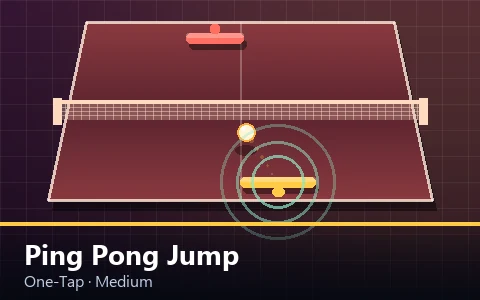
- One run of Ping Pong Jump, where both windows are cut by a third, repeating rule two.
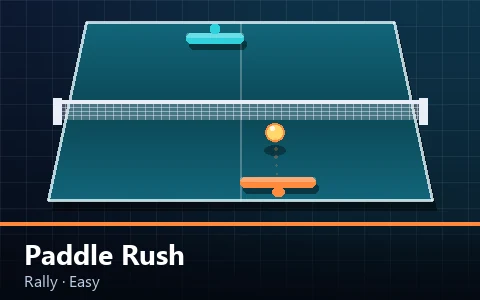
- One run of Paddle Rush pressing the action button on every single return, ignoring the score.
- One run of Serve Challenge timing the meter by counting a beat rather than watching it.
Measuring progress
Score is a poor measure of timing improvement, because it mixes timing with everything else. Better measures exist.
In the one-tap games, the perfect count and the longest streak are displayed separately from the score. Those are direct measures: a run with a lower score and a higher perfect count is a better timing run.
In the serving games, the session accuracy percentage isolates the meter and the aim together. Running one set aiming only and one timing only, as described in the serving guide, separates even those.
The serve meter is the exception
Almost all timing advice on this site says to use a visual cue rather than rhythm. The serve meters are the one place where the opposite is true.
A meter moves at a constant rate that does not ramp — 1.25 sweeps per second in Serve Challenge, 1.7 units per second of fill in Speed Serve. Because the speed never changes, an internal count is reliable.
Counting rather than watching frees your eyes for the aim marker, which is where they are more useful. Four tenths of a second, the Speed Serve sweet spot, is a comfortable beat to internalise.
Realistic expectations
Timing improves quickly at first and then slowly. Most players see a clear jump within two or three focused sessions, almost entirely from fixing the early press and switching to a cue.
Beyond that, improvement is about consistency rather than average. The difference between a good one-tap player and a very good one is not their mean press time — it is how little that time varies from press to press.
As with everything on this site, that is a claim about these games. Whether practising a timing window in a browser game affects timing anywhere else is untested here and therefore unclaimed.
Key takeaways
- Isolate timing in a one-tap game first, because there a miss can only have been the timing.
- The most common error is pressing about eighty milliseconds early; deliberately feel late.
- Rhythm fails after about fifteen returns because the tempo ramp changes the ball's speed.
- Measure with the perfect count and streak rather than with score, which mixes in everything else.
- The serve meters are the one place where counting a beat beats watching a cue.
Frequently asked questions
Which game should I practise timing in?
One-Tap Ping Pong. It removes positioning entirely, so a miss can only have been the timing, which makes the feedback unambiguous.
Why am I always early?
Because anticipation is automatic and 'the cue is nearly there' fires before 'the cue is there'. Deliberately waiting until it has visibly arrived will feel late and be accurate.
How do I know if I am improving?
Use the perfect count and longest streak rather than the score. A run with a lower score and a higher perfect count is a better timing run.
Should I count or watch?
Watch, everywhere except the serve meters. Meters move at a constant rate so a count is reliable, whereas a rally's pace ramps and only a live cue keeps up.