Ping Pong Challenge
A ladder of eight arcade challenges that introduces rallying, placement, survival and pressure in that order.
Challenges games
A goal, a clock, and a very clear reason you did not clear it.
Challenge games ask a question with a right answer. Land eight serves in the deep corners. Hit five rings before the clock runs out. Reach a rally of twenty-five without losing a life. Every game in this category sets an explicit goal, tells you how far off you are while you play, and ends with a number you can try to beat.
That structure suits short sessions better than anything else on the site. A rally game can run for ten minutes; a challenge stage is usually over in forty seconds, which makes this the category people come back to most often on a phone.
A ladder of eight arcade challenges that introduces rallying, placement, survival and pressure in that order.
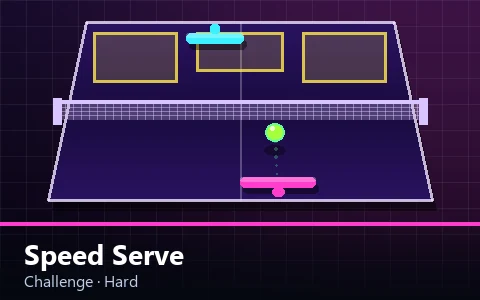
A serving range with no opponent and no rally. Aim, time the meter, and find out exactly where the ball landed.
Serving practice with the clock running. A charge meter replaces the timing bar, and overcharging costs you accuracy.
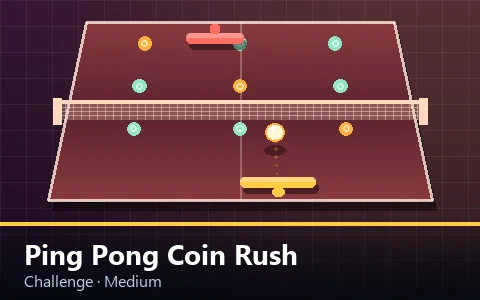
Tokens sit across the table and the ball sweeps them up as it flies. The route matters as much as where it lands.
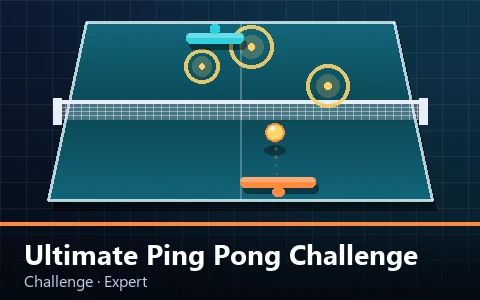
The long one. Ten stages of mixed goals at rising difficulty, built for players who have already cleared the other challenge games.
Challenge goals come in five shapes, and most games mix two or three of them across their stages. Knowing which one you are being asked for changes how you should play, because the safe shot in an accuracy stage is the wrong shot in a survival stage.
Every challenge game keeps its current objective printed above the table and draws a progress bar underneath it. That is a deliberate design rule rather than decoration. A challenge you have to remember is a challenge you will misremember, and the moment a player is unsure what the game wants they stop playing well and start playing cautiously.
The same rule applies to failure. When a stage ends, the game states which condition broke — out of time, out of lives, missed target — instead of simply showing a score. Knowing why you failed is the only part of a failure that is worth anything.
The serving games divide the far half of the table into value zones. The two deep corners are worth the most because they are the hardest to reach without either clipping the net or sending the ball long. The short zones are worth less but are far more forgiving, and there is a middle zone that sits between the two in both difficulty and reward.
Your score in a zone is multiplied by the quality of the release. On the timed meter that means how close to the marked point you stopped the needle; on the power meter it means how close you got to the sweet spot without going past it. Deliberately overcharging is never the best play, which is the whole point of putting the sweet spot short of maximum.
Three games in this category run a ladder of stages rather than a single goal. Each stage changes the objective, the opponent rating and the ball speed, and clearing one returns a life so a strong run can recover from an earlier mistake. The ladders are hand-written rather than generated, so the order in which mechanics are introduced is intentional: rally first, then placement, then serving, then all of it together under a clock.
Ultimate Ping Pong Challenge and Ping Pong Arcade Ultimate are the longest of these. Both are best treated as a set of short challenges that happen to be joined together, rather than as one long run to be survived.
If a specific stage is stopping you, the fastest fix is usually to play the standalone game built around that mechanic. A serving stage that keeps ending your run in Ping Pong Challenge is much easier to fix in Serve Challenge, where you get twelve uninterrupted attempts and immediate feedback on each one. Target stages are the same story with Target Ping Pong.
The mechanics are shared across the whole site — the same solver, the same bounce, the same paddle contact rule — so practice genuinely transfers rather than teaching you a habit that only works in one game.
The most recently published challenges games, newest first.
The long one. Ten stages of mixed goals at rising difficulty, built for players who have already cleared the other challenge games.
Tokens sit across the table and the ball sweeps them up as it flies. The route matters as much as where it lands.
Serving practice with the clock running. A charge meter replaces the timing bar, and overcharging costs you accuracy.
Anyone can hit it hard. These games ask you to hit it exactly there.
5 games
Keep the ball alive. The longer the rally, the more it is worth.
5 games
The whole game happens in the first half second.
5 games
Your best score, best rally and highest stage reached are saved in this browser. Stage ladders themselves restart from the beginning each run, because a challenge you can resume halfway through is no longer the same challenge.
The stage ends immediately and everything you scored up to that point is banked. In timed stages inside a ladder, running out of time costs a life and the stage restarts; it does not end the whole run.
No, and that is deliberate. The power meter's sweet spot sits short of maximum, and charging past it reduces the accuracy multiplier applied to whichever zone you land in. A controlled serve into a deep corner scores more than a wild one into the middle.
The stage ladders are fixed so you can learn them. What varies inside a stage is the placement of targets and the opponent's shot selection, so the goal is consistent while the route to it is not.
Serve Challenge. There is no opponent and no rally to keep alive, so you can concentrate entirely on the aim marker and the meter, and every attempt gives you immediate feedback on where the ball landed.
Try a random game from this category's parent library, or browse everything with filters.