Featured
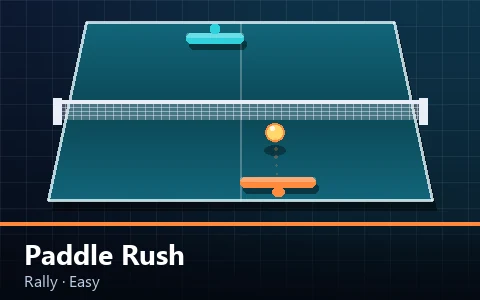
Paddle Rush
A quick, friendly rally game with a wide paddle and a patient opponent. The best place to learn how the table works.
Rally games
Keep the ball alive. The longer the rally, the more it is worth.
A rally is the simplest unit of table tennis and the hardest one to master. Two paddles, one ball, and the only rule that matters is that somebody eventually misses. The games in this category strip everything else away. There is no match score to protect and no bracket to climb — the ball comes back, and you decide how long that keeps being true.
What makes a rally game work in a browser is the pacing. All five games here tie the ball's speed to the rally count rather than to a clock, so the tenth shot is quicker than the first because you earned it, not because thirty seconds went by. That single decision changes the feel completely: every run builds its own difficulty curve, and the hardest moment of a good run is always the one just before it ends.
A quick, friendly rally game with a wide paddle and a patient opponent. The best place to learn how the table works.
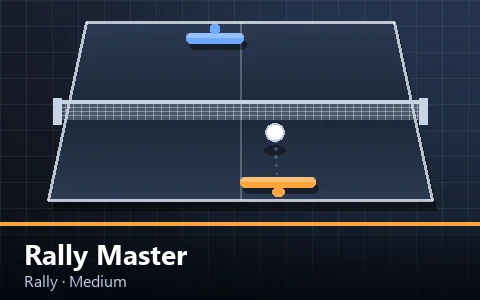
The purest rally game on the site. No match score, no bracket — just a counter that goes up until you miss.
The rally game with the pace turned up. A narrower table means the ball comes back before you have finished the last shot.
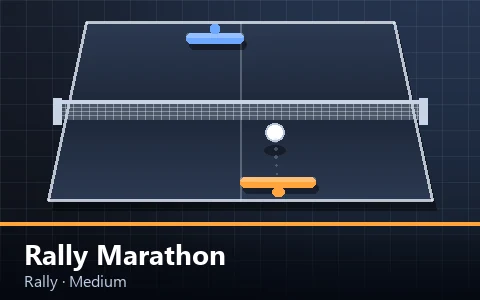
The long-distance rally game. The ball never gets truly fast, so the only thing that ends a run is concentration.
The opponent blends continuously from Easy toward Expert while you play. One mistake ends the run.
A game belongs in this category when the length of the exchange is the score. Points still exist, and you still lose a life when the ball gets past you, but the number the game is really asking you to grow is the rally counter in the corner of the HUD. Everything else is built around protecting it.
That has a knock-on effect on how you should play. In a match you can afford an ambitious shot because a lost point costs you one of eleven. In a rally game an ambitious shot that clips the net wipes out a streak you spent ninety seconds building, so the correct strategy is almost always the boring one: return to the middle, keep the ball deep, and take the safe height over the net.
Every successful return raises a tempo multiplier that is applied to the speed of the next shot. The step is small — a couple of per cent per return — and it is capped, so a rally does not spiral into something unplayable. What it does do is make the difficulty of a run entirely a function of your own performance.
The cap matters as much as the step. Without one, a good player eventually hits a wall of physically impossible speed and every run ends the same way. With one, the game settles into a fast but sustainable rhythm somewhere around the fortieth return, and from there the challenge becomes concentration rather than reaction.
Rally games pay out at 5, 10, 15, 25, 40, 50, 75, 100, 150 and 200 returns. The bonus is announced on screen and added straight to the score. These exist for a practical reason: a long rally is a long time to go without feedback, and a counter ticking upward is not, on its own, very satisfying.
They also give you something to aim at when a run is going badly. Missing a personal best by forty returns is discouraging; missing the next milestone by three is the thing that makes you press restart.
If you have never played a table tennis game in a browser, start with Paddle Rush. It has the widest paddle, the most forgiving opponent and the slowest tempo step, and it is designed to get you to a rally of ten inside your first two or three attempts.
Rally Master is the purest expression of the category — it exists only to grow one number. Table Tennis Dash shortens the table so exchanges come back faster. Rally Marathon removes the speed cap pressure and replaces it with endurance. Endless Rally generates its own difficulty curve and never repeats the same run.
Three habits move players from a rally of eight to a rally of thirty faster than anything else. The first is recovering to the middle after every shot instead of standing where you last hit the ball. The second is aiming down the centre while you are learning, because the middle of the table is the part you can always reach in time. The third is watching the ball's shadow rather than the ball, since in a top-down view the shadow tells you where it will land and the ball only tells you where it is.
Once those are automatic, the way to score more per return is to start moving the ball wide — but only from a position where you have already recovered. Attacking from a bad position is how good rallies end.
The most recently published rally games, newest first.
The opponent blends continuously from Easy toward Expert while you play. One mistake ends the run.
The long-distance rally game. The ball never gets truly fast, so the only thing that ends a run is concentration.
The rally game with the pace turned up. A narrower table means the ball comes back before you have finished the last shot.
The whole game happens in the first half second.
5 games
A goal, a clock, and a very clear reason you did not clear it.
5 games
Four rounds, four opponents, one bracket. Lose once and it is over.
5 games
There is no hard limit. The tempo multiplier is capped, so once you pass roughly fifty returns the ball stops getting faster and the rally can in principle continue indefinitely. In practice runs end through lapses in concentration rather than through the game becoming impossible.
Yes, in your own browser. Each game stores your best score and your longest rally in localStorage on the device you played it on. Nothing is uploaded, there is no global leaderboard, and clearing your browser's site data resets the records.
All of them. Drag anywhere on the table to slide your paddle, or use the large on-screen buttons underneath the playfield. The controls are sized for touch and the canvas scales to the width of the screen without any horizontal scrolling.
Because tying difficulty to performance rather than to a timer keeps every run honest. A player who returns forty balls has demonstrably earned a harder game than one who returned four, and a fixed timer would give both the same experience.
Local two-player play lives in the multiplayer-style category rather than here, because a shared rally with two humans is a different game. The rally titles in this category are single-player against the computer opponent.
Try a random game from this category's parent library, or browse everything with filters.