FeaturedNew
Ultimate Ping Pong Challenge
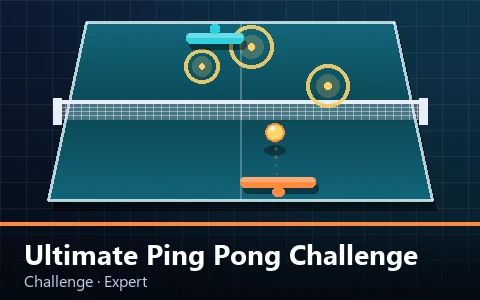
The long one. Ten stages of mixed goals at rising difficulty, built for players who have already cleared the other challenge games.
Eight stages, eight different goals, three lives to get through them.
Drag anywhere on the table to move, and use the smash button under the game for a power shot.
Ping Pong Challenge is a ladder rather than a single game. Eight stages, each with its own goal, its own opponent rating and its own ball speed, played back to back on three shared lives. Clearing a stage returns one life, so a strong middle section can rescue a shaky start.
The order of the stages is deliberate. Rallying comes first because everything else depends on it, then point-winning, then placement, then endurance, then all of it under an Expert opponent. By stage eight you are being asked to build a rally of twenty-five against the hardest opponent in the game, and the seven stages before it are the training for exactly that.
| Action | Input |
|---|---|
| Move your paddle | ← → or A D, or drag on the table |
| Smash | Space or Shift just before contact |
| Pause / resume | P or Esc |
| Restart the run | R |
| Sound on or off | The sound button under the table |
On a touchscreen: Drag anywhere on the table to move, and use the smash button under the game for a power shot.
Losing a point costs a life but does not reset the stage; running out of lives ends the run entirely. Time-limited stages behave differently: if the clock beats you, you lose a life and the stage restarts from the beginning rather than ending the run.
That split keeps the ladder recoverable. A player who stumbles on stage five can still finish the game, which matters when the whole point of a ladder is to teach a sequence of skills.
Each stage sets its own difficulty rating — Easy for the first two, Medium in the middle, Hard from stage five and Expert for the last two. The change is immediate and announced on the stage card.
This is the fastest way to show a player what the difficulty tiers actually mean. Stage two and stage six ask for a very similar thing, and the difference between them is entirely the opponent.
Alongside the opponent, each stage raises the base shot speed by five per cent over the last. By stage eight the ball leaves the paddle thirty-five per cent faster than it did in stage one, on top of whatever the rally tempo has added on the way.
The two multiply, which is why the final stage is genuinely demanding: a rally of twenty-five at 1.35 base speed and a full tempo ramp is close to the quickest ball in any non-endless game on the site.
The ball carries a height as well as a table position, so it arcs, bounces off the surface and can clip the net. When a paddle strikes it, the engine picks a landing point and solves for the exact launch velocity that reaches it, which is why the aim marker on the table is honest. In Ping Pong Challenge the physics run at the site's standard values, which makes it a good reference point for the variants that change them.
The paddle is a blade that slides along your baseline. Four numbers decide how it feels: how fast it moves, how hard the ball leaves the face, how accurately a shot lands where you aimed it, and how high above the table it can still make contact. In Ping Pong Challenge the blade is 17 world units wide and travels at 118 units per second.
Where the ball meets the blade steers the return. A contact at the centre sends the ball straight down the table, and a contact at the edge sends it roughly 26 units off centre. Holding a direction key at the moment of contact adds a smaller correction on top.
The serve here is a single press. The ball is released toward the far half from wherever your paddle is standing, so where you stand when you serve decides the angle. Service alternates between the two ends where the game keeps a match score.
Ping Pong Challenge is rated Medium overall. A balanced opponent that returns most things competently and misjudges perhaps one ball in eight. The opponent rating is set by the game itself rather than by a switch, because it changes as you progress. Expert is deliberately hard rather than impossible: it keeps both a reaction delay and an error rate, because an opponent that never misses is a wall rather than a challenge.
No. The ladder always starts at stage one, because a challenge you can resume halfway through is no longer measuring the same thing. Your highest stage reached is saved so you can see your progress between runs.
You lose one life and the stage restarts from the beginning. Running out of time does not end the run unless it also takes your last life.
Yes. The progress bar tracks the current rally, so losing the point resets it to zero. The score you earned along the way is still banked.
A clean run through all eight stages usually takes between six and ten minutes, with stage five's forty-five-second survival clock being the longest single section.
Stage seven. It is the first time the Expert opponent appears while you are also being asked to place the ball precisely, and the combination catches people who have been relying on safe returns up to that point.
Other games that use the same ideas, or that make a good next step from this one.
The long one. Ten stages of mixed goals at rising difficulty, built for players who have already cleared the other challenge games.
A live rally with moving scoring rings on the opponent's half. Placement under pressure, with the target refusing to stand still.
Everything Ping Pong Arcade does, in one run: rallies, serving, targets, survival and points against the full difficulty range.
A serving range with no opponent and no rally. Aim, time the meter, and find out exactly where the ball landed.
Thirty original games across six categories, all free and all playable in this browser.