 Alex Morgan
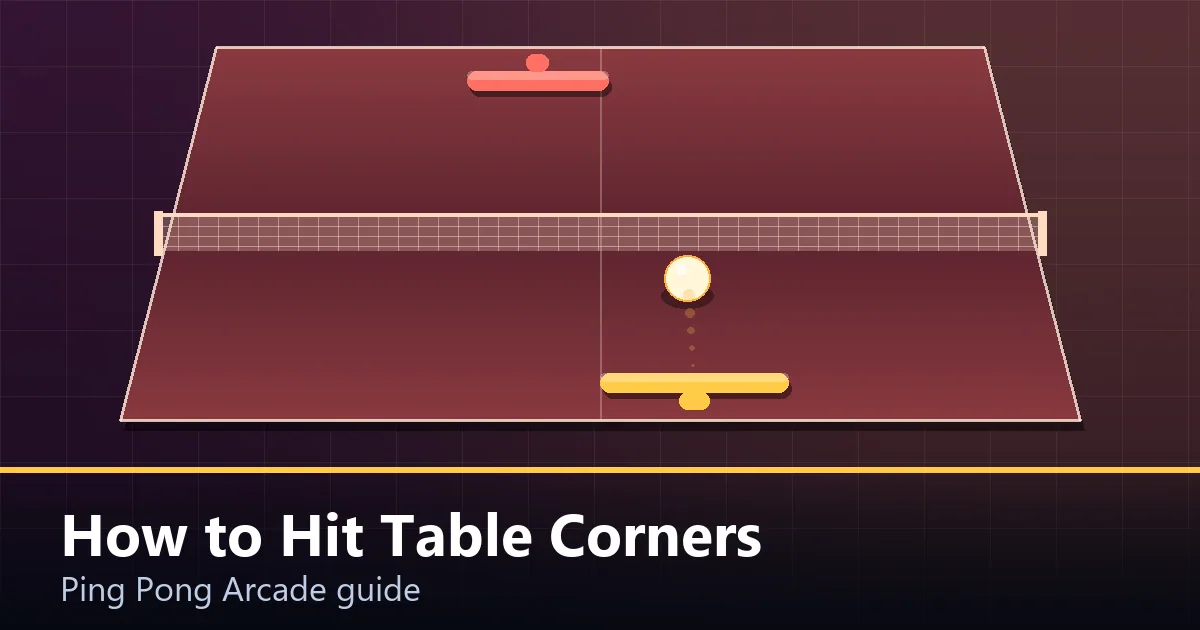
Why corners are worth the most
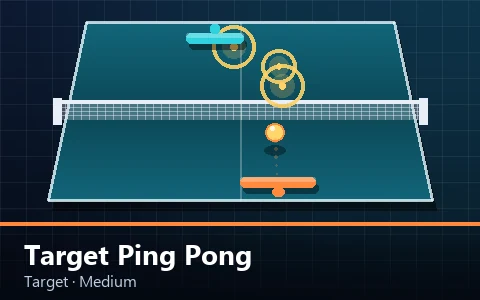
A deep corner zone is worth 260 points against 190 for a wide zone and 150 for the deep centre. In Serve Challenge the corners are worth 300 against 200 for the centre.
The values reflect genuine difficulty. A corner is the longest shot available, which means the flattest arc for a given speed and therefore the most net risk, and it is closest to both the sideline and the baseline, so there are two ways to miss long.
In a real rally it would also be the most valuable, because it moves the opponent furthest out of position. The scoring encodes that even in the modes where no opponent is present.
You need most of the steering range
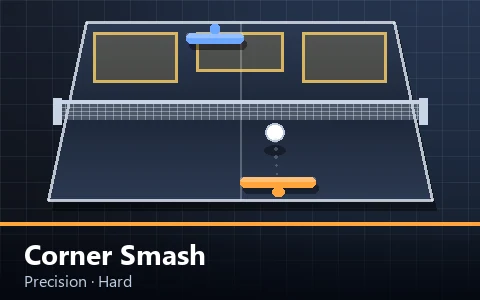
The contact offset is multiplied by a steering range — 26 units in most games, 32 in Corner Smash — and added to the centre of the far half.
On a 76-unit-wide table, the sideline is 38 units from centre. So a 26-unit range gets you to within twelve units of the line at full edge contact, and adding the held-direction input's twelve units closes the gap.
Corner Smash's 32-unit range exists precisely so that an edge contact alone reaches about four units from the sideline, which is inside the corner zone without needing the correction. That is why it is the game to learn corners in.
Be on the correct side of the ball
This is the requirement most players miss, and it is absolute rather than a matter of degree.
To send the ball right, it must meet the right edge of your blade. That means you have to be positioned to the left of where the ball will arrive, so it lands on the far side of the paddle from you.
Reaching across the ball produces the opposite edge and therefore the opposite corner. That is why a corner attempt from a stretch almost always goes to the wrong corner rather than merely missing — the mechanic is working correctly and you were on the wrong side of it.
Hit the corner on your own side
Following from the above: the practical rule is to hit the corner nearer the side of the table you are standing on.
If the ball is arriving on your left and you are already left of it, the right edge of the blade is available and the right corner is reachable. If you are right of it, the left corner is.
That is often not the corner the game called, which is where the real difficulty lives. The answer is to move earlier so you have a choice, not to attempt the impossible one.
The smash trade
A smash multiplies shot speed by 1.5 and aims deeper, which makes a corner reachable that an ordinary shot falls short of.
The cost is height at the net. The shot solver aims at the chosen point, and a faster shot gets there in less time, so it needs less upward launch and crosses the net lower. Smashing a low ball into a corner is the most reliable way to find the tape.
The rule is therefore conditional rather than general: smash at a corner only when the ball has bounced up high enough to give you clearance. On a low ball, take the ordinary shot and accept a slightly shorter landing.
Spin costs you here
A corner is a small target at the end of a long flight, which is the worst combination for side spin.
Drift grows with the square of flight time, and a corner shot has the longest flight available. A blade still moving at contact will miss a corner by a visible margin even at standard spin settings, and by considerably more in Spin Master.
So the discipline is the same as everywhere else, applied harder: arrive early enough to have stopped before contact. On a corner attempt that matters more than on any other shot on the site.
Alternate rather than repeat
Against a live opponent there is a tactical layer on top of the mechanical one.
The AI recovers toward the middle at a fixed rate, so hitting the same corner twice in succession usually finds it already there. In the precision games this is handled for you — the called zone never repeats twice in a row — but in match games it is a decision.
Alternating corners is the pattern that works, because the opponent has the full width of the table to cover between shots. It is also the harder pattern to execute, because it requires moving the contact point from one edge of the blade to the other under pressure.
Key takeaways
- Corners are worth 260 to 300 points because they are the longest, flattest and most marginal shot available.
- You need close to the full steering range plus the held-direction correction on a standard 26-unit range.
- The edge you need must be on the far side of the blade from you, so being behind the ball is mandatory.
- Smash at a corner only on a ball that has bounced up — the flatter trajectory finds the net otherwise.
- Side spin costs the most here, because a corner is the longest flight and the smallest target.
Frequently asked questions
Why does my corner shot go to the opposite corner?
Because you reached across the ball, so it met the opposite edge of the blade. The mechanic worked correctly; you were on the wrong side of it.
Can I reach a corner without the direction keys?
In Corner Smash yes, because its 32-unit steering range puts an edge contact about four units from the sideline. In most other games you need the held-direction correction as well.
Should I smash at the corners?
Only on a ball that has clearly bounced up. A smash crosses the net lower, and a corner is already the flattest shot available, so the two together on a low ball is a fault waiting to happen.
Which game is best for practising corners?
Corner Smash, which has the widest steering range on the site and calls the corners specifically, with the wide zones at 190 available as a safer fallback.