 Alex Morgan

What coordination means here
In a paddle game, hand-eye coordination is the loop between seeing where the ball will be and getting the paddle there. It has three parts: tracking, prediction and movement.
Tracking is following the relevant object. Prediction is working out where it will be. Movement is getting there. Most players assume their weakness is in the third and it is almost always in the first two.
That matters because tracking and prediction respond well to deliberate practice, while raw movement speed is largely fixed.
Track the right object
The single largest improvement available on this site is to track the ball's shadow rather than the ball.
In a top-down view the ball's apparent position includes its height, so where it appears on screen is not where it will land. The shadow is drawn directly beneath it at the surface, so the shadow's path is the landing path.
The habit takes deliberate effort because tracking the bright, fast, high-contrast object is instinctive. Spending one full run consciously watching the shadow is enough for most players to feel the difference.
Look at the source, not the projectile
The second improvement is temporal rather than spatial: watch the far paddle at the moment it strikes.
Its position determines which half of the table the ball is going to, and that information exists roughly a tenth of a second before the ball has travelled anywhere. A tenth of a second is about a third of a typical choice reaction.
This is a general principle in fast games rather than a quirk of these ones. The earliest available information about a projectile is usually the thing that launched it.
Reduce the movement problem
Coordination is easier when there is less to coordinate, and positioning is how you reduce it.
A player who recovers to the middle after every shot faces a shorter movement on the next ball, which means a smaller correction, which means less precision required. Recovery is therefore a coordination technique as much as a tactical one.
Arriving early enough to be stationary at contact helps twice: the movement is complete before the precise part begins, and a stationary blade puts no unintended spin on the ball.
Practise one loop at a time
The site is arranged so each part of the loop can be isolated, which is far more effective than practising all three at once.
| To practise | Play | Because |
|---|---|---|
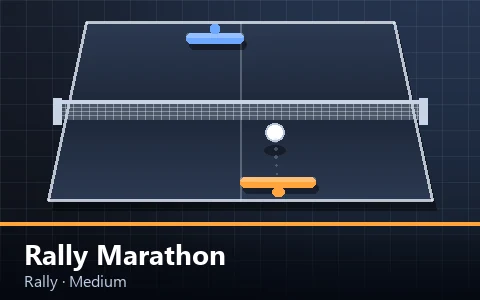
| Tracking | Rally Marathon | Slow ball, long rallies, low pressure |
| Prediction | Reflex Rally | Direction must be read from the far paddle |
| Movement | Table Tennis Dash | Narrow table removes angles, leaves pace |
| Timing only | One-Tap Ping Pong | Position is handled for you |
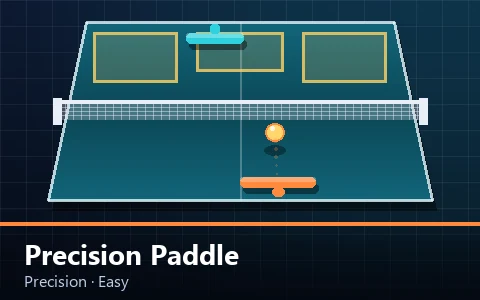
| Placement only | Precision Paddle | Large zones, reduced spin, patient opponent |
Short sessions beat long ones
Coordination practice degrades quickly with fatigue, and practising badly reinforces the wrong pattern.
Ten minutes of deliberate practice — one specific habit, one specific game, ignoring the score — produces more improvement than an hour of ordinary play, and the difference is not close.
The signal that a session is over is specific: you notice your eyes jumping between objects rather than tracking one, or you find yourself surprised by balls you should have read. Either is a reason to stop rather than to push on.
What we will not claim
Practice reliably improves performance at the specific task being practised. That is well established and it is what you will experience here.
Whether improvement at tracking a ball in a browser game transfers to any other activity is a different question. This site has not tested it, has no data on it, and therefore does not claim it.
There is a large market for games that claim cognitive benefits and very little evidence behind most of it. These are games, and the honest description of what they improve is: playing these games.
Key takeaways
- Coordination is tracking, prediction and movement; the first two improve most with practice.
- Track the ball's shadow rather than the ball, because the shadow's path is the landing path.
- Watch the far paddle at the moment it strikes — the earliest information is usually the launcher.
- Recovering to the middle is a coordination technique, because it reduces the movement required.
- Ten minutes of deliberate practice beats an hour of ordinary play, and fatigue reinforces bad patterns.
Frequently asked questions
Will these games improve my coordination generally?
We have not tested that and do not claim it. Practice reliably improves the specific task practised; transfer to unrelated activities is outside what this site can honestly say.
What should I be looking at?
The ball's shadow while it is in flight, and the far paddle at the moment it strikes. Both carry more useful information than the ball itself.
Is coordination something you are born with?
The movement component is largely fixed; the tracking and prediction components respond well to practice. Most players' weakness is in the second two rather than the first.
How long should a practice session be?
Around ten minutes with one specific focus. Coordination degrades with fatigue and practising tired reinforces the wrong pattern.