 Alex Morgan

What 'procedural' means here
A procedural challenge is one whose parameters are computed rather than written by hand. Instead of an author deciding that stage seven needs a rally of twenty at Hard, a formula produces that number from the stage index.
The obvious advantage is that it never runs out. A generator can produce stage fifty as easily as stage five, which is what makes endless modes possible at all.
The less obvious advantage is consistency. A generated ladder has no accidental difficulty spikes caused by an author misjudging one stage, because every stage is derived from the same rule.
What a generator is bad at
A formula has no judgement. It cannot decide that stage seven should introduce a new mechanic, that the player needs a breather after a hard section, or that two consecutive stages testing the same thing is boring.
It also cannot recognise that a particular combination is unfair. A generated stage asking for a long rally against a fast opponent on a narrow table might be mathematically consistent with its neighbours and practically impossible.
Those failures are why purely generated content tends to feel flat. The variation is real but the shape is not, and players notice the absence of intent even when they cannot name it.
The compromise these games use
The approach here is to generate the numbers and author the shape. Where a ladder exists, the sequence of goal types is written by hand and the values within each stage are computed.
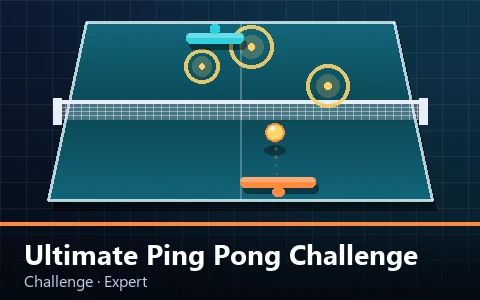
Ultimate Ping Pong Challenge alternates deliberately between its five goal types rather than grouping them, so each mechanic appears once in the Medium-to-Hard half and once in the Hard-to-Expert half. That ordering is a decision, not a formula.
Within that structure, the amounts and speeds follow rules: five per cent more base speed per stage, difficulty tiers assigned in blocks, amounts rising in fixed increments. That part is generated.
Generation in the endless modes
The endless modes are the most purely procedural things on the site, because they have no stages to author.
Difficulty is a continuous function of elapsed time: every quarter of a second the opponent's settings are recomputed by interpolating between two adjacent presets. The tempo cap and the player's shot speed rise alongside on the same curve.
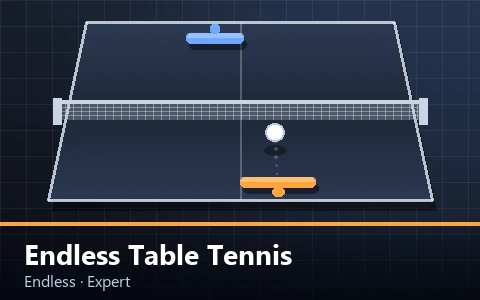
What is authored is where the curve starts, how long it takes and what it ends at. Endless Rally starts at Easy over 150 seconds; Endless Table Tennis starts at Medium over 105. Those choices are what give the two games different characters despite identical code.
Generation within a stage
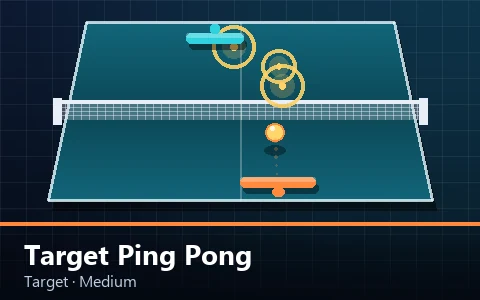
Even in hand-authored stages, some elements are generated at runtime. Target rings pick a position, a size and optionally a movement axis when they spawn. Tokens are laid out on a loose grid with random offsets.
Those generators have constraints written into them. Rings never spawn closer to the edge than their own radius plus a margin; tokens never spawn on the net line, because a token there would be unreachable.
Constraints are where most of the design work in a generator lives. The formula produces variety; the constraints stop the variety producing something broken.
Determinism and repeatability
The engine includes a seeded random generator, which produces the same sequence of values for the same starting seed.
That is useful where a challenge should be identical between attempts, so a player can learn it rather than re-encountering a different problem each time. It is the difference between practising a stage and gambling on one.
Where variety matters more than learnability — the tournament roster draw, target positions — an unseeded generator is used instead, so no two runs are the same.
How to tell which you are playing
It matters for how you approach a game, and there is a simple test.
If the same stage presents the same goal every time you reach it, the ladder is authored and worth learning. If the difficulty is described by a tier label and a progress bar rather than a stage number, it is generated and worth adapting to rather than memorising.
Ultimate Ping Pong Challenge and Ping Pong Arcade Ultimate are the former. Endless Rally and Endless Table Tennis are the latter. Pong Tournament sits between: the structure is fixed and the roster is drawn.
Key takeaways
- A generator never runs out of content and never has judgement about pacing or fairness.
- The approach here is to generate the numbers and author the shape.
- Endless modes compute difficulty as a continuous function of time, with the start, duration and endpoint authored.
- Most generator design work is in the constraints, not the formula.
- Authored ladders are worth learning; generated ramps are worth adapting to.
Frequently asked questions
Are the stage ladders randomly generated?
No. The sequence of goal types is written by hand so mechanics are introduced in a deliberate order. Only the values within each stage — amounts, speeds, tiers — follow rules.
Is the endless difficulty curve random?
No, it is deterministic: a continuous interpolation between difficulty presets based on elapsed time. What varies between runs is your own play, not the curve.
Why do target positions vary but stage goals do not?
Because variety is valuable in a spawn and harmful in a challenge you are meant to learn. A stage you can practise is more useful than one that is different every time.
Can a generated challenge be impossible?
It can in principle, which is why the generators here have constraints — rings never spawn unreachably close to an edge, and ramps are capped rather than open-ended.