FeaturedNew2P Local

Pixel Ping Pong
The fastest two-player variant, in an original pixel-flavoured arena. Sharp, quick and unforgiving.
A full match with a wide blade and a smash button that actually hurts.
In two-player mode each player gets a tinted pair of buttons under the table. It works best on a tablet in landscape.
Paddle Attack is the straightest match game on the site: first to eleven points, two clear, service changing every two points. What sets it apart is the smash. At a 1.5 speed multiplier on a wide blade, a well-set-up attacking shot here is very hard to return, and the game is built around earning the ball that lets you play it.
It is also the flagship of the local two-player category. Flip the Players toggle above the table and the far paddle stops being driven by the computer and starts reading Player 2's arrow keys. Every rule, every physics value and the whole scoreboard stays exactly the same.
| Action | Input |
|---|---|
| Player 1 moves | A D |
| Player 2 moves | ← → |
| Smash | Space just before contact |
| Pause / resume | P or Esc |
| Restart the match | R |
On a touchscreen: In two-player mode each player gets a tinted pair of buttons under the table. It works best on a tablet in landscape.
A smash multiplies the base shot speed by 1.5 and aims deep. The solver then computes the launch that lands it there, which necessarily means a lower crossing height at the net. The higher the ball is when you strike it, the more clearance you have.
That gives the game its rhythm. You do not smash whenever you can — you build the point until the opponent gives you a ball that has bounced up, and then you smash that one. Against the Medium AI, the ball that sits up is usually the return that follows a misjudgement.
In 2P mode the far paddle reads the arrow keys and the near paddle reads A and D. Both paddles use the identical contact test, the identical steering rule and the identical hit box, so neither end of the table has an advantage built into it. Labels appear under each blade so nobody loses track.
On a touchscreen the control strip rebuilds into four buttons — two tinted for Player 1 on the left, two for Player 2 on the right — and both pairs are live simultaneously. It works best on a tablet in landscape.
The match score is the eleven-point one on the table. Alongside it the game keeps an arcade score that rewards long rallies, smashes and won points, and that is the number saved as your personal best.
The two reward different things on purpose. You can win a match eleven-two and score poorly, or lose eleven-nine after a series of long rallies and post a personal best. Both are legitimate ways to play.
The ball carries a height as well as a table position, so it arcs, bounces off the surface and can clip the net. When a paddle strikes it, the engine picks a landing point and solves for the exact launch velocity that reaches it, which is why the aim marker on the table is honest. In Paddle Attack the physics run at the site's standard values, which makes it a good reference point for the variants that change them.
The paddle is a blade that slides along your baseline. Four numbers decide how it feels: how fast it moves, how hard the ball leaves the face, how accurately a shot lands where you aimed it, and how high above the table it can still make contact. In Paddle Attack the blade is 19 world units wide and travels at 118 units per second.
Where the ball meets the blade steers the return. A contact at the centre sends the ball straight down the table, and a contact at the edge sends it roughly 28 units off centre. Holding a direction key at the moment of contact adds a smaller correction on top.
The serve here is a single press. The ball is released toward the far half from wherever your paddle is standing, so where you stand when you serve decides the angle. Service alternates between the two ends where the game keeps a match score.
Paddle Attack is rated Medium overall. A balanced opponent that returns most things competently and misjudges perhaps one ball in eight. Use the difficulty buttons above the table to change the opponent at any time; restarting applies the change immediately. Expert is deliberately hard rather than impossible.
No. This is a static site with no server, so online play is impossible here and is not offered. The two-player mode is local: two people on one keyboard or one touchscreen.
Player 1 uses A and D, Player 2 uses the left and right arrow keys. P pauses for both and R restarts the match. On a touchscreen each player gets a tinted pair of buttons.
None. Both paddles use exactly the same width, speed, contact test and steering rule. The only asymmetry is which keys you press.
Because the ball was too low when you hit it. A smash crosses the net lower than an ordinary shot, so the height of the ball at contact is what decides whether it clears.
Yes. The difficulty buttons above the table switch the computer opponent between Easy, Medium, Hard and Expert, and restarting the match applies the change immediately.
Other games that use the same ideas, or that make a good next step from this one.
The fastest two-player variant, in an original pixel-flavoured arena. Sharp, quick and unforgiving.
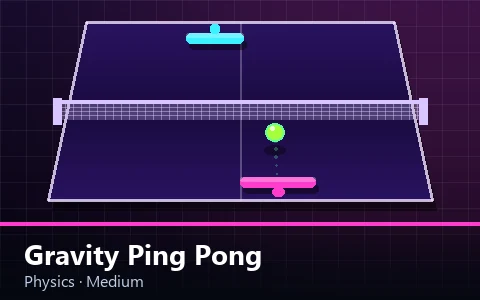
A full match with the gravity halved. The ball floats, arcs flatten, and the net becomes a much bigger problem.
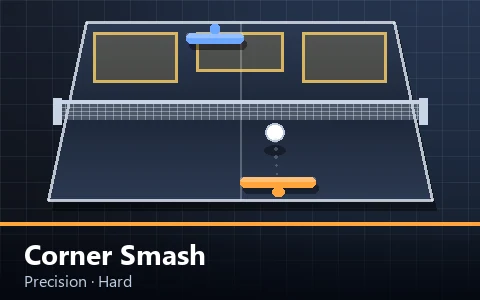
A placement game that rewards the two deep corners above everything else — and gives you a smash button to reach them with.
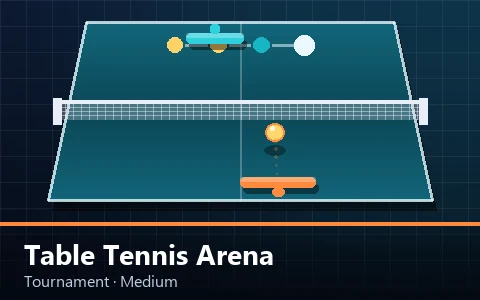
A short knockout series. Three opponents, three described playing styles, and a bracket that saves itself between visits.
Thirty original games across six categories, all free and all playable in this browser.