 Alex Morgan

What is and is not offered
Ping Pong Arcade is a static website. There is no server, no account system and no matchmaking, which means online multiplayer is not possible here and is not claimed anywhere on the site.
What is offered is local two-player: two people, one keyboard or one touchscreen, one shared table. Five games support it, and the 2P Local badge appears only on those five.
That distinction matters because 'multiplayer' in a game listing often means online, and a player who arrives expecting that would be misled. The category is called multiplayer-style for the same reason.
The controls
Player 1 uses A and D. Player 2 uses the left and right arrow keys. Those choices put the two players at opposite ends of a keyboard, which matters physically when two people are sharing one.
P pauses for both players and R restarts the match. The action and smash keys are shared, which is a minor compromise and has not caused problems in practice.
On a touchscreen the control strip rebuilds into four buttons: two tinted for Player 1 on the left, two for Player 2 on the right, both pairs live simultaneously.
Both paddles are identical
This is the most important design property of the mode. Both paddles use the same width, the same speed, the same collision test and the same steering rule.
In a shared game any asymmetry becomes an argument, and 'your paddle is bigger' is not something a second player should ever have to wonder about. Labels appear under each blade so nobody loses track of which is theirs.
The only asymmetry is which keys you press, and the scoreboard in the middle of the table serves both ends — the far player's score is drawn above the net line, the near player's below it.
The five games
All five run the same match mode — first to eleven with a two-point cushion, service alternating every two points — and each changes one thing about the world.
| Game | What is different | Pace |
|---|---|---|
| Paddle Attack | Standard physics, powerful smash, wide blade | Standard |
| Pixel Ping Pong | Retro styling, high speed, narrow blade | Fastest |
| Gravity Ping Pong | Gravity halved, flatter arcs | Medium |
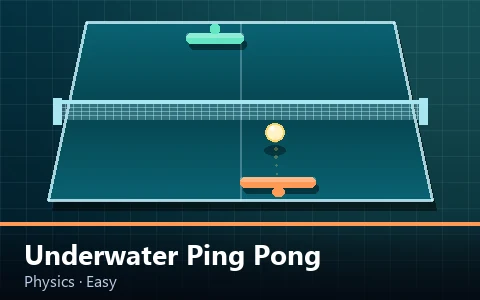
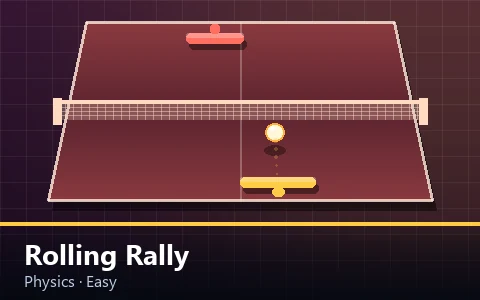
| Rolling Rally | Heavy drag, dead bounce | Slow |
| Underwater Ping Pong | Buoyancy plus heavy drag | Slowest |
One variable per game is deliberate. Five games that each changed three things would feel like five random games rather than five different ones.
Balancing uneven players
The physics variants are the balancing mechanism, and they work better than a formal handicap because neither player has to agree to a disadvantage.
Moving from Pixel Ping Pong to Underwater Ping Pong roughly doubles the time both players have on every ball. That closes most skill gaps, because a large part of the difference between a strong and a weak player is how quickly they can get into position.
If a slower table is not enough, a self-imposed constraint on the stronger player works well and is easy to police because it is visible: cross-court only, or no smashing.
Playing on a shared touchscreen
Two-player on touch works and needs a tablet in landscape to work comfortably.
Both button pairs are live at once, which pointer events handle natively — each touch has its own pointer identifier, so two thumbs pressing simultaneously is not a special case.
On a phone-width table two sets of thumbs is crowded enough that a keyboard is more comfortable if one is available. That is a limitation of the screen rather than of the implementation.
Single-player is unchanged
All five games are complete single-player games too. Leaving the toggle on 1P gives you the computer opponent at whichever difficulty you select.
Nothing about the game changes between the modes except who is driving the far paddle. The physics, the scoring, the match length and the table are identical.
That is why the mode was cheap to build and why it is honest to advertise: it is not a separate feature bolted on, it is the same game with a different controller on one end.
Key takeaways
- There is no online play on this site, and the 2P Local badge appears only on games that genuinely support local play.
- Player 1 uses A and D, Player 2 the arrows, chosen so two people can share one keyboard.
- Both paddles are mechanically identical, which is what stops a shared game becoming an argument.
- The five games each change one variable, and the slower variants are the balancing mechanism.
- Touch two-player works on a tablet in landscape; a phone is too crowded.
Frequently asked questions
Is there online multiplayer?
No. This is a static site with no server, so online play is impossible here and is not claimed anywhere. The only multiplayer is local, on one keyboard or one touchscreen.
Does Player 2 have any disadvantage?
None. Both paddles use identical width, speed, collision test and steering rule. The only difference is which keys you press.
How do I balance a match between uneven players?
Switch to a slower variant. Underwater Ping Pong gives both players roughly twice as long on every ball as Pixel Ping Pong, which closes most skill gaps without a formal handicap.
Can two people play on a phone?
Technically, but a tablet in landscape is much better. Two sets of thumbs on a phone-width table is crowded enough that a keyboard is more comfortable if available.