 Alex Morgan
The three numbers
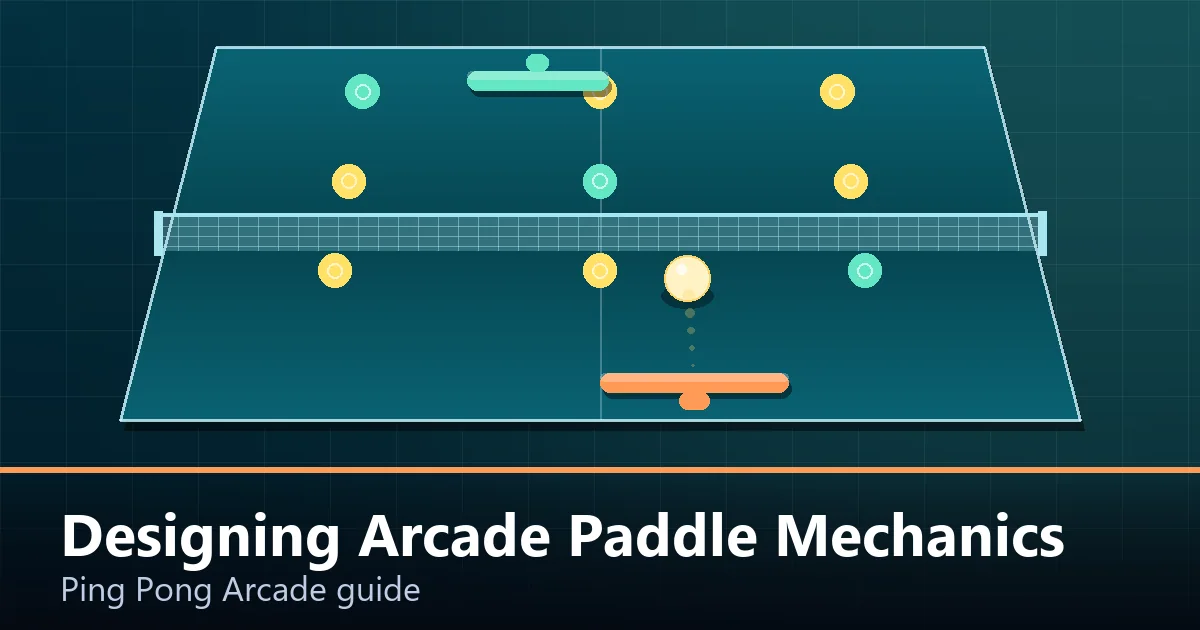
A paddle in these games has five properties, but only three of them vary meaningfully between titles: blade width, movement speed and steering range.
Width decides how much of the table you cover without moving. Speed decides how much you can cover by moving. Steering range decides how far off centre you can send the ball from a given contact point.
The other two — power and control — are held at one throughout, because varying them adds a dimension players cannot see and therefore cannot learn.
Width is a trade
A wider blade is easier to make contact with, which is why beginner games use one. It is not strictly better.
Because the contact offset is measured as a fraction of the blade's half-width, a wide paddle requires the ball to land further from centre in absolute terms to produce the same angle. So wide blades give finer control over small angles and make extreme angles harder to reach reliably.
Narrow blades reverse that. Pixel Ping Pong's fifteen units reaches the corners with a smaller offset, which suits a fast game where you have less time to aim precisely, and makes fine adjustments correspondingly twitchier.
Speed sets the recovery budget
At the standard 118 world units per second and a typical 0.7-second flight, a paddle can cover about eighty-two units — more than the table's seventy-six-unit width.
That margin is what makes positioning a solvable problem. Drop the speed to Underwater Ping Pong's ninety-six and the budget falls to sixty-seven units, which is less than the table; the variant compensates with a much longer flight time.
The relationship between paddle speed and flight time is the one that actually determines how a game feels. A fast paddle on a slow ball is forgiving; a slow paddle on a fast ball is punishing; the two numbers have to be tuned together.
Steering range is the aiming budget
The contact offset, between minus one and plus one, is multiplied by the steering range and added to the centre of the far half.
| Range | Edge contact lands | Distance from sideline | Used by |
|---|---|---|---|
| 26 units | 26 from centre | 12 units | Most games |
| 27 units | 27 from centre | 11 units | Precision Paddle |
| 30 units | 30 from centre | 8 units | Spin Master |
| 32 units | 32 from centre | 6 units | Corner Smash |
On a 76-unit table the sideline is 38 units from centre. So even the widest range needs the held-direction correction to reach the line itself, which keeps the extreme angle a deliberate act rather than a default.
How the three interact
Changing one number without adjusting the others produces a game that feels wrong in a way that is hard to diagnose.
A narrow blade with a small steering range is frustrating: hard to make contact with and unable to do much when you do. A wide blade with a large steering range is vague: easy to hit and hard to aim precisely, because the offset changes slowly across a wide face.
The combinations that work pair a narrow blade with a moderate range, or a wide blade with a slightly larger one. Corner Smash is the exception — a standard blade with the widest range — and it is exceptional because reaching corners is the entire point of the game.
The smash as a fourth lever
The smash multiplies shot speed by 1.5 and aims deeper, which makes it a way of extending a paddle's effective reach without changing its numbers.
Its cost — a flatter trajectory and therefore a lower crossing height at the net — is what stops it being a free upgrade. A smash requires a ball that has bounced up high enough to give clearance, and the bounce height depends on restitution.
That produces an elegant cross-dependency: the smash is powerful in games with a lively bounce and almost unavailable in games with a dead one. Rolling Rally's 0.50 restitution removes it almost entirely, which is why that variant has long rallies.
What is deliberately not adjustable
Power and control exist as properties and are held at one everywhere, which is a decision rather than an oversight.
A power multiplier would make two paddles produce different shot speeds from the same contact, which is invisible to the player and therefore unlearnable. A control multiplier would add randomness to where a shot lands, which breaks the first design principle on the site: failure must be legible.
Keeping them fixed means every difference between two paddles is something the player can see — how wide it is, how fast it moves, how far it steers.
Key takeaways
- Only three paddle numbers vary meaningfully: width, speed and steering range.
- Width is a trade between fine control on small angles and reach on extreme ones.
- Paddle speed and flight time must be tuned together; neither means anything alone.
- Even the widest steering range needs the held-direction correction to reach the sideline.
- Power and control are deliberately fixed, because varying them would make outcomes unlearnable.
Frequently asked questions
Is a wider paddle better?
Easier to hit with, and worse at extreme angles, because the contact offset is a fraction of the blade's half-width. It is a trade rather than an upgrade.
How far can a paddle travel during a shot?
About eighty-two world units at the standard speed and a typical flight, which is more than the table's width. That margin is what makes positioning solvable.
Why is the smash useless in some games?
Because it needs a ball that has bounced up high enough for clearance, and bounce height depends on restitution. Rolling Rally's dead bounce removes the opportunity almost entirely.
Why do paddles not have different power ratings?
Because a power difference is invisible to the player and therefore unlearnable, and a control multiplier would add randomness that breaks the requirement for legible failure.