 Alex Morgan
What 'fast' means here
Shot speeds in these games run from about 118 world units per second at the gentle end to 280 in the reflex game's late stages. The table is 124 units long, so at the top end a ball crosses it in under half a second.
Two things make a game feel fast. One is the base shot speed, set per game. The other is the rally tempo multiplier, which raises the speed of every shot as the rally goes on, capped between 1.45 and 2.05 times depending on the game.
That matters because the two respond to different strategies. A high base speed is a constant condition you adapt to once. A tempo ramp is something that creeps up on you mid-rally, which is why players are often comfortable at return five and beaten at return twenty-five at what feels like the same pace.
Read direction before speed
Against a fast ball your first job is not to judge how quickly it is arriving but which way it is going, because getting the direction wrong costs the full width of the table while getting the speed wrong costs a fraction of a second.
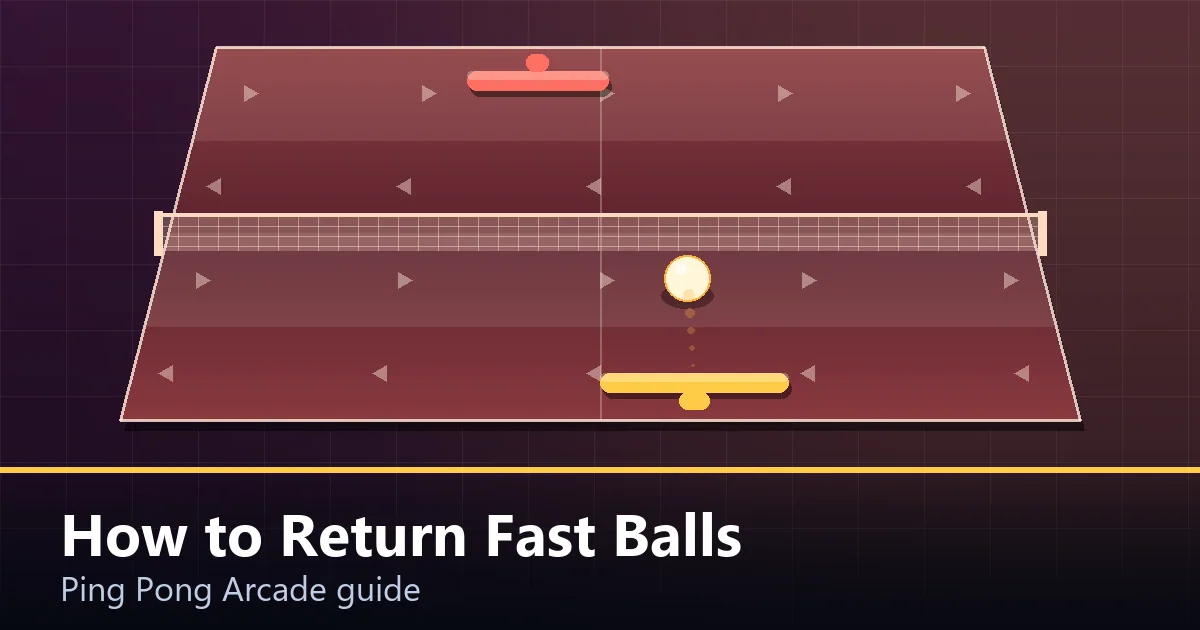
The earliest available cue is the far paddle's position at the moment it strikes. It tells you which half the ball is heading to before the ball has travelled anywhere, which is worth about a tenth of a second.
The second cue is the ball's shadow, which shows the landing point directly. Both are better than tracking the ball itself, which tells you only where it is now.
Cut the angle instead of chasing it
The instinctive response to a wide fast ball is to run toward where it will land. Often the better move is to go partway and meet it earlier.
The ball is still curving if it carries spin, and it is still travelling wide, so the further along its path you intercept it the further you have to travel. Moving to an intermediate point and taking the ball sooner shortens the distance and the time.
That is only possible if you started early, which is why this technique and the recovery habit are really the same advice. A player already near the centre has the option; a player still standing where they last hit does not.
Take pace off your return
This is the counter-intuitive one. When the ball is too fast, hitting it back harder makes your next problem worse, because the opponent's return of a fast ball tends to arrive quickly too.
A slower return buys you time in two ways. It takes longer to reach the opponent, which gives you longer to recover, and it produces a higher arc, which reduces the chance of clipping the net — a real risk at high speed because the shot solver flattens the trajectory as speed rises.
In practice, taking pace off means not pressing the smash or power button, and avoiding a contact right at the edge of the blade, which sends the ball on a longer and therefore flatter path.
Play the middle when you are under pressure
A ball returned down the centre of the far half comes back to the centre of yours, which means you are already in position for it.
That is worth far more than the points a wide shot would earn in almost every situation where the pace is uncomfortable. In a rally game the rally itself is the score, and in a match game a rally you survive is a rally the opponent can still lose.
The exception is a precision game, where a central ball scores almost nothing. Even there, a central return to reset a rally you are losing control of is usually better than a zone attempt you will miss.
Know which games are fast and why
Speed is not one thing, and knowing which kind you are facing changes the response.
| Game | Source of speed | Best response |
|---|---|---|
| Table Tennis Dash | Narrow table, low drag, steep ramp | Start moving earlier; angles do not exist |
| Pixel Ping Pong | High base speed, low drag, lively bounce | Commit early; the blade is narrow |
| Reflex Rally | Serves fired wide and accelerating | Watch the far paddle; do not guess |
| Endless Table Tennis | Ramping opponent and ramping ball | Win points early, defend later |
| Falling Ball Frenzy | Ball count rather than pace | Play the lowest ball, not the fastest |
Key takeaways
- Read direction first — a wrong direction costs the table's width, a wrong speed costs a fraction of a second.
- The far paddle gives direction about a tenth of a second before the ball does.
- Meeting a wide ball earlier is shorter than chasing where it will land, if you started from the centre.
- Taking pace off buys time twice: a longer flight and a higher arc over the net.
- A central return comes back centrally, which is why it is the correct reset under pressure.
Frequently asked questions
Is there a maximum ball speed?
Yes. Every game caps its tempo multiplier, and Reflex Rally caps incoming speed at 280 world units per second. Past the cap the game stops accelerating.
Why do fast shots hit the net more often?
Because the shot solver aims at a landing point, and a faster shot reaches it in less time, so it needs less upward launch and crosses the net lower.
Should I smash a fast ball back?
Rarely. A smash is flatter still, so against an already fast ball it is mostly net risk. Save it for a ball that has bounced up high.
Which game is best for practising against speed?
Table Tennis Dash, because its narrow table removes the angles and leaves only the pace, so you cannot avoid the problem by moving the ball around.