 Alex Morgan

The rally is continuous
Most sports have long gaps between moments of action. A tennis point has a serve, a few shots and then twenty seconds of nothing. A football match has ninety minutes containing perhaps three minutes of decisive events.
Table tennis has a continuous exchange in which something is decided roughly every second. There is no gap to fill, no transition to animate and no downtime to design around.
For a two-minute browser session that is close to ideal. The player is doing something at all times, which is the thing a short game most needs.
The whole playfield fits one screen
A football pitch, a tennis court or a basketball court is larger than a screen, which forces either a moving camera or a view so zoomed out that nothing is legible.
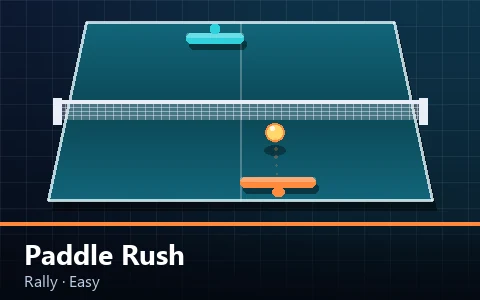
A table tennis table fits complete, from above, at a readable size, on anything from a 320-pixel phone to a monitor. There is no camera to manage, nothing off screen and no information hidden from the player.
Its proportions help too. A table is longer than it is wide, which matches a phone's screen almost exactly and is why these games work in portrait without compromise.
The input is one-dimensional
A paddle moves along a line. That single fact is the quiet reason table tennis keeps reappearing in arcade form.
One axis means the game is controllable with two keys, a drag gesture, or — with the positioning automated — a single button. Compare that to a game needing a virtual stick and three action buttons on a five-inch screen.
It also means the control scheme has essentially no learning curve, so all of the difficulty can live in the timing and the placement rather than in remembering what the buttons do.
Failure is legible
When you lose a point in table tennis you know why: you were in the wrong place, the ball was too fast, you hit it into the net.
That translates directly into a game. Each of those failures has one visible cause, which means a player can attribute a loss and form a plan — the requirement that makes a game worth replaying.
Contrast a sport where a loss is the product of many simultaneous factors. Those make excellent simulations and poor short-session arcade games, because the player cannot tell what to change.
The mechanics scale to variants
A table, a net, a ball with a height and two paddles is a small enough system that changing one constant produces a genuinely different game.
| Change | Produces | Example |
|---|---|---|
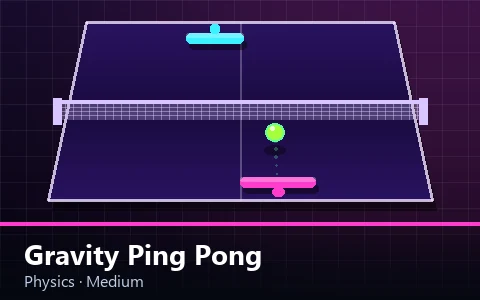
| Halve gravity | Flatter arcs, more net risk | Gravity Ping Pong |
| Triple drag | Slow, deliberate rallies | Underwater Ping Pong |
| Lower restitution | No smashes, long exchanges | Rolling Rally |
| Narrow the table | No angles, pure pace | Table Tennis Dash |
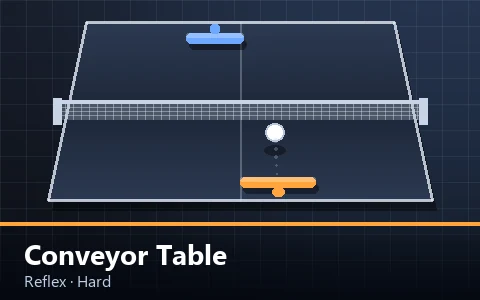
| Add surface drift | Constant re-aiming | Conveyor Table |
| Automate positioning | Pure timing | One-Tap Ping Pong |
That leverage is why thirty games can share one engine. In a sport with more moving parts, changing one constant would produce something incoherent rather than something different.
The scoring is naturally arcade-shaped
Table tennis already has a rally count, which maps directly onto a score, and a point structure that provides natural punctuation.
That gives an arcade designer two things for free: a continuous quantity to grow (rally length) and a discrete event to bank it at (the point). Most sports provide one or the other.
Layering a combo multiplier and milestone bonuses on top is then straightforward, because there is already a natural rhythm of accumulation and resolution to attach them to.
What does not transfer
It is worth being clear about the limits of the analogy, because the fit is good and not perfect.
Footwork, bat angle, stroke technique, service rules and the physical demands of the sport are all absent or heavily abstracted. The contact-point aiming rule used here has no equivalent in real play at all — it is a game mechanic that happens to sit in a table tennis frame.
That is the trade every arcade sports game makes. What is kept is the shape of the activity; what is dropped is most of the sport. For the real rules and equipment specifications, the governing body is the place to look.
Key takeaways
- The rally is continuous, so there is no downtime to design around in a short session.
- The whole playfield fits one screen at any size, with proportions that suit a phone.
- One-dimensional input means two keys, a drag or a single button — and almost no learning curve.
- Failure has one visible cause, which is what makes a loss attributable and a run worth repeating.
- The system is small enough that changing one constant produces a coherent new game.
Frequently asked questions
Why is table tennis so common in video games?
Because it reduces to two paddles, one ball and a rectangle, which was about what early display technology could represent — and the structural advantages that made it work then still apply.
What makes it suit phones specifically?
The table's proportions match a portrait screen, the whole playfield fits without a camera, and the one-axis input maps naturally onto a drag or two large buttons.
Why can thirty games share one engine?
Because the system is small — a table, a net, a ball with height and two paddles — so changing a single constant produces something coherent and different rather than something broken.
Do these mechanics teach me anything about the real sport?
Very little. Footwork, bat angle and stroke technique are absent, and the contact-point aiming rule has no equivalent in real play. It is a game mechanic in a table tennis frame.