 Alex Morgan

Why table tennis came first
When video games were new, the constraint was not imagination but display technology. A screen could show a small number of moving rectangles, and a computer could track a small number of positions.
Table tennis fits that constraint better than any other sport. Two paddles, one ball, a rectangular playing area and a rule set that reduces to 'hit it back'. No other sport reduces so cleanly — football needs twenty-two moving objects, tennis needs a net that matters in three dimensions and a court that does not fit a screen.
That accident of fit is why paddle-and-ball games became the template for an entire generation of games, including many that had nothing to do with sport. Once you have a paddle, a ball and a wall, you have a whole genre.
What the earliest paddle games established
Several ideas appeared almost immediately and have never left, because they turn out to be correct rather than merely convenient.
- Contact point steers the return — where the ball hits the paddle changes its angle, which gives the player agency without an extra input
- The ball speeds up over a rally, which produces escalation without a timer
- Two players on one machine, which is still the only multiplayer these games need to be good
- A score that is a single number, displayed large, with no explanation required
- A round that lasts a minute or two, so there is always time for another
Every one of those is present in the games on this site. The contact-point rule in particular is essentially unchanged: a ball striking the edge of the blade goes wide, a ball striking the centre goes straight, and that is the whole aiming system in every game here.
What the third dimension added
The single largest change between early paddle games and modern ones is that the ball acquired a height.
In a two-dimensional paddle game the ball travels in straight lines and bounces off walls. There is no arc, no bounce on the surface, no net to clear and no lob. The game is geometry.
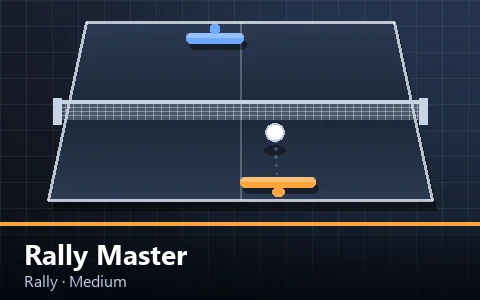
Adding an altitude with gravity acting on it changes the category of the game. Now there is a bounce, which means a rhythm. There is a net, which means a flat shot has a cost. There is an arc, which means a slow shot and a fast shot are different shapes rather than different speeds. And there is a shadow, which is how a top-down view communicates any of it.
That is the change these games are built around, and it is why 'ping pong game' and 'pong-like' now mean different things.
Editor’s note
Almost everything interesting in a modern ping pong game — the net risk on a smash, the lob, spin dipping the ball — is downstream of one design decision: giving the ball a height.
The plugin era and what it taught
For roughly a decade, browser games meant plugin-based games. The technology is gone, and it is worth being clear about what was good and bad about it rather than being nostalgic.
What was good: a very low barrier to publishing, which produced enormous variety and a culture of small, experimental games. Many mechanics that are now standard in browser games were worked out in that period by people making something in a weekend.
What was bad: it required a plugin, which meant it required permission, updates and trust, and it worked badly or not at all on phones — which is where most people ended up playing.
The current generation kept the first half and discarded the second. A browser game today is still a small thing published cheaply, but it runs on the platform itself, works on a phone, and needs no permission to start.
What mobile changed
The arrival of touchscreens as the dominant way people play casual games changed what a paddle game could assume about its input.
A keyboard gives discrete, repeatable, two-handed input. A touchscreen gives continuous, approximate, frequently one-handed input, on a screen partly covered by the hand using it.
The games that adapted well did so by reducing rather than translating. A virtual joystick recreating keyboard control is a poor touch experience; a drag gesture that maps a thumb's position directly onto a paddle's position is a good one, because it uses what touch is actually good at.
The extreme version of that reduction is the one-button game, which turns out to be both the most touch-native format and the most accessible one. That is not a coincidence — both come from the same discipline of requiring less.
What did not survive
Several ideas were common at various points and have largely disappeared, mostly for good reasons.
Lives as a currency you buy or wait for belonged to a business model rather than to a design, and games that keep it usually keep it for that reason. Nothing on this site has it.
Long tutorials disappeared because they solve a problem better solved by design. A game whose first thirty seconds are self-explanatory does not need a tutorial, and a game that needs one has usually made a mistake earlier.
Fake social proof — invented player counts, fabricated leaderboards, generated reviews — was common in the plugin era and is now both less effective and more visible. It is also, straightforwardly, dishonest, which is why there is none of it here.
Where the ideas came together
A modern browser ping pong game is a fairly direct inheritance from each of those stages, and it is worth naming which part came from where.
| Idea | Origin | Present here as |
|---|---|---|
| Contact point steers the ball | Earliest paddle games | The site-wide aiming rule |
| Rally speeds the ball up | Earliest paddle games | The tempo multiplier |
| Two players, one machine | Arcade cabinets | Five local two-player games |
| Ball height and bounce | 3D sports games | The core of the physics model |
| Short, experimental, cheap to publish | Plugin-era browser games | Thirty games from one engine |
| Direct manipulation input | Touchscreens | Drag-to-move on every game |
| Single-input design | Mobile one-button games | One-Tap Ping Pong |
What is likely to change next
Predicting is risky, so this is a statement about pressures rather than a forecast.
The clearest pressure is accessibility, which is moving from an afterthought toward a baseline expectation. Games that require two hands, fine motor control or simultaneous inputs will increasingly look like games that made a choice rather than games that had no option.
The second is performance on modest hardware. As browser games reach a wider range of devices, a game that assumes a fast machine excludes people quietly. Fixed-step simulation and capped resolution are unglamorous and increasingly standard.
The third is honesty about what a game is and does. Fabricated statistics and claimed features are less survivable than they were, partly because players are better at spotting them and partly because platforms are less tolerant of them.
None of those is a technological change. All three are about discipline, which is usually where the useful changes come from.
Key takeaways
- Table tennis became the template for early video games because it reduced to two paddles, one ball and a rectangle.
- Contact-point steering and the rally speed-up appeared immediately and have never been improved on.
- Giving the ball a height is the change that separates a modern ping pong game from a pong-like.
- The plugin era's good half — cheap, small, experimental games — survived; its dependence on a plugin did not.
- Touchscreens rewarded reduction rather than translation, which produced the one-button format.
- Lives as currency, long tutorials and fabricated social proof have largely and deservedly gone.
Frequently asked questions
Why did paddle games come first in video game history?
Because table tennis reduces to two moving rectangles, one moving square and a rule set of 'hit it back', which was about what early display technology could represent. No other sport fits that constraint as cleanly.
What is the difference between a pong-like and a ping pong game?
The ball's height. A two-dimensional paddle game is geometry — straight lines and wall bounces. Adding an altitude with gravity produces the arc, the bounce, the net and the lob.
Did browser games get worse when plugins disappeared?
They got more portable. The culture of small, cheap, experimental games survived; what was lost was a dependence on a plugin that worked badly on phones, which is where most casual play moved.
Why do one-button games keep appearing?
Because a single input has no learning curve, works identically with a key, a tap or a switch, and suits a touchscreen better than a recreated joystick. It is both the most touch-native and the most accessible format.
Are the games on this site based on any older game?
No. The code, artwork, sound and characters are all original to this site. Ideas like contact-point steering are general design conventions rather than anything copied from a specific title.
What is likely to change in browser games next?
Accessibility moving from afterthought to baseline, performance on modest hardware becoming a design constraint rather than an optimisation, and less tolerance for fabricated statistics. All three are about discipline rather than technology.